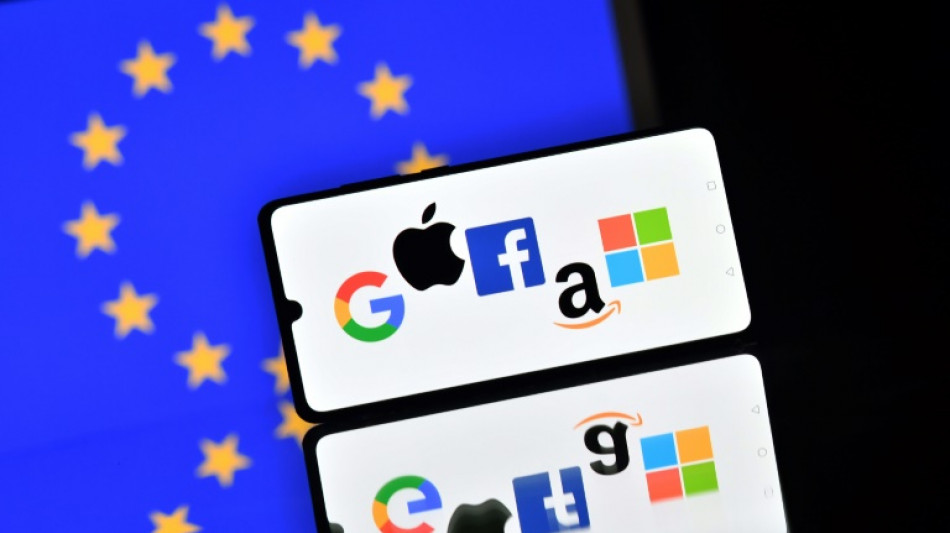
EU hits tech titans with tougher market restraints / Photo: © AFP/File

 Boasting South Korea footballers spark rethink of military service exemptions

 Five dead as Hurricane Simon, Rachel pummel Mexico's Pacific coast

 Seoul, Tokyo stocks plunge as Asia suffers fresh tech rout

 Damaged and drained, Indonesia's peatlands go up in smoke

 Dominant Australia wary of Pacific threat at Rugby League World Cup

 Pope to be admitted to hospital for lung operation

 Samoa's McFarland welcomes 'massive' arrival of ex-All Blacks for World Cup run-in

 Brewers beat Dodgers 7-4 to extend MLB playoff lead

 Teenager shoots headmaster, teacher at French school

 'Breaking Bad' actor RJ Mitte dead: representatives

 Former DR Congo president Kabila forms new force with M23 armed group

 Tom Cruise's 'Digger' tanks, leaving studio with $250 mn hole

 US actress Selma Blair arrested after flight altercation

 One dead as Hurricane Simon creeps along Mexico's Pacific coast

 Carrick's Man United 'hungry and eager' to fix worst start in decades

 Fury as US federal agents search anti-Trump lawmaker's home

 One goal enough for Flick as Barca enter Galatasaray cauldron

 A7 to unveil a service that will re-invent the international payments market

 'Status quo' with EU 'not good enough', UK PM says as summit date set

 Stolen Renoir paintings found behind wall in France

 French supermarkets suffer refrigerator shutdown after 'unprecedented' cyberattack

 Arsenal lose Hincapie and Zubimendi in freak double blow

 Saudi says resilience tested, vows response after deadly airport attacks

 Alcaraz exits Shanghai Masters in straight-sets loss
 Pope to enter hospital on Tuesday for lung operation

The European Union on Wednesday unveiled the list of digital giants -- including Apple, Facebook owner Meta and TikTok parent ByteDance -- that will face tough new curbs on how they do business.
Brussels is working through a dense legislative agenda to build tougher regulation of big tech, arguing it needs to protect European consumers online and to encourage competition in an industry dominated by US giants.
The latest announcement is a milestone in the application of the Digital Markets Act (DMA), which will force the largest firms to change their ways under a checklist of dos and don'ts and, regulators hope, create a fairer market.
Observers say the law could open a new battlefront between digital titans and the European Union as some companies consider launching legal challenges.
The European Commission, the EU's powerful antitrust body, named 22 "core platform" services belonging to five US tech behemoths identified as "gatekeepers" -- Google parent Alphabet, Amazon, Apple, Meta, Microsoft -- and China's ByteDance.
The services included Apple's App Store; Meta's Facebook, Instagram and WhatsApp; Google's YouTube video platform and Chrome browser, as well as Apple's Safari.
Others included operating systems run by Apple, Microsoft and Google as well as Alphabet's Google Maps, Play and Shopping.
They must fully comply with the DMA by March 6, 2024.
The "gatekeeper" status applies when a service has more than 45 million monthly active users and more than 10,000 yearly active business users established in the EU.
Apple on Wednesday said it was "very concerned about the privacy and data security risks the DMA poses for our users" and said it would seek to "mitigate these impacts".
There will be fines of up to 10 percent of a firm's global revenues for breaking some of the most serious competition rules, and even up to 20 percent for repeat offenders.
One major change under the DMA is the rule that forces interoperability between messaging apps, making it easier for users to share links and images.
"With today's designation we are finally reining in the economic power of six gatekeepers, giving more choice to consumers and creating new opportunities for smaller innovative tech companies," said the EU's top tech enforcer, industry commissioner Thierry Breton.
- Taking a bite of the Apple -
Apple and Microsoft argued parts of their businesses should not be classified as a "core" service, and the commission said it launched probes to assess Apple's claims regarding iMessage, and Microsoft for Bing, Edge and its advertising platform.
A Microsoft spokesperson welcomed the decision to launch an investigation into the three services which the company said "operate as challengers in the market".
Meanwhile, Apple said it looked "forward to explaining to the commission why iMessage is outside the scope of the DMA".
The EU has led the way globally for taking on big tech.
The DMA, alongside its sister law, the Digital Services Act (DSA), gives the commission sharper teeth against tech behemoths that critics say have for too long been given free rein to act to the detriment of users.
One of the DMA's main aims is to stop larger players crushing the progression of smaller companies that threaten to become rivals by gobbling them up through takeovers.
The EU believes past examples of this are Facebook's buyouts of Instagram and WhatsApp as well as Google's purchase of YouTube and Waze.
The commission must be notified of all takeovers, regardless of size, under the DMA.
One of the law's main targets is Apple, previously the subject of multiple investigations and slapped with huge EU fines.
The new rules will force the iPhone-maker to allow alternative app stores on its products, allowing software and payments to be made outside of its control.
The commission is also looking into whether Apple's iPadOS system should be designated as a "gatekeeper, despite not meeting the thresholds", it said.
Under the DMA, companies are forbidden to favour their own services over those offered by competitor firms and will have to share key information with business customers.
- Bumpy road ahead -
Some experts predict legal challenges to the DMA designations, just as some were made against the DSA.
"When you have a new law which is a complex law in a complex environment, it's inevitable to have legal challenges at the beginning," said Alexandre de Streel, academic director of the digital research programme at the Centre on Regulation in Europe think tank.
Amazon and European clothing retailer Zalando filed a case in the EU courts against their designation as "very large" online platforms under the DSA.
And big tech faces more regulation as the EU races to pass the world's first law on artificial intelligence, an issue that gained urgency after dizzying advances in 2022.
K.Brown--BTB