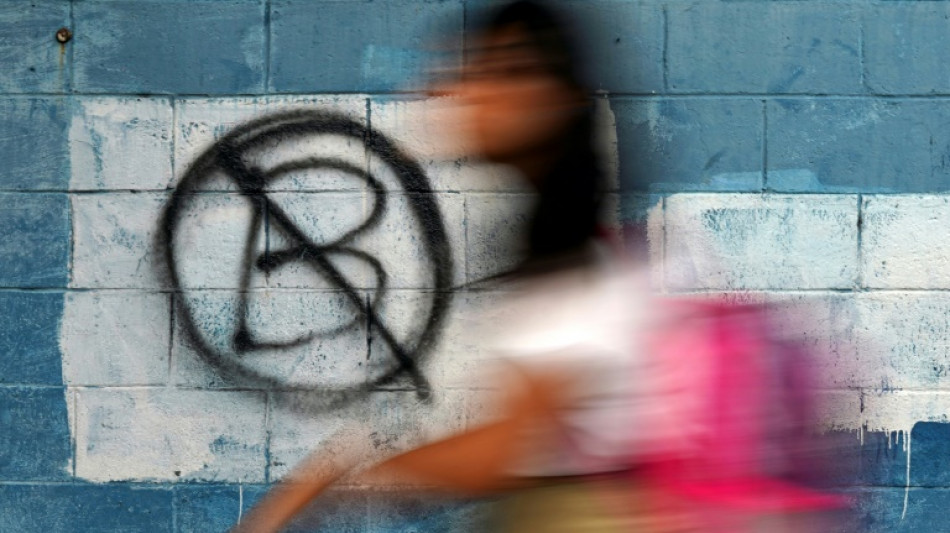
'It's robbery': Salvadorans slow to adopt Bitcoin / Photo: © AFP

 Fiji appoint ex-Springboks boss White as coach ahead of World Cup

 Hungary to reverse Orban-era anti-LGBTQ legislation
 Allen rushes Bills to thrilling 37-34 win over Rams

 India youth shift tactics as police clamp down on election protest
 Malaysia's Firefly extends flight cancellations due to haze

 IMF upgrades 2026 growth forecast but warns of 'split' outlook
 Infantino could pull off 'Houdini' act as critics struggle for candidate

 France braces for fresh nationwide student demonstrations
 Ahead of Israel vote, desert town becomes frontline against ultra-Orthodox expansion

 El Nino Watch: the impacts around the world this week

 Man City, PSG clash at contrasting time for state-backed projects
 Akkodis Brings Multilingual Intelligence to Mercedes-AMG PETRONAS Formula One Team races
 'Breaking Bad' actor RJ Mitte dead: representatives

 Former DR Congo president Kabila forms new force with M23 armed group
 Tom Cruise's 'Digger' tanks, leaving studio with $250 mn hole
 US actress Selma Blair arrested after flight altercation
 One dead as Hurricane Simon creeps along Mexico's Pacific coast
 Carrick's Man United 'hungry and eager' to fix worst start in decades
 Fury as US federal agents search anti-Trump lawmaker's home

 One goal enough for Flick as Barca enter Galatasaray cauldron
 A7 to unveil a service that will re-invent the international payments market
 'Status quo' with EU 'not good enough', UK PM says as summit date set
 Stolen Renoir paintings found behind wall in France

 French supermarkets suffer refrigerator shutdown after 'unprecedented' cyberattack
 Arsenal lose Hincapie and Zubimendi in freak double blow
Two years ago, El Salvador shrugged off a chorus of warnings and adopted Bitcoin as legal tender in a bid to revitalize its economy and improve access to financial services.
It has not worked.
Bitcoin has lost more than half its value since then and though President Nayib Bukele is wildly popular for his clampdown on criminal gangs, his currency gamble has not gone down equally well.
Tech enthusiast Bukele wanted to make it easier, and cheaper, for Salvadorans to receive remittances from family members abroad and to provide financial services access to the 70 percent of people with no bank account.
Remittances account for a fifth of the country's GDP.
But two years after El Salvador became the first country in the world to adopt Bitcoin as its currency, alongside the US dollar, "the goals that were pursued... have not been achieved, people hardly use it, they don't have much trust" in crypto, economist and former Reserve Bank governor Carlos Acevedo told AFP.
"The experiment has not worked, it is a crypto winter," he said.
There are no figures available on how many Salvadorans have taken up Bitcoin.
But a poll conducted in May by the Central American University found that 71 percent believed the cryptocurrency "has in no way helped to improve their family economic situation."
On the streets of San Salvador, the verdict is harsh.
"I don't see that money working, it's just propaganda. Where's the benefit? There's no benefit. It's a bad investment," newspaper vendor Juan Antonio Salgado, 65, told AFP.
"It's robbery," he added, in reference to the currency's volatility.
Two years ago, Bitcoin traded at about $45,000, and a few months later reached a record $68,000.
Today, it is worth just over $25,500.
- Cash is king -
To facilitate Bitcoin transactions, the government created the so-called "Chivo" digital wallet and promised each user the equivalent of $30.
But in one measure of Bitcoin's slow adoption, the Reserve Bank said only one percent of the $4.71 billion received in remittances between January and July this year came via Chivo.
"People don't really have confidence in a cryptocurrency whose value changes from one moment to the next, and... people prefer to use hard cash," economist Julia Martinez told AFP.
For Acevedo, it is too soon to "speak of a government failure" as Bitcoin's "price could rise at any moment and then it will be a different scenario."
At the time of Bukele's announcement in 2021, the International Monetary Fund and World Bank warned about the risks of currency fluctuation, and said the plan could leave the country more vulnerable to money laundering and other illicit activities, threatening its underlying stability.
The change meant that every Salvadoran business -- even neighborhood shopkeepers -- had to accept the cryptocurrency as payment.
After Bitcoin hit $68,000 in November 2021, a buoyant Bukele announced plans to build a "Bitcoin City" that would be powered by thermal energy from a volcano.
The country would issue $1 billion in Bitcoin bonds to finance the initiative, he announced.
Nothing has come of the project or the bonds to date.
- 'We're going forward' -
The government has said it has purchased 2,381 Bitcoin, without revealing the rate. The last purchase was of 80 units in June 2022.
In November last year, Bukele said the government would buy one Bitcoin every day, though it is not known whether this has come to pass.
Economist Cesar Villalona told AFP that Bitcoin "does not exist in the local economy" in any significant way, because in El Salvador "everything" is paid in dollars: wages, services and goods.
The crypto initiative does have its fans, though.
YouTuber Jose Francisco Ayala, 38, said it was just a matter of education.
"We're going forward, we're not going backwards," he told AFP. "The more we learn the more we will get into it."
M.Furrer--BTB