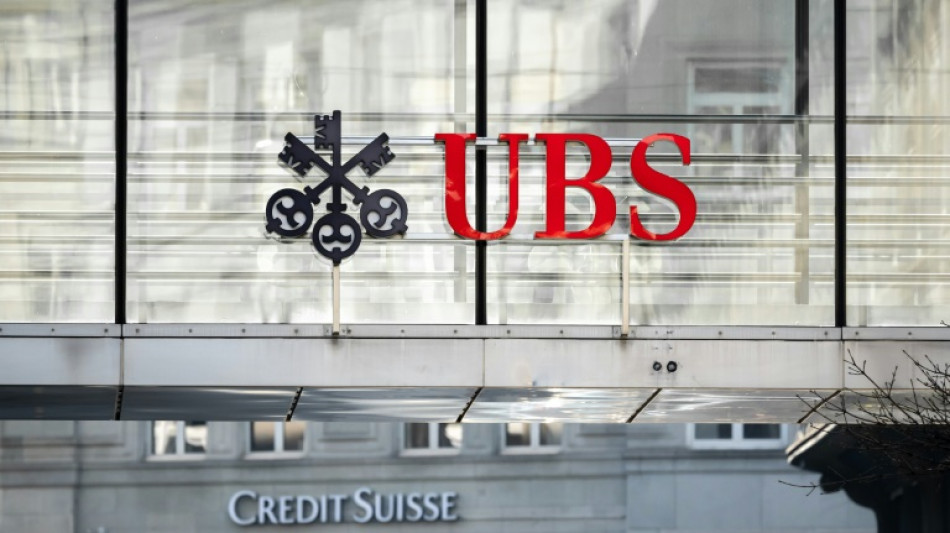
UBS's Credit Suisse takeover, 'deal of the century'? / Photo: © AFP/File

 Fiji appoint ex-Springboks boss White as coach ahead of World Cup

 Hungary to reverse Orban-era anti-LGBTQ legislation

 Allen rushes Bills to thrilling 37-34 win over Rams

 India youth shift tactics as police clamp down on election protest

 Malaysia's Firefly extends flight cancellations due to haze

 IMF upgrades 2026 growth forecast but warns of 'split' outlook

 Infantino could pull off 'Houdini' act as critics struggle for candidate

 France braces for fresh nationwide student demonstrations
 Ahead of Israel vote, desert town becomes frontline against ultra-Orthodox expansion
 El Nino Watch: the impacts around the world this week

 Man City, PSG clash at contrasting time for state-backed projects

 Akkodis Brings Multilingual Intelligence to Mercedes-AMG PETRONAS Formula One Team races

 'Breaking Bad' actor RJ Mitte dead: representatives
 Former DR Congo president Kabila forms new force with M23 armed group

 Tom Cruise's 'Digger' tanks, leaving studio with $250 mn hole
 US actress Selma Blair arrested after flight altercation
 One dead as Hurricane Simon creeps along Mexico's Pacific coast

 Carrick's Man United 'hungry and eager' to fix worst start in decades

 Fury as US federal agents search anti-Trump lawmaker's home

 One goal enough for Flick as Barca enter Galatasaray cauldron

 A7 to unveil a service that will re-invent the international payments market

 'Status quo' with EU 'not good enough', UK PM says as summit date set
 Stolen Renoir paintings found behind wall in France

 French supermarkets suffer refrigerator shutdown after 'unprecedented' cyberattack

 Arsenal lose Hincapie and Zubimendi in freak double blow

Did banking giant UBS make "the deal of the century" when it bought one of the world's biggest banks for a pittance as it teetered on the edge of the abyss?
Switzerland's largest bank was in March strong-armed by Swiss authorities into a $3.25-billion takeover of Credit Suisse, to keep its closest domestic rival from going under.
At the time, investors gasped at the risks UBS was taking on with the purchase.
But by August, the bank said it would not need the billions in support offered by the Swiss government and central bank to offset any surprises that might pop up in its stricken rival's accounts.
That must mean that Credit Suisse's situation was "much better than described in March", Thomas Aeschi, a member of parliament with the populist rightwing Swiss People's Party (SVP), wrote on X, formerly Twitter.
UBS seemed to prove him right when it unveiled its second quarter results on August 31.
The bank posted a towering net profit of $29.2 billion for the three-month period, thanks to an exceptional gain due to the gulf between the amount paid for Credit Suisse and its book value.
- 'Godsend' -
"UBS has pulled off the deal of the century," Switzerland's Socialist Party said, maintaining the "rescue" was more of a "godsend", allowing it to snatch up a bank at a dramatically reduced rate.
"If we had chosen another path, (like) a temporary or partial nationalisation," said Samuel Bendahan, a Socialist MP and economics professor at the University of Lausanne, the Swiss state "would have taken on the risk, but those $29 billion would have gone to the population".
Instead, the takeover has created "a monopolistic situation", he told AFP, warning that while this might strengthen UBS, it puts Switzerland in an extremely risky position if the new mega-bank were to one day face a crisis.
Politicians are not the only ones taking issue with the takeover.
Gisele Vlietstra, founder of the Swiss Investor Protection Association, told public broadcaster RTS that UBS's towering quarterly profit confirms that the "intrinsic value" of Credit Suisse was "far higher" than the purchase price.
She said she hoped that the lawsuits brought by her association and others on behalf of thousands of Credit Suisse shareholders will help determine "the correct value" that they should be compensated.
- 'Nickel and dime' -
"UBS paid a nickel and dime" and "got rid of its main competitor" in one fell swoop, Carlo Lombardini, a lawyer and banking law professor at Lausanne University, told AFP.
The coming restructuring will clearly carry risks, "but having paid just three billion, it can't go wrong", he said, slamming the option chosen by the Swiss authorities.
Like UBS, Credit Suisse was listed among 30 international banks deemed too big to fail because of their importance in the global banking architecture.
But the collapse of three US regional lenders in March left the firm looking like the next weakest link in the chain.
The Swiss government feared Credit Suisse would have quickly defaulted and triggered a global crisis, shredding Switzerland's reputation for sound banking.
But its chosen option for dealing with the issue was certainly a boon to UBS, which will now swell to manage $5 trillion of invested assets.
- Confidence 'evaporated' -
UBS chief Sergio Ermotti acknowledged in a recent interview with the SonntagsZeitung weekly that the bank had been "worried" about its competitor since 2016, and had among other things looked into the possibilities of buying it, for fear a foreign lender might snap it up.
He acknowledged that Credit Suisse may have survived for a time if the central bank had injected more cash, "but it would not have been enough, since confidence had evaporated".
Since the takeover announcement in March, UBS has seen its share price soar 31 percent.
But the bank still faces significant challenges, Vontobel analyst Andreas Venditti told AFP.
The $29 billion "is a huge one-off gain, but this is just accounting", he said, stressing that "the losses and costs will come later".
The analyst, who a few months ago wondered in a note whether UBS had secured "the deal of the decade or a decade of headaches", stressed that "it's going to be a huge task".
He said it would only become clear "whether it was worth it" after most of the restructuring is done three years down the line.
Parts of the business are continuing to "produce huge losses", he said, warning "many things can still go wrong".
Swissquote analyst Ipek Ozkardeskaya agreed, recalling that "UBS was forced" into the merger.
Now it is up to the bank to "transform an 'obligation' to its advantage".
K.Brown--BTB