European bumblebee populations projected to plummet / Photo: © DPA/AFP/File

 Fiji appoint ex-Springboks boss White as coach ahead of World Cup

 Hungary to reverse Orban-era anti-LGBTQ legislation

 Allen rushes Bills to thrilling 37-34 win over Rams

 India youth shift tactics as police clamp down on election protest

 Malaysia's Firefly extends flight cancellations due to haze

 IMF upgrades 2026 growth forecast but warns of 'split' outlook
 Infantino could pull off 'Houdini' act as critics struggle for candidate

 France braces for fresh nationwide student demonstrations

 Ahead of Israel vote, desert town becomes frontline against ultra-Orthodox expansion

 El Nino Watch: the impacts around the world this week

 Man City, PSG clash at contrasting time for state-backed projects

 Akkodis Brings Multilingual Intelligence to Mercedes-AMG PETRONAS Formula One Team races

 'Breaking Bad' actor RJ Mitte dead: representatives

 Former DR Congo president Kabila forms new force with M23 armed group

 Tom Cruise's 'Digger' tanks, leaving studio with $250 mn hole

 US actress Selma Blair arrested after flight altercation

 One dead as Hurricane Simon creeps along Mexico's Pacific coast

 Carrick's Man United 'hungry and eager' to fix worst start in decades

 Fury as US federal agents search anti-Trump lawmaker's home

 One goal enough for Flick as Barca enter Galatasaray cauldron

 A7 to unveil a service that will re-invent the international payments market

 'Status quo' with EU 'not good enough', UK PM says as summit date set

 Stolen Renoir paintings found behind wall in France

 French supermarkets suffer refrigerator shutdown after 'unprecedented' cyberattack

 Arsenal lose Hincapie and Zubimendi in freak double blow

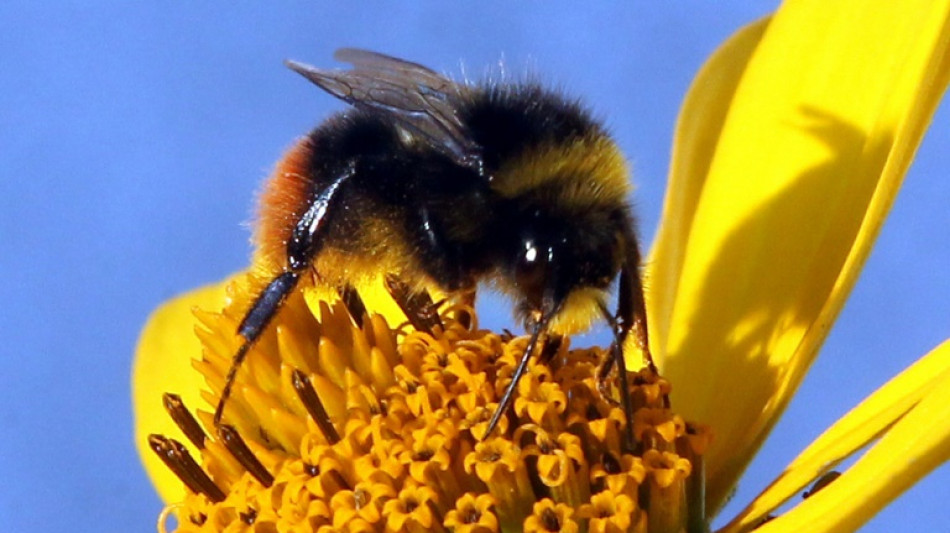
Populations of European bumblebees are projected to fall drastically in the coming decades due to climate change and habitat loss, researchers warned on Wednesday.
Europe's 68 species of bumblebees -- including the fluffy, black-and-yellow striped ones often seen buzzing through gardens -- play a crucial role in pollinating crops and wild plants.
But they are used to the cooler temperatures of the Northern Hemisphere, and a warming world caused by human-caused climate change is putting them increasingly under threat, according to the study in the journal Nature.
A team of Belgian researchers collected data on 46 bumblebee species across Europe, assessing the past (1901-1970) and present 2001-2014), comprising more than 400,000 different observations.
They combined this data with the latest modelling from the UN's IPCC climate change panel as well as predictions of changes in land use.
Under the worst-case scenario, they found that "up to 75 percent of bumblebee species which are not currently threatened will see their distribution area shrink 30 percent by 2061-2080," lead author Guillaume Ghisbain of the Universite Libre de Bruxelles told AFP.
This means that most of the European bumblebees currently classified as of "least concern" on the IUCN's list of threatened species could fall into the endangered category.
Bumblebee species in Arctic or alpine environments may even be pushed to the edge of extinction, with an expected loss of 90 percent of their habitat.
There was also bad news for the most common of Europe's bumblebees, Bombus terrestris, a plump bee often spotted pollinating flowers in backyards.
By 2080, it "would see the limit of its geographical distribution, which currently borders the Sahara Desert, pull back to the Loire Valley" in central France, said co-author Pierre Rasmont of the University of Mons.
- Sensitive to heat -
Part of the expected decline was due to how land is expected to be used in the next half century.
"Intensive agriculture fragments habitats and relies on synthetic fertilisers which artificially enrich the soil with nitrogen," Ghisbain said.
"However, bumblebees mainly consume plants which grow in soil poor in nitrogen," such as clover, he added.
Repeated droughts, made more frequent and severe by climate change, also kill off the plants eaten by bumblebees.
But heatwaves intensified by global warming pose an even bigger threat. Apart from a few resistant species, bumblebees are particularly sensitive to heat.
"We observed this in our laboratory one day when the air conditioning broke down -- it was 40 degrees Celsius (104 Fahrenheit) and our colonies died in less than an hour," Rasmont said.
"Some survive, but their sperm becomes deficient."
The researchers suggested that some bees could seek refuge in the cooler climes of Scandinavia.
They have even spotted a few industrious bees who have already made the trek north.
"One day I was collecting bumblebees in northern Norway and suddenly, among the Arctic species, I came across a Bombus terrestris," Rasmont said.
"It had leapt 800 kilometres (500 miles) north" of its natural habitat, he added.
C.Kovalenko--BTB