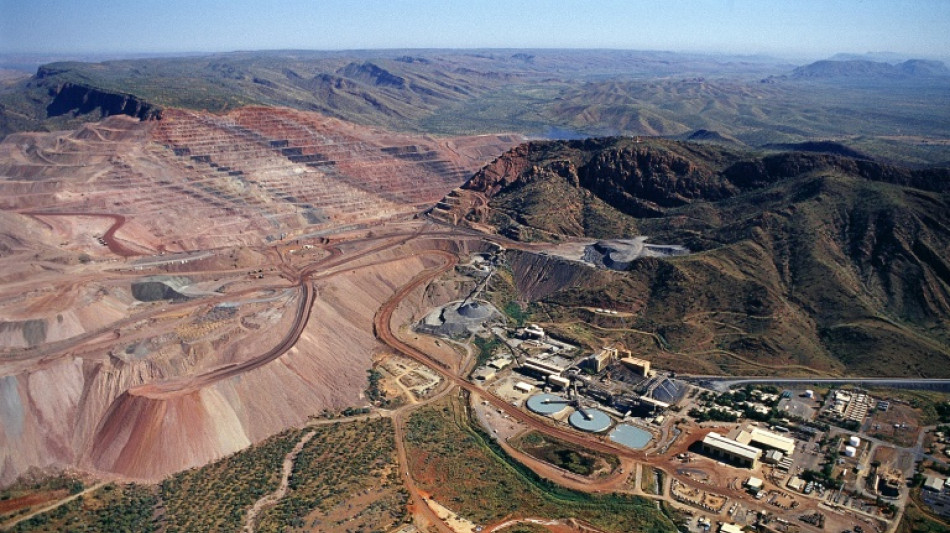
Scientists find 'missing ingredient' for pink diamonds / Photo: © NATURE PUBLISHING GROUP/AFP

 ePlanet Brokers Publishes H1 2026 Transparency Report and Highlights Best Broker 2026 Award

 Van Gogh work unseen in public for 60 years on show in Hong Kong

 Prosecutors drop most impeachment charges against Philippine VP Duterte

 Hypersonic weapons highlight arms race on the Korean peninsula

 Fiji appoint ex-Springboks boss White as coach ahead of World Cup

 Hungary to reverse Orban-era anti-LGBTQ legislation

 Allen rushes Bills to thrilling 37-34 win over Rams

 India youth shift tactics as police clamp down on election protest

 Malaysia's Firefly extends flight cancellations due to haze

 IMF upgrades 2026 growth forecast but warns of 'split' outlook

 Infantino could pull off 'Houdini' act as critics struggle for candidate

 France braces for fresh nationwide student demonstrations

 Ahead of Israel vote, desert town becomes frontline against ultra-Orthodox expansion

 El Nino Watch: the impacts around the world this week

 Man City, PSG clash at contrasting time for state-backed projects

 Akkodis Brings Multilingual Intelligence to Mercedes-AMG PETRONAS Formula One Team races

 'Breaking Bad' actor RJ Mitte dead: representatives

 Former DR Congo president Kabila forms new force with M23 armed group
 Tom Cruise's 'Digger' tanks, leaving studio with $250 mn hole

 US actress Selma Blair arrested after flight altercation

 One dead as Hurricane Simon creeps along Mexico's Pacific coast

 Carrick's Man United 'hungry and eager' to fix worst start in decades

 Fury as US federal agents search anti-Trump lawmaker's home

 One goal enough for Flick as Barca enter Galatasaray cauldron

 A7 to unveil a service that will re-invent the international payments market

Scientists said on Tuesday they have found the "missing ingredient" for pink diamonds, some of the world's most expensive stones due their rarity and beauty, and the discovery could help find more.
More than 90 percent of all the pink diamonds ever found were discovered at the recently closed Argyle mine in the remote northwest of Australia.
But exactly why Argyle -- which unlike most other diamond mines does not sit in the middle of a continent but on the edge of one -- produced so many pink gems has remained a mystery.
In a new study published in the journal Nature Communications, a team of Australia-based researchers said the pink diamonds were brought to the Earth's surface by the break up of the first supercontinent around 1.3 billion years ago.
Hugo Olierook, a researcher at Curtin University in the state of Western Australia and the study's lead author, told AFP that two of the three ingredients for forming pink diamonds had already been known.
The first ingredient is carbon -- and it must be in the bowels of Earth.
Anything shallower than 150 kilometres (93 miles) deep would be graphite -- "that stuff in your pencils, not nearly as pretty on an engagement ring", Olierook said.
The second ingredient is just the right amount of pressure, to damage the otherwise clear diamonds.
"Push just a little bit and it turns pink. Push a little too hard and they turn brown," he said.
Most of the diamonds discovered at Argyle were of this less valuable brown hue, he added.
- 'Like a champagne cork' -
The missing ingredient was the volcanic event that sent the diamonds shooting up to the Earth's surface, where humans could get their hands on them.
In the 1980s it was estimated that the Argyle diamonds emerged 1.2 billion years ago.
But there was no "trigger" for the rare diamonds to rise at that time, Olierook said, so the researchers sought to establish a more accurate timeline.
They used a laser thinner than a human hair to probe tiny crystals in an Argyle rock sample supplied by the mine's owner, Anglo-Australian mining giant Rio Tinto.
By measuring the age of elements in the crystals, the researchers determined that Argyle was 1.3 billion years old -- meaning the diamonds came up 100 million years later than previously thought.
That lines up with the break-up of the world's first supercontinent, known as Nuna or Columbia.
In Nuna, "just about every single landmass on Earth was squashed together", Olierook said.
The immense pressure that twisted colour into the diamonds -- the second ingredient -- occurred during collisions between western Australia and northern Australia 1.8 billion years ago.
When Nuna started to break up five hundred million years later, it re-aggravated the "scar" from that event, Olierook said.
Magma shot up through this old scar "like a champagne cork going off", taking the diamonds along for the ride, he added.
Study co-author Luc Doucet said such a "massive explosion" -- which sent the diamonds travelling at near the speed of sound -- has not taken place in recorded human history.
- Where to look next? -
Over the last 200 years, people have mostly looked for diamonds in the centre of massive continents.
But knowing the "missing ingredient" for pink diamonds could assist future efforts to find the rare stones, Olierook said, adding that discovering more was unlikely to be easy or quick.
Old mountain belts marking Nuna's breakup near the edges of continents have the potential to be home to a new "pink diamond paradise", he said, naming Canada, Russia, southern Africa and Australia as possible locations.
John Foden, an expert on diamonds at the University of Adelaide not involved in the study, told AFP that the researchers had "convincingly shown" the age of the Argyle diamonds.
But he cautioned that other diamond-rich provinces had also been linked to Nuna's break-up -- and they had not produced pink diamonds.
This suggests that "pinkness seems to be a local Argyle attribute", he added.
The Argyle mine closed in 2020 due to "various financial reasons", Olierook said, meaning the value of pink diamonds could continue to rise as supply stalls.
H.Seidel--BTB