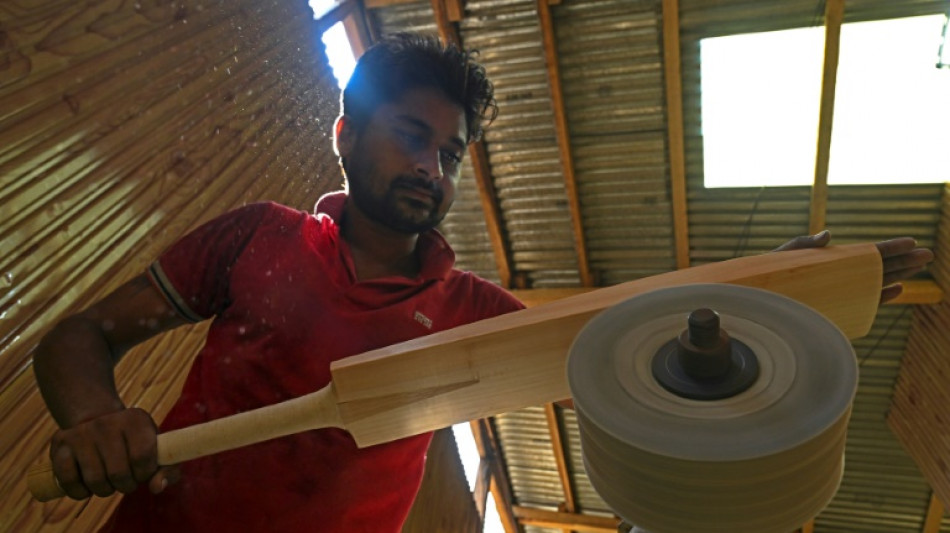
Axed: Rampant logging hits India's batmakers for six / Photo: © AFP

 B2PRIME Expands Tier-1 Access and Liquidity Architecture for Sophisticated Institutional Flow

 STARTRADER Adds 48 US Stock CFDs with 24-Hour Weekday Trading

 'Ink' director Danny Boyle slams Trump's Truth Social 'lies'

 Coach Kovac extends contract at Dortmund until 2029

 Activist Thunberg joins France student rally after violence at protests

 Archer and Bethell in England squad for Australia ODI series

 Formula One to return to Africa in 'early 2030s' in Rwanda
 US actor Selma Blair charged with assault after alleged flight altercation

 Hungary cuts anti-LGBTQ legislation from Orban-era law

 'Our future is being robbed': Greta Thunberg joins France student protests

 Late superstar Anita Mui's ashes missing in Hong Kong

 'No choice': IMF says developing countries must cut spending despite war shock

 Boasting South Korea footballers spark rethink of military service exemptions

 Five dead as Hurricane Simon, Rachel pummel Mexico's Pacific coast
 Seoul, Tokyo stocks plunge as Asia suffers fresh tech rout
 Damaged and drained, Indonesia's peatlands go up in smoke

 Dominant Australia wary of Pacific threat at Rugby League World Cup

 Pope to be admitted to hospital for lung operation

 Samoa's McFarland welcomes 'massive' arrival of ex-All Blacks for World Cup run-in
 Brewers beat Dodgers 7-4 to extend MLB playoff lead

 Teenager shoots headmaster, teacher at French school

 Digi Power X Announces $200 Million Debt Financing Commitment to Support Completion of Alabama AI Data Center and Provides Expansion Update
 'Breaking Bad' actor RJ Mitte dead: representatives

 Former DR Congo president Kabila forms new force with M23 armed group
 Tom Cruise's 'Digger' tanks, leaving studio with $250 mn hole

When the Cricket World Cup opens in India next month several players will carry Kashmiri willow wood bats, but manufacturers say over-exploitation of trees means their craft faces ruin.
Unchecked logging without replanting has reduced swathes of woodland to scrub in the disputed Indian-administered Himalayan territory, and bat manufacturers face a bleak future.
"It's a case of culling all the time and no sowing," said Irfan Ali Shah, a senior official in the government's forest service.
Willow grows far more slowly than the more commercially viable poplar, and bat-makers warn the entire industry -- a major employer -- is at risk.
"We have started searching far-off corners of the valley, but there is not much good willow to be found anywhere for making the best quality bats," said Fawzul Kabiir, whose GR8 bats are International Cricket Council-approved and sold worldwide.
"If the government doesn't help plant again soon on a large scale... we will run out of raw material in three to five years," he told AFP.
Found from Europe to central Asia, water-loving white willows -- scientific name Salix alba -- are deciduous trees growing up to 30 metres (100 feet) tall.
Numbers expanded enormously during the 19th century under British colonial rule, when plantations were laid for firewood during the freezing mountain winter.
The ready supply of willow -- the wood favoured by cricketers -- also sparked a craft in bats.
- Tendulkar, Kohli and Waugh -
Willow has criss-crossing fibres that give it strength and tiny air pockets that reduce vibrations, making the wood light but powerful enough to smash a ball for six.
International big hitters have traditionally preferred willow from England, but the same tree grows in Kashmir and every year the region now produces three million "clefts" -- the rough-cut blocks of wood ready for shaping.
It is the bulk of global supply and bat-maker Kabiir, 31, insists: "The best Kashmir willow bat is at least as good as English willow."
GR8 says its customers include cricketing greats from Indian heroes Sachin Tendulkar and Virat Kohli to Australia's Steve Waugh and South Africa's Graeme Smith and AB de Villiers.
Kashmir's bat-makers prospered over the decades as cricket's popularity grew -- demand surged after India's 1983 World Cup win and the sport now has more than a billion fans globally.
Today, the industry employs some 120,000 people across 400 workshops, according to manufacturers.
It is a key contributor to the economy of Kashmir, a Muslim-majority region claimed in full by both India and Pakistan but split between them, with the portion controlled by New Delhi roiled by a long-running insurgency.
- 'Near extermination' -
But supplies are vanishing fast.
Agricultural scientists at Sher-e-Kashmir University have warned female willow trees -- the most suitable for bat-making -- are facing "near extermination" in Kashmir.
Nearly a million trees were logged in the past decade as the government removed plantations sucking up water from the shrinking Wular lake, protected under the United Nations Ramsar convention.
Elsewhere, willows have been hacked down to make space for farmland and rice paddies.
Demand for timber from other industries, including plywood and pencils, has meant some have replaced willow with swifter-growing poplar.
"A willow tree matures in 30 years and poplar in half the time, and it fetches the same price," said Feroz Ahmed Reshi, whose family has supplied willow wood to bat-makers for generations. "This year, we planted 300 poplars and about five willows."
- 'Our SOS' -
The government banned cleft exports to the rest of India or overseas 25 years ago in a bid to control logging and boost industry in Kashmir.
But the law is repeatedly flouted with some 100,000 clefts illegally sent elsewhere annually, a bat-makers association official said.
"Smuggling of our precious raw material has not stopped," the official said, speaking on condition of anonymity due to the sensitive nature of the topic.
Authorities used to plant willow on state land to maintain firewood supplies but stopped decades ago as electricity and gas became available for heating.
Shah, the forestry official, believes bat-makers must "plant their own willow on their own land" to replace each tree felled.
But private land is scarce in Kashmir, and prices have surged since New Delhi suspended the region's semi-autonomous status and imposed direct rule in 2019.
That allowed Indians from elsewhere to buy land in Kashmir for the first time, a policy denounced by critics as "settler colonialism".
GR8's factory and showroom are in the small town of Sangam, the centre of the bat industry, where tourists snap up bats from lines of stores, spending anything from $12 to $180.
"This is our SOS to the government," owner Kabiir said. "We cannot do it alone."
J.Horn--BTB