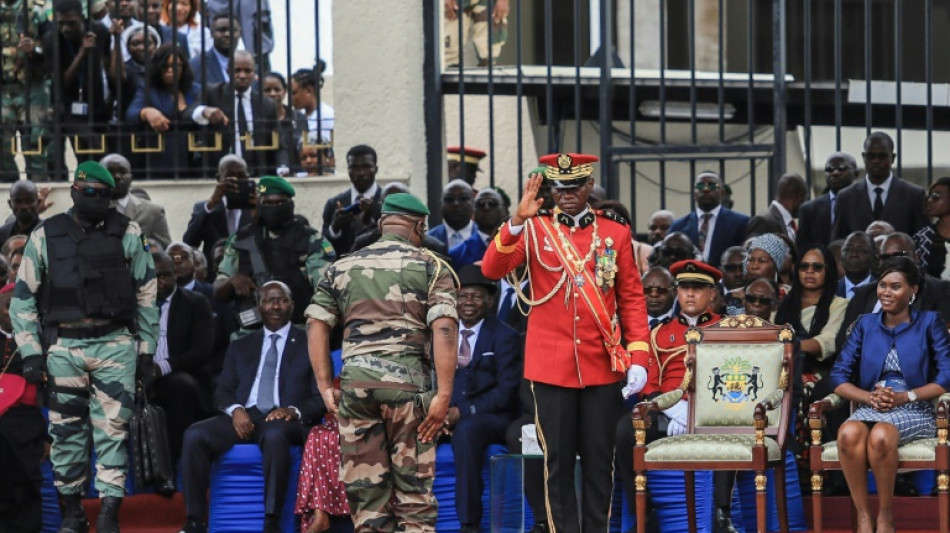
Students see glimmer of hope in post-Bongo Gabon / Photo: © AFP/File

 B2PRIME Expands Tier-1 Access and Liquidity Architecture for Sophisticated Institutional Flow

 STARTRADER Adds 48 US Stock CFDs with 24-Hour Weekday Trading

 'Ink' director Danny Boyle slams Trump's Truth Social 'lies'

 Coach Kovac extends contract at Dortmund until 2029

 Activist Thunberg joins France student rally after violence at protests

 Archer and Bethell in England squad for Australia ODI series

 Formula One to return to Africa in 'early 2030s' in Rwanda

 US actor Selma Blair charged with assault after alleged flight altercation
 Hungary cuts anti-LGBTQ legislation from Orban-era law
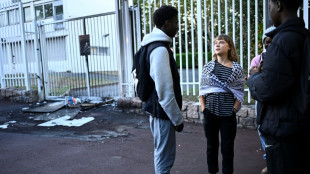 'Our future is being robbed': Greta Thunberg joins France student protests
 Late superstar Anita Mui's ashes missing in Hong Kong
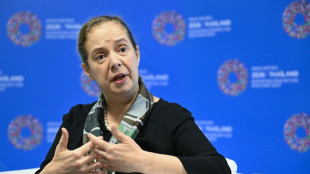 'No choice': IMF says developing countries must cut spending despite war shock

 Boasting South Korea footballers spark rethink of military service exemptions
 Five dead as Hurricane Simon, Rachel pummel Mexico's Pacific coast
 Seoul, Tokyo stocks plunge as Asia suffers fresh tech rout
 Damaged and drained, Indonesia's peatlands go up in smoke
 Dominant Australia wary of Pacific threat at Rugby League World Cup
 Pope to be admitted to hospital for lung operation
 Samoa's McFarland welcomes 'massive' arrival of ex-All Blacks for World Cup run-in
 Brewers beat Dodgers 7-4 to extend MLB playoff lead

 Teenager shoots headmaster, teacher at French school

 Digi Power X Announces $200 Million Debt Financing Commitment to Support Completion of Alabama AI Data Center and Provides Expansion Update
 'Breaking Bad' actor RJ Mitte dead: representatives

 Former DR Congo president Kabila forms new force with M23 armed group
 Tom Cruise's 'Digger' tanks, leaving studio with $250 mn hole
At Omar Bongo University in Gabon's capital, student Nathan Ovono Obiang is as absorbed by what's going on in his post-coup country as he is in his maths lessons.
"I don't see any prospects, but we are aware that things can't change from one day to the next," the 25-year-old, who is in the third year of a degree course, said.
Just under a month ago, Gabon's new military rulers brought an abrupt end to 55 years of rule by a family accused of extracting fabulous wealth from the country's oil reserves.
The August 30 ousting of President Ali Bongo Ondimba -- who took over when his father Omar died in 2009 after nearly 42 years in power -- came moments after he was proclaimed the winner of disputed elections.
Coup leader General Brice Oligui Nguema was swiftly sworn in as transitional president.
He has promised to hand back the country to civilian rule with elections after a transitional period but has not given a date.
Oligui has also pledged to introduce reforms to help the poor and young, including in education.
Ali Bongo left behind an education system in ruins after years of underfunding and what the new military leaders say was disastrous management by corrupt governments.
Omar Bongo University (UOB), created in 1970, is the country's main seat of learning.
But, despite its illustrious title, the start of the academic year has once again been pushed back, its walls are in a poor state and its equipment badly in need of updating.
Some buildings are derelict, while grants for the neediest are not paid and several teachers complain of sometimes going several months without receiving their salary.
Classrooms and lecture halls are crowded but the chance of students finding a job after their studies are slim.
"There were 2,000 students in the first year of the course. It was really first come, first served to get a seat in the lessons," Ovono Obiang said.
- 'Lacked everything' -
Some are upbeat but also impatient, like many Gabonese who cheered the coup leaders for freeing the country from the clutches of the Bongo family.
Sarah Emmanuel, who is studying for a law degree, said under the former regime "we lacked everything at university".
"It will inevitably take time to change things but I am optimistic with the announcements of reforms and notably more resources to help us enter the job market," she said.
The challenges are considerable.
Gabon has one of Africa's highest unemployment rates, with one fifth of the active population out of work, rising to a third for under-25s, the United Nations said in 2020.
In Africa's third-richest country in terms of per-capita GDP, one in three lives below the poverty line, according to the World Bank.
"It's not just a financial problem. There is no match between our training and the expectations of companies at the end," Ovono Obiang said.
Noel Bertrand Boundzanga, a UOB university lecturer and researcher, said in the government daily L'Union last week, that the problem was not so much "the nature of the training as the capacity of an economy to generate factors favourable to job creation".
- Future prospects -
Gabon's wealth from its abundant oil reserves and other natural resources was kept in the hands of a small elite under the Bongos.
Critics point to a failure to diversify the economy to make it less dependant on oil, manganese and timber by developing a production or manufacturing sector.
"Future prospects were very restricted because there aren't a lot of opportunities after studying," economics student Marcus Mouloud, 24, said.
"With the new institutions, we can dream bigger and think that we will be saved compared to other generations of young people".
Law student Karly Elislande says she hopes the country's new leaders will build student accommodation and even create a university in every province.
That would relieve the pressure on the capital and mean not all students "come to Libreville and overload the first and second years", she said.
O.Lorenz--BTB
