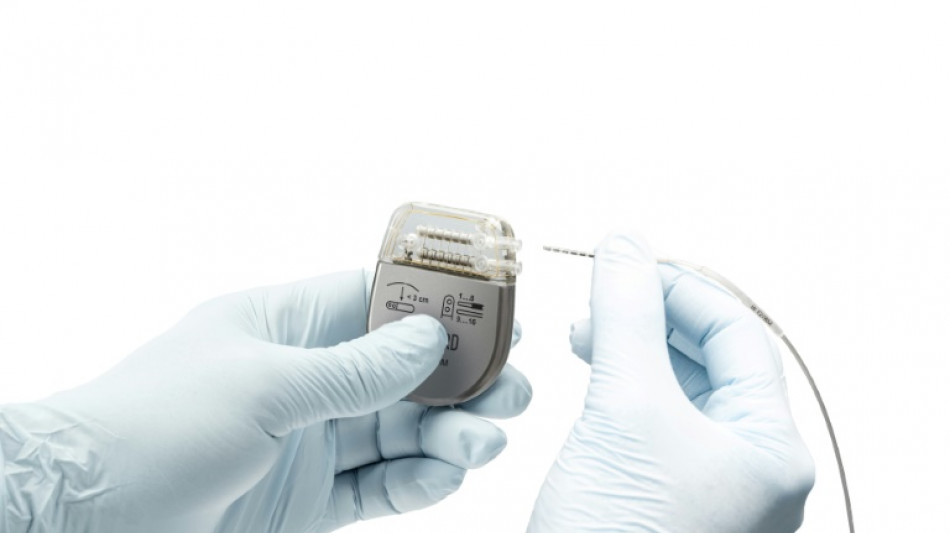
Brain implants could restore paralyzed patients' arm movements / Photo: © ONWARD Medical/AFP

 B2PRIME Expands Tier-1 Access and Liquidity Architecture for Sophisticated Institutional Flow

 STARTRADER Adds 48 US Stock CFDs with 24-Hour Weekday Trading

 'Ink' director Danny Boyle slams Trump's Truth Social 'lies'

 Coach Kovac extends contract at Dortmund until 2029

 Activist Thunberg joins France student rally after violence at protests

 Archer and Bethell in England squad for Australia ODI series

 Formula One to return to Africa in 'early 2030s' in Rwanda

 US actor Selma Blair charged with assault after alleged flight altercation

 Hungary cuts anti-LGBTQ legislation from Orban-era law

 'Our future is being robbed': Greta Thunberg joins France student protests

 Late superstar Anita Mui's ashes missing in Hong Kong

 'No choice': IMF says developing countries must cut spending despite war shock

 Boasting South Korea footballers spark rethink of military service exemptions

 Five dead as Hurricane Simon, Rachel pummel Mexico's Pacific coast

 Seoul, Tokyo stocks plunge as Asia suffers fresh tech rout

 Damaged and drained, Indonesia's peatlands go up in smoke

 Dominant Australia wary of Pacific threat at Rugby League World Cup

 Pope to be admitted to hospital for lung operation

 Samoa's McFarland welcomes 'massive' arrival of ex-All Blacks for World Cup run-in

 Brewers beat Dodgers 7-4 to extend MLB playoff lead

 Teenager shoots headmaster, teacher at French school

 Digi Power X Announces $200 Million Debt Financing Commitment to Support Completion of Alabama AI Data Center and Provides Expansion Update

 'Breaking Bad' actor RJ Mitte dead: representatives

 Former DR Congo president Kabila forms new force with M23 armed group

 Tom Cruise's 'Digger' tanks, leaving studio with $250 mn hole
A paralyzed Swiss man has become the first person to test a new technology that reads his thoughts using AI and then transmits signals through his own nervous system to his arms, hands and fingers in order to restore movement.
The treatment, a combination of a brain-computer interface and a spinal implant, had previously allow a paraplegic patient to walk again, a breakthrough that was published in the scientific journal Nature in May.
But this is the first time it's being used for "upper extremity function," Onward, the Dutch company behind it, said Wednesday.
"The mobility of the arm is more complex," surgeon Jocelyne Bloch, who carried out the implantation procedures, told AFP.
Though walking comes with its own challenges -- notably balance -- "the musculature of the hand is quite fine, with many different small muscles activated at the same time for certain movements," she said.
The patient, who wishes to remain anonymous, is a 46-year-old who lost the use of his arms after a fall. Two operations were carried out last month at the Lausanne University Hospital in Switzerland.
The first involved removing a small piece of cranial bone and inserting in its place the brain implant, which was developed by the French group CEA-Clinatec and measures a few centimeters in diameter.
In the second, surgeons placed a stimulator roughly the size of a credit card developed by Onward inside the patient's abdomen, and connected it through electrodes to the top of his spinal column.
The brain-computer interface (BCI) records brain signals and decodes them using artificial intelligence to make sense of the patient's intentions, acting as a "digital bridge" to send these instructions on to the spinal cord stimulator.
"It's going well so far," said Bloch, who co-founded Onward and is a consultant for the company. "We are able to record brain activity, and we know that the stimulation works," she said.
"But it is too early to talk about what progress he has made. "
- Still in training -
The patient is still in the training phase, teaching his brain implant to recognize the different desired movements.
The movements will then have to be practiced many times before they can become natural. The process will take a few months, according to Dr. Bloch.
Two more patients are scheduled to participate in this clinical trial, and the full results will be published later.
Spinal cord stimulation has already been used in the past to successfully move paralyzed patients' arms, but without reading their thoughts by pairing it with a brain implant.
And brain implants have already been used so that a patient can control an exoskeleton. The Battelle research organization used a brain implant to restore movement in a patient's arm -- through a sleeve of electrodes placed on the forearm, stimulating the muscles required from above.
"Onward is unique in our focus on restoring movement in people who have paralysis by stimulating the spinal cord," the company's CEO Dave Marver told AFP, adding the technology could be commercialized by the end of the decade.
Brain implants were long trapped in the realm of science fiction, but the field is now rapidly growing thanks to firms like Synchron and Elon Musk's Neuralink.
They are working on having paralyzed patients to control computers through thought, restoring for example the ability to write.
D.Schneider--BTB