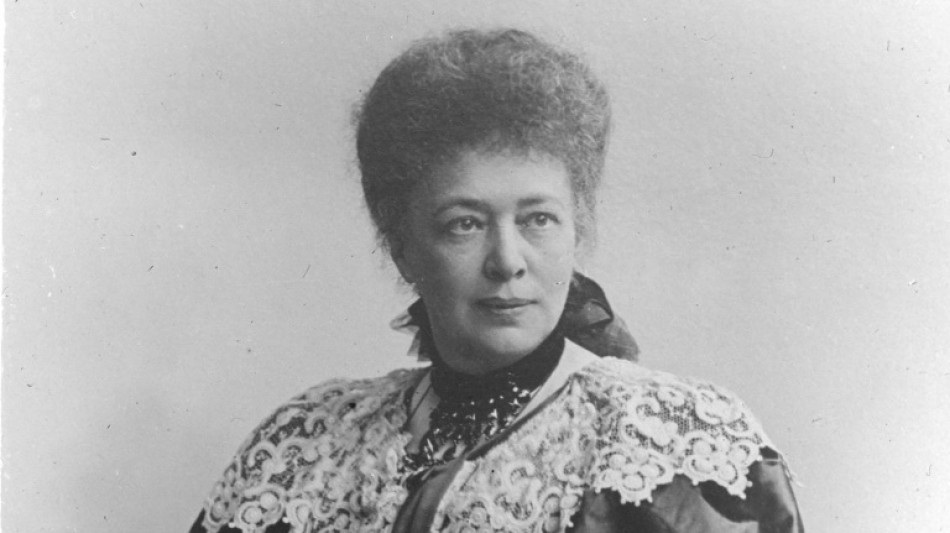
Peace pioneer Bertha von Suttner's message still resonates / Photo: © APA/AFP/File

 B2PRIME Expands Tier-1 Access and Liquidity Architecture for Sophisticated Institutional Flow

 STARTRADER Adds 48 US Stock CFDs with 24-Hour Weekday Trading

 'Ink' director Danny Boyle slams Trump's Truth Social 'lies'

 Coach Kovac extends contract at Dortmund until 2029

 Activist Thunberg joins France student rally after violence at protests

 Archer and Bethell in England squad for Australia ODI series

 Formula One to return to Africa in 'early 2030s' in Rwanda

 US actor Selma Blair charged with assault after alleged flight altercation

 Hungary cuts anti-LGBTQ legislation from Orban-era law

 'Our future is being robbed': Greta Thunberg joins France student protests

 Late superstar Anita Mui's ashes missing in Hong Kong

 'No choice': IMF says developing countries must cut spending despite war shock

 Boasting South Korea footballers spark rethink of military service exemptions

 Five dead as Hurricane Simon, Rachel pummel Mexico's Pacific coast

 Seoul, Tokyo stocks plunge as Asia suffers fresh tech rout

 Damaged and drained, Indonesia's peatlands go up in smoke

 Dominant Australia wary of Pacific threat at Rugby League World Cup

 Pope to be admitted to hospital for lung operation

 Samoa's McFarland welcomes 'massive' arrival of ex-All Blacks for World Cup run-in

 Brewers beat Dodgers 7-4 to extend MLB playoff lead

 Teenager shoots headmaster, teacher at French school

 Digi Power X Announces $200 Million Debt Financing Commitment to Support Completion of Alabama AI Data Center and Provides Expansion Update

 'Breaking Bad' actor RJ Mitte dead: representatives

 Former DR Congo president Kabila forms new force with M23 armed group

 Tom Cruise's 'Digger' tanks, leaving studio with $250 mn hole

The first woman to be awarded the Nobel Peace Prize in 1905, Austrian pacifist Bertha von Suttner's reflections are still cited by peace advocates as the war in Ukraine grinds on.
Von Suttner was looking for a "better ideal", according to French journalist Antoine Jacob, whose new biography "Bertha la Paix" ("Bertha of Peace") will be published next week.
More than a century later, her 1906 Nobel Peace Prize recipient speech -- in which she said happiness is developed in times of peace -- has lost nothing of its acuity.
"Fortresses are being erected, submarines built, whole areas mined, airships tested for use in war; and all this with such zeal –- as if to attack one's neighbour were the most inevitable and important function of a state," von Suttner told her mostly male listeners.
- Provocative work -
She was born into an aristocratic family in the Austrian Empire in 1843.
Burdened by her mother's gambling debts, she became a governess and music teacher in the von Suttner household and married the family's son Arthur, who like her refused to conform to norms.
As journalist and novel writer, the polyglot published 60 short stories, a few essays and 19 novels, including the influential and provocative anti-war novel "Lay Down Your Arms" in 1889.
Thanks to her aristocratic origins, her energy and determination, and her talent for mobilising goodwill, von Suttner became one of the leaders of the international peace movement.
"Daughter of a general, she was raised in an environment where falling at the front with God's approval was an honour," her biographer Jacob told AFP.
"We have to realise how far she came."
With Russia's invasion of Ukraine, von Suttner's reflections on respect for international law, disarmament and multilateralism are "more relevant than ever", said Norwegian Nobel historian Asle Sveen.
"The international order advocated by Suttner and the peace movement is once again disintegrating," Sveen said.
"Her admonishing message 'Lay Down Your Arms' is more relevant than ever in the face of nuclear threat gestures," Austrian Foreign Minister Alexander Schallenberg told AFP.
Her cosmopolitan, liberal and anti-clerical worldview, however, earned her fierce enmity in nationalist circles, where she became derided as "Bertha of the Jews".
She died in June 1914 at the age of 71, just before World War I broke out.
- 'Decisive role' -
Von Suttner also played "a decisive role" in convincing her friend and patron, Swedish inventor Alfred Nobel, to award a prize for peace, according to Jacob.
But since the prestigious prize was first awarded in 1901, only 18 women have obtained the distinction, compared to 92 men.
The second woman to win it was American Jane Addams, 26 years after von Suttner.
Despite her prominence, which included being given a private audience by then US president Theodore Roosevelt, von Suttner did not have the right to vote -- and had to be accompanied by her husband when she travelled.
"Among all these men, she tried to play a role completely contrary to the dominant way of thinking and without anyone pushing her," Jacob told AFP.
Her legacy in Austria also had its ups and downs.
The Nazi regime, which annexed Austria in 1938, burned her books, and a Vienna square inaugurated in her honour was renamed in 1957 after poet Rainer Maria Rilke.
But in 1966 her image was printed on the 1,000-schilling banknote.
In 1986, a small Vienna street was named after her.
And today she appears on the two-euro coin of Austria, a neutral country which is host to several UN bodies.
S.Keller--BTB

