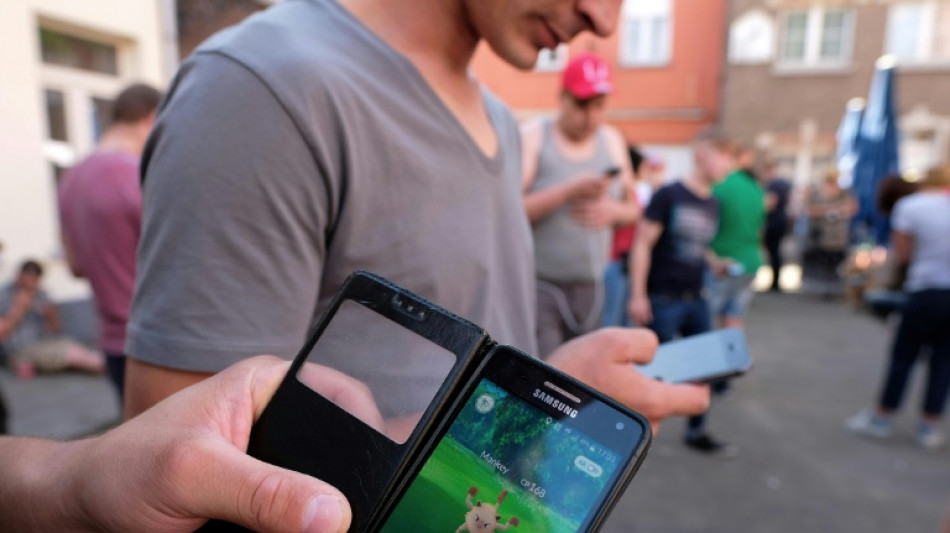
How a 20-cent fee upended the gaming world / Photo: © BELGA/AFP

 B2PRIME Expands Tier-1 Access and Liquidity Architecture for Sophisticated Institutional Flow

 STARTRADER Adds 48 US Stock CFDs with 24-Hour Weekday Trading

 'Ink' director Danny Boyle slams Trump's Truth Social 'lies'

 Coach Kovac extends contract at Dortmund until 2029

 Activist Thunberg joins France student rally after violence at protests

 Archer and Bethell in England squad for Australia ODI series

 Formula One to return to Africa in 'early 2030s' in Rwanda

 US actor Selma Blair charged with assault after alleged flight altercation

 Hungary cuts anti-LGBTQ legislation from Orban-era law

 'Our future is being robbed': Greta Thunberg joins France student protests

 Late superstar Anita Mui's ashes missing in Hong Kong

 'No choice': IMF says developing countries must cut spending despite war shock

 Boasting South Korea footballers spark rethink of military service exemptions

 Five dead as Hurricane Simon, Rachel pummel Mexico's Pacific coast

 Seoul, Tokyo stocks plunge as Asia suffers fresh tech rout

 Damaged and drained, Indonesia's peatlands go up in smoke
 Dominant Australia wary of Pacific threat at Rugby League World Cup

 Pope to be admitted to hospital for lung operation

 Samoa's McFarland welcomes 'massive' arrival of ex-All Blacks for World Cup run-in

 Brewers beat Dodgers 7-4 to extend MLB playoff lead

 Teenager shoots headmaster, teacher at French school

 Digi Power X Announces $200 Million Debt Financing Commitment to Support Completion of Alabama AI Data Center and Provides Expansion Update

 'Breaking Bad' actor RJ Mitte dead: representatives

 Former DR Congo president Kabila forms new force with M23 armed group

 Tom Cruise's 'Digger' tanks, leaving studio with $250 mn hole
Their language was salty and the message was clear: game developers believed their livelihoods were under threat and they were not going to accept it.
Unity, a US company whose software is used to create and run thousands of games including smash hits like "Pokemon GO" and "Genshin Impact", announced on September 12 new fees for developers.
The firm was going to charge 20 cents every time a Unity-backed game was installed on any device, a move that analysts warned could collapse studios and nix new releases.
Ten days later, after a spirited and often vulgarity-laden fightback from studios and developers, Unity rowed back some of the changes.
But for many developers, the damage may be irreparable.
"If I'm forced to accept the current conditions, I will leave," Alain Puget, director of the French studio Alkemi, told AFP.
Unity claims that its technology underpins 70 percent of the top 1,000 mobile games, and that people download apps made with its software four billion times a month.
Levying even a tiny fee would reap it big rewards.
But there are plenty of alternative "engines", as the software is known.
"Game makers have already begun to consider switching engines," said Rhys Elliott, market analyst at the Newzoo consultancy.
- 'Disconnected from reality' -
It was all very different back in 2005, when Unity launched with promises of democratising game development.
Its software platform was cheap and easy to use, and quickly became a favourite for independent and smaller developers.
The main innovation was that designers could build on elements from other games, such as the lighting of a background or the movements of characters.
Before Unity and its competitors emerged, each game was custom made, with graphics and everything else built from the ground up.
After a stellar rise, the firm went public in 2020.
For many industry watchers, the stock market flotation was the start of the fall.
The firm, which projects revenues of $2 billion this year, has instituted several waves of layoffs and alienated users by tweaking the software and pricing.
Then came the September 12 bombshell.
"The first proposal they made was completely disconnected from reality," said Puget of Alkemi.
Hundreds of developers took to social media to slam a proposal they said would kill studios relying on free-to-download games and any smaller outfits that happened to develop a hit game.
"There is no way Unity talked to a single developer before launching this," developer and consultant Rami Ismail posted on X, formerly Twitter.
The firm returned with an apology -- "we heard your concerns", "you are what makes Unity great" -- and a new offer to limit the levy to the most successful games.
Puget believes the firm made a "totally unreasonable" initial proposal so that their later offer, which will still give them a huge windfall, seems more palatable.
- 'Stop it' -
The vitriol from developers suggests Unity has a long way to go before it is accepted back into the fold.
Shortly after the initial announcement, an account sprang up on X to collate the responses under the handle "fucked by Unity", gaining more than 15,000 followers in a few days.
While some developers issued heartfelt letters, others resorted to images of raised middle fingers in front of the Unity logo, or short messages with obscenities of discontent.
"Stop it. WTF?" was the stark response from Innersloth, whose game "Among Us", made with Unity software, has an estimated 500 million players.
Puget said he was unsure if there was a way back for Unity, saying that "like everyone else" he would look at alternatives.
"It makes me sad to think that I've invested 13 years of learning, of research and development, in a solution that I'll have to throw away," he said.
W.Lapointe--BTB

