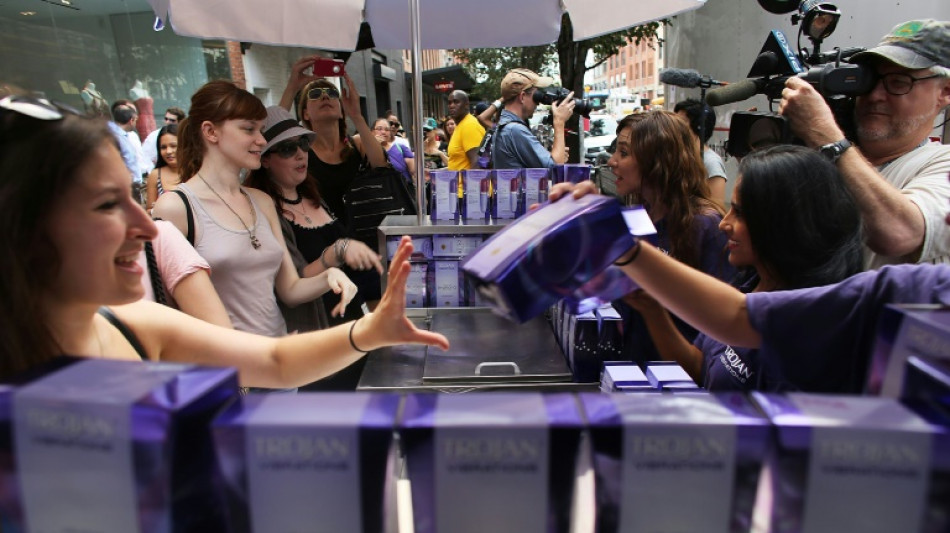
Sexual wellbeing industry revels in swelling sales / Photo: © GETTY IMAGES NORTH AMERICA/AFP/File

 Hazlewood takes six as Australia beat South Africa in 1st Test

 Saudi coalition tells Sanaa residents to flee site before operation

 Zverev defies 'physical issues' to reach Shanghai Masters quarter-finals

 'We're not giving up': Activist Thunberg joins France student protests

 Man City captain Dias defends celebrations after Liverpool win

 B2PRIME Expands Tier-1 Access and Liquidity Architecture for Sophisticated Institutional Flow

 STARTRADER Adds 48 US Stock CFDs with 24-Hour Weekday Trading

 'Ink' director Danny Boyle slams Trump's Truth Social 'lies'

 Coach Kovac extends contract at Dortmund until 2029

 Activist Thunberg joins France student rally after violence at protests

 Archer and Bethell in England squad for Australia ODI series

 Formula One to return to Africa in 'early 2030s' in Rwanda

 US actor Selma Blair charged with assault after alleged flight altercation

 Hungary cuts anti-LGBTQ legislation from Orban-era law

 'Our future is being robbed': Greta Thunberg joins France student protests

 Late superstar Anita Mui's ashes missing in Hong Kong

 'No choice': IMF says developing countries must cut spending despite war shock

 Boasting South Korea footballers spark rethink of military service exemptions

 Five dead as Hurricane Simon, Rachel pummel Mexico's Pacific coast

 Seoul, Tokyo stocks plunge as Asia suffers fresh tech rout

 Damaged and drained, Indonesia's peatlands go up in smoke

 Dominant Australia wary of Pacific threat at Rugby League World Cup

 Pope to be admitted to hospital for lung operation

 Samoa's McFarland welcomes 'massive' arrival of ex-All Blacks for World Cup run-in

 Brewers beat Dodgers 7-4 to extend MLB playoff lead

From creams and oils promising to take the user to seventh heaven to multi-sensory vibration devices and erotic lingerie, the sex accessory market has become more feminine over the years, even feminist.
In doing so, it has managed to broaden its market and is reaping the dividends, enjoying impressive growth.
The global market was estimated to be worth around $19 billion in 2021, with the United States leading the way ($4.4 billion), according to a study by consultancy firm PwC.
Further growth is predicted to reach $27 billion by 2026.
The repositioning of the market towards "sexual wellbeing", with more playful and refined designs and discreet packaging, has helped attract women who would otherwise be turned off by products with more "hardcore" connotations.
Although the shift began way back in the 1970s with feminists who wanted to emancipate women and their sexuality, it gathered pace at the turn of the century.
"I remember going to the big sex toys market wholesaler," said Ky Hoyle, who describes herself as "founder and head girl" of Sh! Women's Erotic Emporium in east London.
"In the beginning it was owned by porn barons," she told AFP.
"The same porn barons realised there was a whole market and came to us to ask us what can we do to be more female friendly."
Manufacturers then began making their products more suitable for women, with pastels or more sober colours and less conspicuous packaging.
- 'Sex and the City' -
Female sexuality gradually began getting more media attention, with hit television series such as "Sex and the City" widely credited with helping to bring "sex toys" out of the closest.
In one episode, Charlotte -- the most buttoned-up of the show's four main characters -- becomes obsessed with her vibrator.
Meanwhile the worldwide success of "Fifty Shades of Grey", a big-screen adaptation of the best-selling erotic novels about a college graduate's sadomasochistic relationship with a billionaire, is also seen as lifting many taboos.
The phenomenal interest in the film "actually provided a step change about the industry and made people become more open about their desires," said Lucy Litwack, chief executive and owner of erotic lingerie brand Coco de Mer.
"We saw people come to our stores asking about... BDSM accessories or toys."
Coco de Mer sells handcuffs, martinets, ropes and other restraints, at eye-watering prices.
Elsewhere in Hollywood, star Gwyneth Paltrow has established herself as a pioneer in "sex-wellness".
She sells items such as vibrators and rings for men, alongside oils and lubricants sold in golden bottles or with lyrical or names such as "viva la vulva".
Paltrow is not the only one: other celebrities have put their name to sensual devices, such as the British singer Lily Allen.
- Covid trigger -
In France, feminist fashion designer Sonia Rykiel began selling vibrators and other accessories in 2002 in her upmarket boutique in Saint-Germain-des-Pres on the Left Bank in Paris.
The brand's artistic director, Rykiel's daughter Nathalie, said at the time she wanted a "guilt-free" approach to pleasure.
Fast-forward two decades and the coronavirus pandemic triggered a huge boost in sales, according to retailers.
"We saw a massive increase in the sale of sex toys to people alone, also couples who were open to experiment, had time on their hands," said Litwack.
"The subject started to be normalised much more. One positive thing that came out of Covid was that it put self-care at the top of our priority list."
Sex toy accessories now account for a quarter of Coco de Mer sales.
From growing at five percent a year pre-Covid, the global market grew by 50 percent between 2019 and 2021, said PwC.
It projects a seven percent annual increase until 2026.
The consultancy said that consumers in the United States, the UK and France now own an average of nearly four sex toys.
It attributed the trend to a relaxing of social taboos but also that sexual wellbeing has begun to be seen as "increasingly important".
The popularity of sex toys had also quickened the pace of innovation in the sector.
T.Bondarenko--BTB

