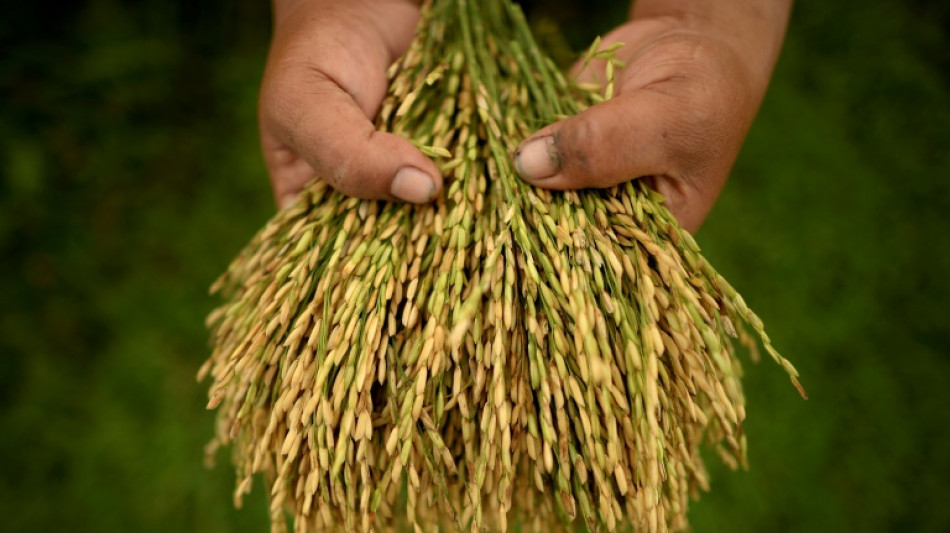
Marcos lifts cap on Philippines' rice prices / Photo: © AFP/File

 Pope Leo in Rome hospital for lung operation

 EU watchdog says smart glasses must give 'clear warnings' when recording

 Houthis say Saudi Arabia strikes oil site in Yemen's capital

 France roiled by marches in support of protesting students

 Goldman Sachs profits jump as CEO says no plans to exit

 Apple unveils HomeView smart display in renewed home push

 Novelist Thelyson Orelien denies AI use, admits plagiarism 'mistakes'

 Trump asks Greece ambassador to resign amid bribery scandal: White House

 11 missing after ships struck off Bulgaria in latest Black Sea attack

 France budget debate faces rocky start as Socialists vow to fight

 AI could 'change the stakes' on bioweapons: UK spy chief

 Sweden centre-left leader fails to form government

 EU economy chief doubtful Russian diesel exports will affect prices

 Capital International Highlights Multilingual Access to Its Platform as European Economic Conditions Diverge

 Hazlewood takes six as Australia win first Test

 Pope Leo admitted to hospital for lung operation

 Hungary cuts anti-LGBTQ measures from Orban-era law

 Tech stocks slump on AI jitters; oil falls

 ePlanet Brokers Publishes H1 2026 Transparency Report and Highlights Best Broker 2026 Award

 Van Gogh work unseen in public for 60 years on show in Hong Kong

 Prosecutors drop most impeachment charges against Philippine VP Duterte

 Hypersonic weapons highlight arms race on the Korean peninsula

 Fiji appoint ex-Springboks boss White as coach ahead of World Cup

 Hungary to reverse Orban-era anti-LGBTQ legislation
 Allen rushes Bills to thrilling 37-34 win over Rams

Philippine President Ferdinand Marcos lifted a price ceiling on rice Wednesday, weeks after capping the cost of the staple to support poor households.
In early September, Marcos set the maximum retail price of regular milled rice at 41 pesos ($0.72) per kilogramme (2.2 pounds) and 45 pesos for the higher-quality "well-milled" rice.
The measure was criticised by some economists, who warned it could distort the market and lead to shortages.
A member of Marcos's economic team was sacked after she appeared to mock the plan on social media.
"As of today, we are lifting the price caps on rice, both for the regular milled rice and for the well-milled rice," Marcos said, at an event in Manila where a thousand sacks of "smuggled" rice seized in a raid were distributed to poor families.
Marcos, who is also the agriculture minister, said it was the "appropriate time" to remove the cap since the government was "giving away rice".
Government assistance for farmers and the poor would continue, he said, noting "we still need to fix our agriculture sector".
Rice is a staple in the country of 110 million people, but the nation cannot produce enough and is one of the world's top importers of the grain.
Marcos's government has been struggling to rein in consumer prices, with the year-on-year inflation rate hitting 5.3 percent in August, up from 4.7 percent in July.
Marcos's approval rating has fallen to 65 percent, according to a Pulse Asia Research survey conducted in September after the price ceiling was imposed. That compares with 80 percent in June.
A separate poll showed inflation was the top concern among those surveyed.
Marcos has insisted supply is not a problem and instead blamed hoarders and opportunistic traders for high prices, as well as a ban on rice exports by major producer India and the war in Ukraine.
Political analyst Richard Heydarian said the price cap was "just not working" and the government realised more drastic measures were needed to bring down prices of basic commodities and staple foods.
Economist Victor Abola said the recent start of the rice harvest meant there was "no more need for the price cap".
The Philippines should now be "importing rice so that in the lean months there is rice to take care of the demand or else (prices) will go up again", said Abola, an assistant professor at Manila's University of Asia and the Pacific.
I.Meyer--BTB