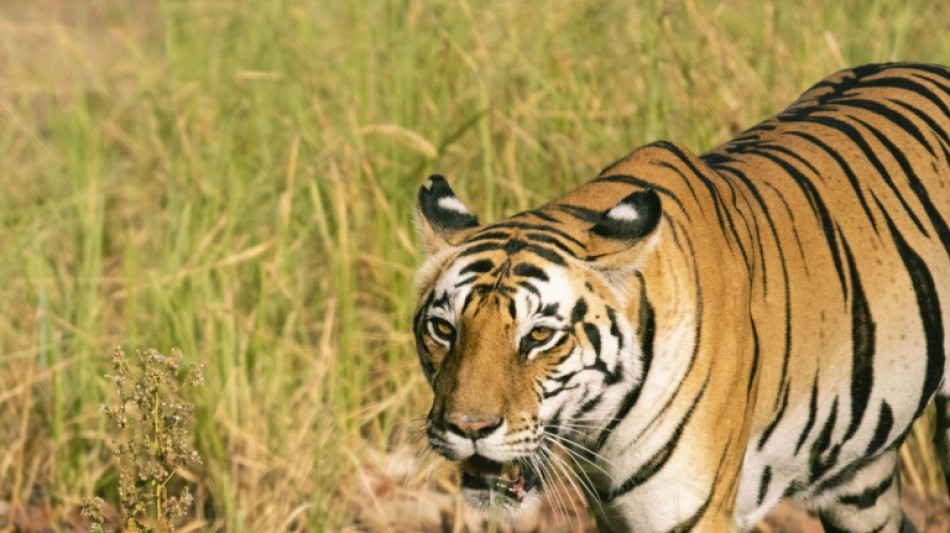
AI of the tiger: Tiny camera 'protects' predator -- and people / Photo: © RESOLVE Inc. and Clemson University/AFP

 Pope Leo in Rome hospital for lung operation

 EU watchdog says smart glasses must give 'clear warnings' when recording

 Houthis say Saudi Arabia strikes oil site in Yemen's capital

 France roiled by marches in support of protesting students

 Goldman Sachs profits jump as CEO says no plans to exit

 Apple unveils HomeView smart display in renewed home push

 Novelist Thelyson Orelien denies AI use, admits plagiarism 'mistakes'

 Trump asks Greece ambassador to resign amid bribery scandal: White House

 11 missing after ships struck off Bulgaria in latest Black Sea attack

 France budget debate faces rocky start as Socialists vow to fight

 AI could 'change the stakes' on bioweapons: UK spy chief

 Sweden centre-left leader fails to form government

 EU economy chief doubtful Russian diesel exports will affect prices

 Capital International Highlights Multilingual Access to Its Platform as European Economic Conditions Diverge

 Hazlewood takes six as Australia win first Test

 Pope Leo admitted to hospital for lung operation

 Hungary cuts anti-LGBTQ measures from Orban-era law

 Tech stocks slump on AI jitters; oil falls

 ePlanet Brokers Publishes H1 2026 Transparency Report and Highlights Best Broker 2026 Award

 Van Gogh work unseen in public for 60 years on show in Hong Kong

 Prosecutors drop most impeachment charges against Philippine VP Duterte

 Hypersonic weapons highlight arms race on the Korean peninsula

 Fiji appoint ex-Springboks boss White as coach ahead of World Cup

 Hungary to reverse Orban-era anti-LGBTQ legislation

 Allen rushes Bills to thrilling 37-34 win over Rams

Tiger populations are on the rise in the jungles of India and Nepal and the predators are roaming ever closer to villages, sparking a race among conservationists to find ways of avoiding conflict.
They are increasingly finding solutions with artificial intelligence, a bunch of technologies designed to reason and make decisions like humans.
Experts from Clemson University in South Carolina and several NGOs published research last month on their work using AI-enabled cameras that they say could help revolutionise tiger conservation.
They placed tiny devices around enclosures in the two South Asian nations, both to protect villagers from the predators -- and the predators from poachers.
According to their research, published in the BioScience journal, the camera system called TrailGuard can distinguish between tigers and other species and relay images to park rangers or villagers within seconds.
"We have to find ways for people and tigers and other wildlife to coexist," Eric Dinerstein, one of the authors of the report, told AFP.
"Technology can offer us a tremendous opportunity to achieve that goal very cheaply."
- Elephants and Amazon loggers -
The research claims the cameras were immediately effective, picking up a tiger just 300 metres from a village, and on another occasion identifying a team of poachers.
They say their system was the first AI camera to identify and transmit a picture of a tiger, and it has almost wiped out false alarms -- when traps are tripped by passing boars or falling leaves.
The scheme is one of several putting an AI spin on the established ideas of wildlife surveillance.
Researchers in Gabon are using AI to sift their camera trap images and are now trying a warning system for elephants.
Teams in the Amazon are piloting equipment that can detect the sounds of chainsaws, tractors and other machinery associated with deforestation.
And US tech titan Google teamed up with researchers and NGOs four years ago to collect millions of images from camera traps.
The project, called Wildlife Insights, automates the process of identifying species and labelling images, saving many hours of laborious work for researchers.
Conservationists like Dinerstein, who also leads the tech team at the Resolve NGO, are sure that technology is helping their cause.
- 'Early warning system' -
Their goal is to ensure that 30 percent of the Earth's land and oceans are designated protected zones by 2030, as agreed by dozens of governments last year, with that number eventually going up to 50 percent.
Those zones will need to be monitored, and animals will need to move safely between protected areas.
"That's what we're shooting for, and the critical element of that is an early warning system," he said.
The plight of tigers underscores the size of the challenge.
Their habitats have been devastated across Asia and their numbers in India fell to an all-time low of 1,411 in 2006, before steadily rising to current levels of around 3,500.
In the mid-20th century, India was home to an estimated 40,000.
- 'Jury still out' -
Jonathan Palmer, head of conservation technology at the US-based Wildlife Conservation Society (WCS), who was not involved in the study, said TrailGuard had exciting potential.
But Palmer, who helped found Wildlife Insights with Google, said the broader uses of AI in conservation were not yet settled.
"In most cases, AI species identification is still in its infancy," he said.
His NGO recommends outside verification of any species identification done by AI.
And Palmer said the "jury was out" on whether AI was better deployed in cameras at the scene or afterwards on servers or laptops.
Those uncertainties aside, Dinerstein is widening the rollout of TrailGuard -- this time with even bigger animals in his sights.
"Elephants wander outside parks all the time and it leads to a massive amount of conflict," he said.
They destroy crops, cause chaos in villages and can even cause train crashes, with dozens of deaths every year, he added.
"There's an immense opportunity here to prevent that."
A.Gasser--BTB