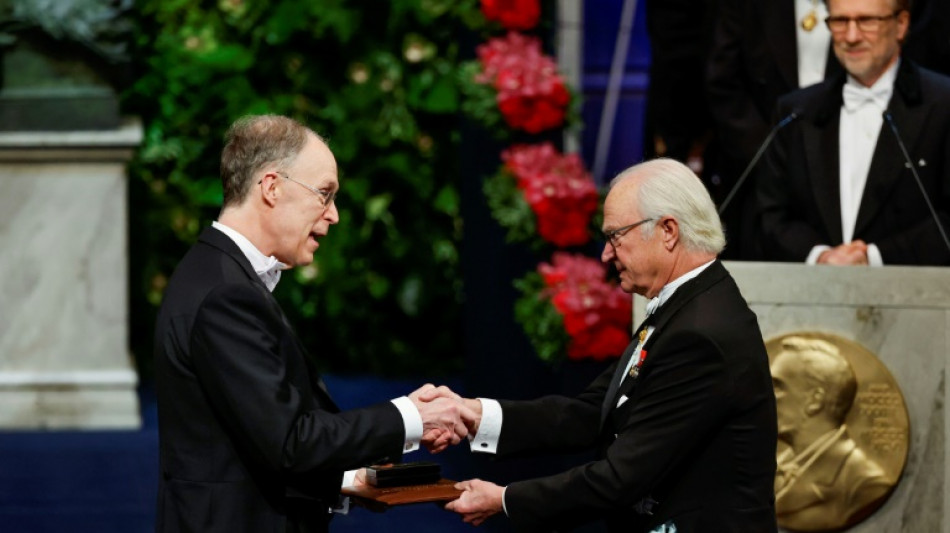
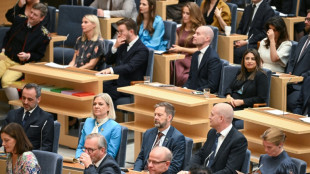
Economics prize closes out 2023 Nobel season / Photo: © TT NEWS AGENCY/AFP

 Nvidia says to invest in French medical website
 Real Madrid's Mourinho has 'trust' in referees despite complaints

 Mendis, Shanaka star in Sri Lanka consolation T20I win
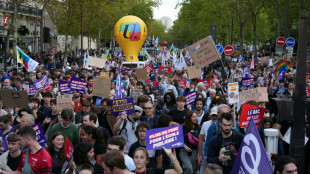
 Demonstrations backing France's protesting students gather strength

 Trump says US Senate as hard to defend as House in midterms
 Suspected Russian drones hit two ships off Bulgaria, 11 missing
 Tech stocks slide on AI jitters
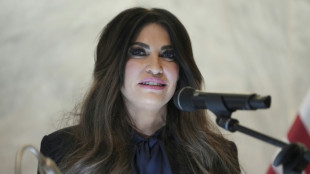 Trump asks Greece ambassador to resign amid ethics scandal

 New White House spokeswoman heavy on Trump praise, light on questions in debut
 Emery urges Villa to make most of reduced home comfort
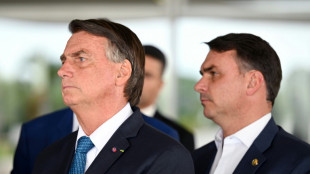 Flavio Bolsonaro visits father under house arrest ahead of Brazil runoff
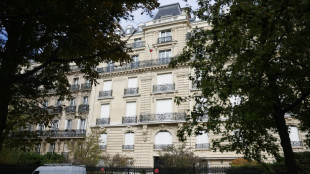 France, Eq. Guinea in standoff over luxury Paris mansion
 'Holding our ground': Israel demolishes dozens of Bedouin homes
 Hazlewood takes six as Australia beat South Africa in 1st Test

 Saudi coalition tells Sanaa residents to flee site before operation
 Zverev defies 'physical issues' to reach Shanghai Masters quarter-finals
 'We're not giving up': Activist Thunberg joins France student protests
 Man City captain Dias defends celebrations after Liverpool win
 B2PRIME Expands Tier-1 Access and Liquidity Architecture for Sophisticated Institutional Flow

 STARTRADER Adds 48 US Stock CFDs with 24-Hour Weekday Trading

 'Ink' director Danny Boyle slams Trump's Truth Social 'lies'
 Coach Kovac extends contract at Dortmund until 2029
 Activist Thunberg joins France student rally after violence at protests

 Archer and Bethell in England squad for Australia ODI series

 Formula One to return to Africa in 'early 2030s' in Rwanda
The economics prize closes the prestigious Nobel awards season on Monday, with specialists on credit, the job market or inequalities expected to be among the contenders.
US labour economist Claudia Goldin, a professor at Harvard, is a favourite to win the award, which is due to be announced at 11:45 am (09:45 GMT) in Stockholm.
Of all the Nobels, the economics prize has the fewest number of women who have won, with just two since it was first awarded in 1969 -- Elinor Ostrom in 2009 and Esther Duflo in 2019.
"Equality and diversity are priorities and the committee encourages it in the nominations," Micael Dahlen, a professor in marketing at the Stockholm School of Economics, told AFP.
"But the number one priority is to choose a field of research... which decides who the candidates can be," he continued.
Goldin's research, which has focused on inequality and the female labour force, ever remains on the agenda, Dahlen added.
Last year, the honour went to US economists Douglas Diamond and Philip Dybvig together with former Federal Reserve chief Ben Bernanke for research on banks in times of turmoil.
The pick has many commentators ruling out another win in the field of banking.
"In a wider sense the same subject matter can be rewarded one year after another, but it is more common that this is not the case," Mikael Carlsson, professor of economics at Uppsala University in Sweden explained.
Carlson added that he thought the work of Japan's Nobuhiro Kiyotaki and Briton John H. Moore could be given the nod.
Their "research, which has provided information, among other things, on interest rate cycles and real estate markets, is well placed this year, very topical issues," Dahlen noted.
Analytics group Clarivate, which keeps an eye on potential Nobel science laureates, suggests Frenchman Thomas Piketty, who rose to prominence with his book "Capital in the Twenty-First Century," is another favourite.
Frequently featured in prize discussions in recent years, Piketty could be honoured together with his compatriot Gabriel Zucman and Franco-American Emmanuel Saez.
The institute, which bases its predictions on the number of citations from researchers, also floated the names of Americans Raj Chetty, a specialist on the conditions of economic opportunity and social mobility, and Edward L. Glaeser for his analysis of urban economics.
- False Nobel -
Frenchman Philippe Aghion, the Americans George Loewenstein, Kenneth Rogoff and Carmen Reinhart are also among the academics often considered to be worthy of the prize.
Turkish-American Daron Acemoglu is also often a top name, potentially paired with Russian-American Andrei Shleifer.
Magnus Henrekson of the Research Institute of Industrial Economics in Sweden told AFP "it's doubtful they'll dare" to award Schleifer given his Russian origins and the war in Ukraine.
The economics prize is the only prize not among the original five set out by the will of Alfred Nobel, who died in 1896.
It was instead created through a donation from the Swedish central bank in 1968, and detractors have thus dubbed it "a false Nobel".
However, just like the other science prizes the Royal Swedish Academy of Sciences decides the winner and finding candidates follows the same process.
Just like all the prizes it comes with a gold medal, a diploma and a prize sum of 11 million Swedish kronor (about $1 million), and laureates receive their prizes from King Carl XVI Gustaf at a lavish prize ceremony in Stockholm.
The prestigious Peace Prize on Friday went to imprisoned Iranian women's rights campaigner Narges Mohammadi.
Earlier in the week, Norwegian playwright Jon Fosse was rewarded in literature.
The chemistry prize was awarded to Moungi Bawendi, Louis Brus and Alexei Ekimov for their work on nanoparticles called quantum dots.
In physics, Anne L'Huillier, Pierre Agostini and Ferenc Krausz were honoured for using ultra-quick light flashes that enable the study of electrons inside atoms and molecules.
The medicine prize, the first to be announced, went to a duo -- Katalin Kariko and Drew Weissman -- for their groundbreaking technology that paved the way for mRNA Covid-19 vaccines.
J.Fankhauser--BTB