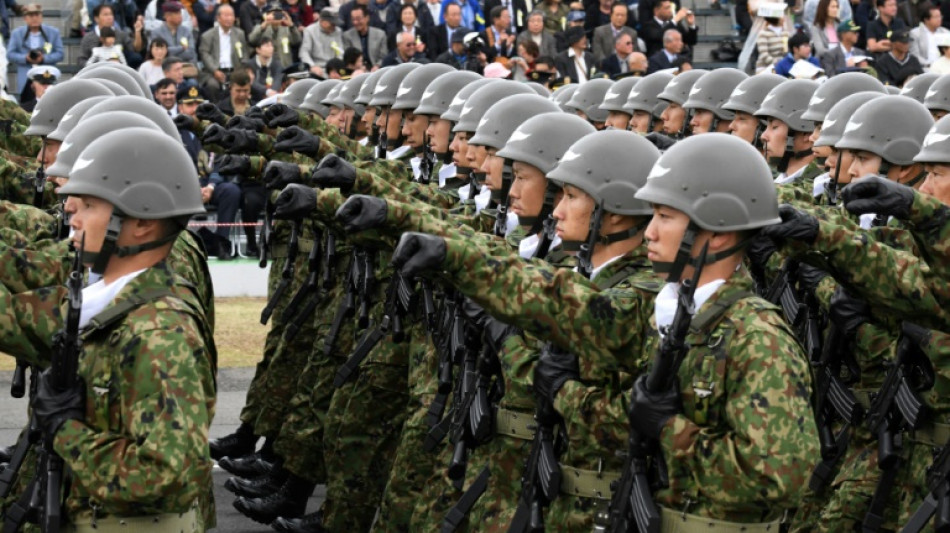
'Not proud at all': Japan's army struggles to recruit / Photo: © AFP

 Nvidia says to invest in French medical website

 Real Madrid's Mourinho has 'trust' in referees despite complaints

 Mendis, Shanaka star in Sri Lanka consolation T20I win

 Demonstrations backing France's protesting students gather strength

 Trump says US Senate as hard to defend as House in midterms

 Suspected Russian drones hit two ships off Bulgaria, 11 missing

 Tech stocks slide on AI jitters

 Trump asks Greece ambassador to resign amid ethics scandal

 New White House spokeswoman heavy on Trump praise, light on questions in debut

 Emery urges Villa to make most of reduced home comfort

 Flavio Bolsonaro visits father under house arrest ahead of Brazil runoff

 France, Eq. Guinea in standoff over luxury Paris mansion

 'Holding our ground': Israel demolishes dozens of Bedouin homes
 Hazlewood takes six as Australia beat South Africa in 1st Test

 Saudi coalition tells Sanaa residents to flee site before operation

 Zverev defies 'physical issues' to reach Shanghai Masters quarter-finals

 'We're not giving up': Activist Thunberg joins France student protests

 Man City captain Dias defends celebrations after Liverpool win

 B2PRIME Expands Tier-1 Access and Liquidity Architecture for Sophisticated Institutional Flow

 STARTRADER Adds 48 US Stock CFDs with 24-Hour Weekday Trading

 'Ink' director Danny Boyle slams Trump's Truth Social 'lies'

 Coach Kovac extends contract at Dortmund until 2029

 Activist Thunberg joins France student rally after violence at protests

 Archer and Bethell in England squad for Australia ODI series

 Formula One to return to Africa in 'early 2030s' in Rwanda

A recent open day at a Japanese military base near Tokyo was a fun family outing but, despite the games and snacks, the army recruitment stand was bereft of visitors.
"This is the reality. The festival is always packed but no one comes," confessed one of the two soldiers on duty, unwanted leaflets on the table next to a green armoured vehicle.
Japan has massively upped its defence spending in recent years, alarmed by China's growing assertiveness in the region and the frequency of North Korea's missile tests.
But a report by a panel of experts in July highlighted an "extremely high" risk that the armed forces would be weakened because of a lack of personnel.
Although numbers fluctuate from year to year, since 1990 the strength of the Self-Defense Forces, as Japan's military is known, has fallen by more than seven percent to under 230,000.
In 2022 fewer than 4,000 people joined up, undershooting the target by more than half. The last time its objective was met was in 2013.
- 'Ashamed' -
Many advanced economies are having problems recruiting enough people, with the situation particularly acute in Japan, where one in 10 people is 80 or over.
But according to current and former soldiers who spoke to AFP, it's not just demographics to blame.
"I was ashamed to say that I was in the Self-Defence Forces. It didn't make me proud at all," said Yuichi Kimura, 45, a former parachutist who now runs a firm helping former soldiers get civilian jobs.
Morale is "low", he said, due to "poor pay" and a "lack of ambition" on the part of the armed forces, whose role since World War II has been exclusively defensive in line with Japan's pacifist constitution.
Many join up hoping to help during natural disasters, but are dismayed to find themselves doing military tasks.
"Most soldiers weren't thinking at all about national defence (when they joined)," said Kohei Kondo, 25, a former sergeant.
Japan's defence ministry insists it only recruits suitable candidates but according to media reports, standards have fallen, including when it comes to psychological tests.
In June, two people were killed by a new recruit in a shooting incident at a military firing range.
Japan "recruits just about anybody because no one expects an actual armed conflict", said Kimura, the former paratrooper.
- Sexual harassment -
In an effort to halt the decline, in 2018 Japan increased the maximum age for new soldiers to 32 from 26.
Another solution, the July report said, is to use more unmanned vehicles in the air, on sea and on land.
The army is even reportedly considering allowing recruits with tattoos -- markings traditionally associated with "yakuza" gangsters.
Japan also aims to increase the proportion of women by 2030 to 13 percent, from nine percent at present.
Featuring photos of smiling servicewomen, the defence ministry website promises "an environment adapted to women".
But according to Fumika Sato, professor of military sociology and gender sociology at Hitotsubashi University, there is a considerable gap with "reality on the ground".
The army is "an environment conducive to harassment and sexual violence", she told AFP.
The army has been roiled for the past year by a series of damaging revelations of sexual assault within its ranks.
They started when former soldier Rina Gonoi went public with explosive allegations of abuse that drew major attention.
There is no concrete evidence of a link, but in the year to March 2023, the number of female recruits tumbled 12 percent, having previously risen every year since 2017.
"Things were happening in my company that could have had the same repercussions," admitted Kodai Suzuki, 27, another former soldier.
"What parents would let their daughter join such an institution?" a serving junior officer said on condition of anonymity.
J.Fankhauser--BTB