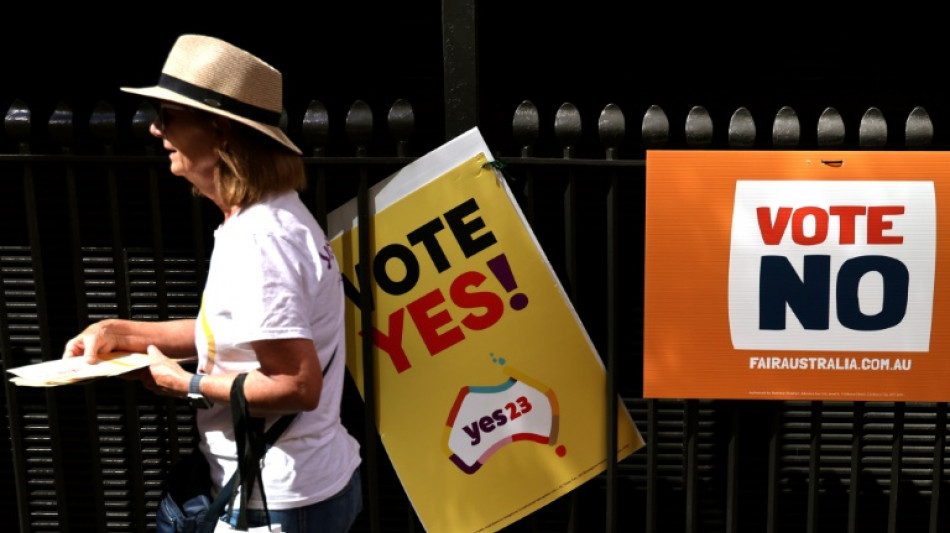
Australia holds historic Indigenous rights referendum / Photo: © AFP

 Nvidia says to invest in French medical website

 Real Madrid's Mourinho has 'trust' in referees despite complaints

 Mendis, Shanaka star in Sri Lanka consolation T20I win

 Demonstrations backing France's protesting students gather strength

 Trump says US Senate as hard to defend as House in midterms

 Suspected Russian drones hit two ships off Bulgaria, 11 missing

 Tech stocks slide on AI jitters

 Trump asks Greece ambassador to resign amid ethics scandal

 New White House spokeswoman heavy on Trump praise, light on questions in debut

 Emery urges Villa to make most of reduced home comfort

 Flavio Bolsonaro visits father under house arrest ahead of Brazil runoff

 France, Eq. Guinea in standoff over luxury Paris mansion

 'Holding our ground': Israel demolishes dozens of Bedouin homes
 Hazlewood takes six as Australia beat South Africa in 1st Test

 Saudi coalition tells Sanaa residents to flee site before operation

 Zverev defies 'physical issues' to reach Shanghai Masters quarter-finals

 'We're not giving up': Activist Thunberg joins France student protests

 Man City captain Dias defends celebrations after Liverpool win

 B2PRIME Expands Tier-1 Access and Liquidity Architecture for Sophisticated Institutional Flow

 STARTRADER Adds 48 US Stock CFDs with 24-Hour Weekday Trading

 'Ink' director Danny Boyle slams Trump's Truth Social 'lies'

 Coach Kovac extends contract at Dortmund until 2029

 Activist Thunberg joins France student rally after violence at protests

 Archer and Bethell in England squad for Australia ODI series

 Formula One to return to Africa in 'early 2030s' in Rwanda

Australians are poised to reject greater rights and recognition for Indigenous citizens Saturday, voting in a referendum that has exposed deep fissures between the country's white majority and the descendants of its first inhabitants.
Almost 18 million Australians will cast ballots for or against constitutional changes to recognise Indigenous peoples for the first time and create an advisory body -- an Indigenous Voice -- to weigh laws that affect those communities.
Opinion polls give the reforms little hope, with recent surveys indicating the "yes" camp is polling at just over 40 percent and the "no" side at nearly 60 percent.
Australia's Indigenous people, whose ancestors have lived on the continent for more than 60,000 years, make up just 3.8 percent of the population.
But they have been on the wrong side of deepening inequality since white settlement more than 200 years ago.
Aboriginal and Torres Strait Islanders are much more likely to be sick, imprisoned or to die young than their wealthier white compatriots.
Supporters say the reforms would help address these inequalities.
The opposition campaign has amplified fears about the role and effectiveness of the "Voice" assembly, encouraging voters to vote "no" if they are uncertain.
Polls have consistently shown that most Australians care little about problems in Indigenous communities and rank the issue low down the list of public priorities.
In the days before the vote, media attention has focused as much on events in the Middle East as the political debate at home.
- 'Shameful day' -
"Yes" campaigner Karen Wyatt told AFP she was "trying to stay positive" in the face of a seemingly inevitable defeat.
But even before the votes are counted, hard questions are being asked about what a "no" vote would say about Australians' regard for each other, and the willingness to face up to the legacy of an often brutal past.
If the Voice was rejected, it would be "a shameful day for Australia", 59-year-old Wyatt told AFP in Sydney.
"I think it does say something for the path of this country, to say 'no' to something that was a simple request and a generous proposition," she added.
"I hope if it is a 'no', we can recover from it and move forward."
Dee Duchesne, 60, a volunteer for the "no" campaign, said she was "fighting to keep an extra layer of bureaucracy out of our constitution".
She said she had been called racist while handing out leaflets near a Sydney polling station during early voting. "I'm not," she said.
- Fallout -
Centre-left Prime Minister Anthony Albanese has spent a year and much precious political capital advocating for the "yes" campaign.
On the eve of the vote he made an emotional plea for Australians to show "kindness".
Speaking in Adelaide on Friday, he said a victory for the "yes" camp "may just make life better" for Indigenous people.
Voting is compulsory for Australia's 17.5 million voters.
The referendum can only pass with support from a majority of voters nationally and a majority of voters in at least four of the country's six states.
Polling opens on the populous east coast at 8 am (2100 GMT on Friday), with more than 7,000 voting stations across the country.
Referendum expert Matt Qvortrup told AFP he expected the Voice to get between 46 and 48 percent of the vote.
People are more likely to vote for something if they do not need to learn about the issue, he told AFP, using the 2017 vote on gay marriage as an example.
That vote saw 62 percent support for allowing same-sex couples to marry.
"People would know gay people, they had formed an opinion about this, they didn't have to learn new things about it," Qvortrup said.
"When people have already formed an opinion then you can actually get an increase in the vote because people have a fairly good idea of what it's about."
Voters are unlikely to be swayed by what celebrities say, he added, especially if they are seen as having little credibility on the issue.
C.Kovalenko--BTB
