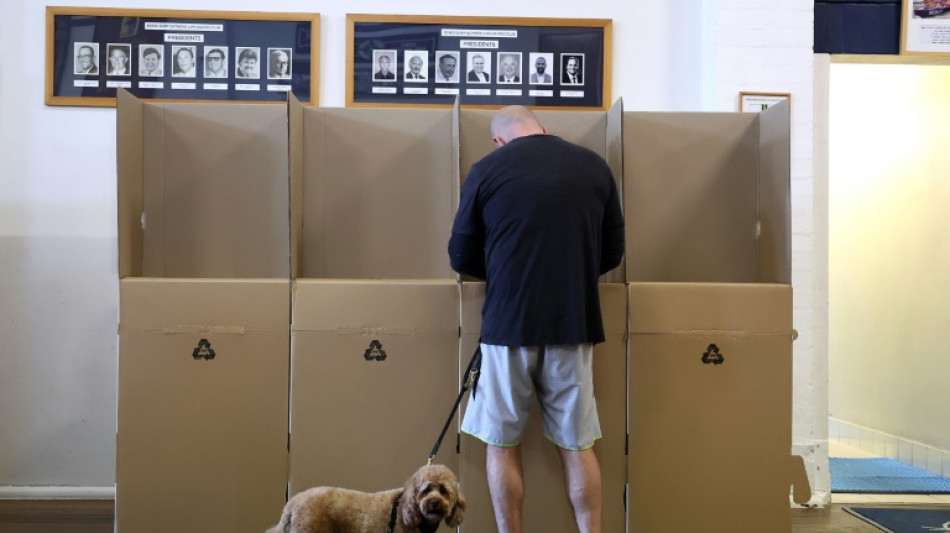
Anger, sorrow as Indigenous Australians weigh referendum defeat / Photo: © AFP

 Nvidia says to invest in French medical website

 Real Madrid's Mourinho has 'trust' in referees despite complaints

 Mendis, Shanaka star in Sri Lanka consolation T20I win

 Demonstrations backing France's protesting students gather strength

 Trump says US Senate as hard to defend as House in midterms

 Suspected Russian drones hit two ships off Bulgaria, 11 missing

 Tech stocks slide on AI jitters

 Trump asks Greece ambassador to resign amid ethics scandal

 New White House spokeswoman heavy on Trump praise, light on questions in debut

 Emery urges Villa to make most of reduced home comfort

 Flavio Bolsonaro visits father under house arrest ahead of Brazil runoff

 France, Eq. Guinea in standoff over luxury Paris mansion

 'Holding our ground': Israel demolishes dozens of Bedouin homes
 Hazlewood takes six as Australia beat South Africa in 1st Test

 Saudi coalition tells Sanaa residents to flee site before operation

 Zverev defies 'physical issues' to reach Shanghai Masters quarter-finals

 'We're not giving up': Activist Thunberg joins France student protests

 Man City captain Dias defends celebrations after Liverpool win

 B2PRIME Expands Tier-1 Access and Liquidity Architecture for Sophisticated Institutional Flow

 STARTRADER Adds 48 US Stock CFDs with 24-Hour Weekday Trading

 'Ink' director Danny Boyle slams Trump's Truth Social 'lies'

 Coach Kovac extends contract at Dortmund until 2029

 Activist Thunberg joins France student rally after violence at protests

 Archer and Bethell in England squad for Australia ODI series

 Formula One to return to Africa in 'early 2030s' in Rwanda

Aboriginal Australians on Sunday voiced anger and sorrow over the rejection of a landmark push for Indigenous rights and recognition, which was spurned by the country's white majority in a binding national referendum.
Indigenous leaders called for a "week of silence" to mourn the "bitter" outcome of the poll, after Prime Minister Anthony Albanese had urged his divided nation to heal "in the spirit of unity".
With more than 70 percent of ballots counted Sunday morning, around 60 percent of Australians said "no" when asked if the 1901 constitution should be changed to recognise the country's first inhabitants.
The reforms would also have created a consultative body -- a "Voice" to Parliament -- tasked with working on solutions to the pervasive inequalities plaguing Aboriginal communities.
The proposal was defeated in every state across the country.
Aboriginal advocacy groups said Sunday that millions of Australians had ignored the chance to atone for the "brutal dispossession of our people".
"Now is the time for silence, to mourn and deeply consider the consequence of this outcome," a joint statement read.
"The truth is that we offered this recognition and it has been refused. We know now where we stand in our own country," it added, before calling for a "week of silence" to grieve and reflect.
Indigenous voter Auntie Shirley Lomas was defiant in defeat, saying it had done nothing to crush her resolve.
"Aboriginal people have been here for 60,000 years and we'll continue to be here," she told AFP in the wake of the result.
"Voters voted no because they fear change. Most of them wouldn't even know an Aboriginal person."
Just under four percent of Australia's 26 million population are Indigenous.
- 'Painfully familiar' -
Political gains have not come easily for Aboriginal Australians, who have fought tooth-and-nail over the years to secure basic voting rights, own traditional lands, and win election to parliament.
Against this backdrop, Indigenous "yes" campaigner Dean Parkin said the crushing outcome was "painfully familiar" and just the latest "chapter in the story of our struggle".
Supporters saw the referendum as a way to unite the country while addressing the historical injustices inflicted upon First Nations people.
Instead, it has exposed the deep racial fault lines that still run through the country more than two centuries since British colonisers dropped anchor in Sydney Harbour.
Albanese has vowed that his government will continue working to deliver Indigenous recognition -- although it is unclear what options remain.
Prominent Aboriginal activist and scholar Marcia Langton declared that decades of work to build trust between Australians had failed.
"Reconciliation is dead," she told an Indigenous television broadcaster.
- A new chapter -
While the vast majority of Aboriginal Australians supported the referendum, some opposed it as a token measure that would not drive meaningful change.
Indigenous "no" campaigner Warren Mundine told national broadcaster ABC on Sunday he was thankful the referendum had failed.
The opposition campaign had deftly channelled fears about the role and effectiveness of the "Voice" assembly, encouraging people to vote "no" if they were uncertain.
The debate was accompanied by reams of online misinformation suggesting the "Voice" would lead to land seizures, that it would create a South African-style system of apartheid, or that it was part of a United Nations plot.
Conservative opposition leader Peter Dutton, who staunchly opposed the referendum, expressed his relief on Saturday evening.
"It is clear obviously that the referendum has not been successful and I think that is good for our country."
Aboriginal Australians, whose ancestors settled on the continent around 60,000 years ago, are today celebrated as the flag bearers of one of the world's oldest continuous cultures.
But 235 years since the first British colonisers arrived, they are still far more likely to die young, live in poverty, and wind up in prison.
C.Meier--BTB
