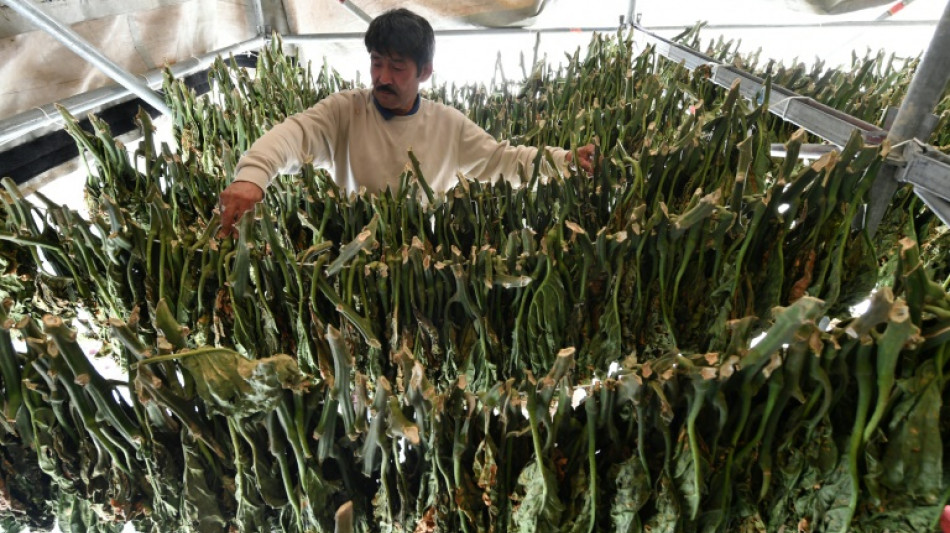
Nasvay: The chewing tobacco poisoning Kyrgyzstan / Photo: © AFP

 No lights, no friends: Cuban youth grapple with loneliness

 Saudi coalition strikes Yemen oil sites after Houthi attacks

 French economy minister denies country caught in debt 'snowball'

 Judge extends halt to Trump's golf course tree-cutting

 Milan's Saelemaekers set for lenghty spell out after ankle surgery

 Nvidia says to invest in French medical website

 Real Madrid's Mourinho has 'trust' in referees despite complaints

 Mendis, Shanaka star in Sri Lanka consolation T20I win

 Demonstrations backing France's protesting students gather strength

 Trump says US Senate as hard to defend as House in midterms

 Suspected Russian drones hit two ships off Bulgaria, 11 missing

 Tech stocks slide on AI jitters

 Trump asks Greece ambassador to resign amid ethics scandal

 New White House spokeswoman heavy on Trump praise, light on questions in debut

 Emery urges Villa to make most of reduced home comfort

 Flavio Bolsonaro visits father under house arrest ahead of Brazil runoff

 France, Eq. Guinea in standoff over luxury Paris mansion

 'Holding our ground': Israel demolishes dozens of Bedouin homes

 Hazlewood takes six as Australia beat South Africa in 1st Test

 Saudi coalition tells Sanaa residents to flee site before operation

 Zverev defies 'physical issues' to reach Shanghai Masters quarter-finals

 'We're not giving up': Activist Thunberg joins France student protests

 Man City captain Dias defends celebrations after Liverpool win

 B2PRIME Expands Tier-1 Access and Liquidity Architecture for Sophisticated Institutional Flow

 STARTRADER Adds 48 US Stock CFDs with 24-Hour Weekday Trading

Farmer Askarbek Duisheyev pours a small plastic bottle into the palm of his hand and tips some green balls under his tongue.
This is nasvay, a type of toxic chewing tobacco hugely popular in Central Asia that is a key part of the fragile economy of impoverished southern Kyrgyzstan.
"I've been growing tobacco to make nasvay for the past two years. What else is there to do? There's no work in the Batken region," Duisheyev, 59, told AFP.
"I have to earn money and feed my family," he said, as he cut tobacco leaves with a sickle in the village of Kara-Bulak, not far from the Tajik border.
Batken province is the poorest in the former Soviet republic, with nearly half the population living below the poverty line of 540 euros ($570) a year.
Surviving often means either leaving to work in Russia or growing tobacco to make nasvay.
The unregulated production of this addictive and cancerogenic product supports a third of the population according to the campaign group "Kyrgyzstan Without Tobacco".
- Mysterious recipe -
At the start of autumn, barns in Batken are filled with drying tobacco leaves.
Since he does not have enough space of his own, Duisheyev rents storage from a neighbour who has left to work in Russia like millions of Kyrgyz.
"You can't stay (inside) too long. The smell is overpowering," he warned.
After being dried, crushed and mixed in with mysterious ingredients -- usually lime, oil or even poultry droppings -- the tobacco becomes nasvay, which users slip between their gums and lips.
"The secret is simply mixing three or four ingredients," said nasvay producer Israil Khakimov.
But chewing the altered tobacco can lead to a long list of health problems.
"Consumption of nasvay can lead to gastrointestinal, oral and liver diseases, as well as cancer of the lips, throats and stomach," said Saipidin Toroyev, a cancer specialist at Batken hospital.
"Nasvay is dangerous because, as it is placed in the mouth, the saliva brings particles down to the stomach and into the blood stream, causing damage to the whole body," he told AFP, also pointing to its psychotropic and addictive effects.
Cheaper than cigarettes, consumption has shot up in recent years among both men and women, according to the health ministry.
- 'Had to find another job' -
Working out the number of users is tough since nasvay is part of the black economy.
And politicians are torn over whether to eradicate a public health hazard or turn a blind eye to an industry that supports a farming region suffering from water shortages and frequent cross-border conflicts with neighbouring Tajikistan.
Alisher Seidakmatov, who is in charge of agricultural development for the Batken region, told AFP that it is "also profitable to grow fruit and vegetables".
That view is not shared by producers.
"I had to grow tobacco because my salary was insufficient and I would not earn the same growing potatoes," said Duisheyev.
His salary as a forest ranger was just 10,000 soms (100 euros) per month.
"I had to find another job," he said.
With his relatively modest production of around half a tonne of nasvay, he was able to earn his annual forest ranger salary with one harvest.
The nasvay ends up being sold in 50-kilo sacks on Saturdays in the regional capital at a busy tobacco market crowded with trucks and vans.
A buyer comes up to Dzhunusali Seidakmatov's stall, picks up a fistful of tobacco, rubs it and breathes in.
Negotiations begin, but the two fail to strike a deal.
"He wanted me to sell it to him for 445 soms per kilo. I was expecting 450 soms," said the seller, who wore a traditional Kyrgyz white felt halt.
"It's not a problem. I've already sold more than 80 kilos," he said.
C.Meier--BTB