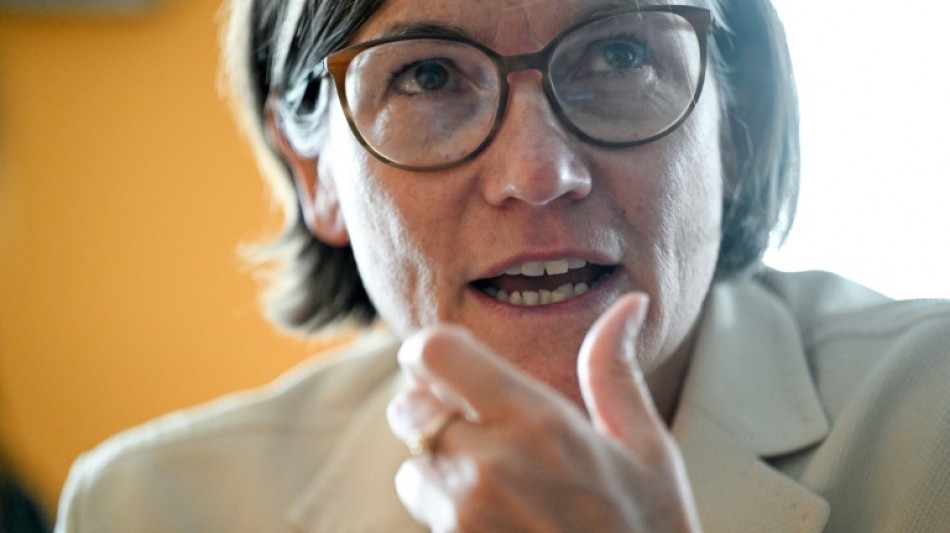
Christiane Benner, first woman to lead Germany's biggest union / Photo: © AFP

 Bybit Expands Beyond Crypto as CEO Outlines Next Phase of Financial Platform

 Bayern held by Viking after 'super dumb' Olise red in Champions League

 Why AI makes computer worms harder to stop

 US fines Bank of America $1.2 bn for anti-money laundering violations

 Bayern held by Viking after Olise sees red in Champions League

 Atletico down Carrick's struggling Man United

 Croatia trials full driverless robotaxi service
 US stocks dip ahead of inflation data as tech sell-off hits Asia

 No lights, no friends: Cuban youth grapple with loneliness
 Saudi coalition strikes Yemen oil sites after Houthi attacks

 French economy minister denies country caught in debt 'snowball'

 Judge extends halt to Trump's golf course tree-cutting

 Milan's Saelemaekers set for lenghty spell out after ankle surgery
 Nvidia says to invest in French medical website
 Real Madrid's Mourinho has 'trust' in referees despite complaints

 Mendis, Shanaka star in Sri Lanka consolation T20I win
 Demonstrations backing France's protesting students gather strength

 Trump says US Senate as hard to defend as House in midterms
 Suspected Russian drones hit two ships off Bulgaria, 11 missing
 Tech stocks slide on AI jitters

 Trump asks Greece ambassador to resign amid ethics scandal

 New White House spokeswoman heavy on Trump praise, light on questions in debut

 Emery urges Villa to make most of reduced home comfort
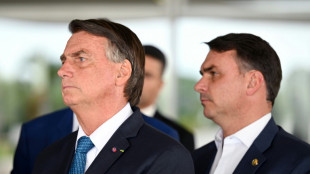 Flavio Bolsonaro visits father under house arrest ahead of Brazil runoff

 France, Eq. Guinea in standoff over luxury Paris mansion

Christiane Benner will become the first woman to lead Germany's biggest union when she takes the helm at IG Metall next week. But the milestone comes as the once mighty industrial sector battles a series of crises.
Soaring energy costs due to Russia's war in Ukraine, high inflation and weaker demand from key trade partner China have culminated in a manufacturing slump that has raised fears about Germany's future as an industrial powerhouse and export champion.
Benner's appointment is set to be confirmed at an IG Metall congress on Monday.
As she prepares to go to bat for IG Metall's more than two million members in sectors including the automotive, machine tool and electrical industries, Benner is clear about her priorities.
"The most important thing is keeping industry in Germany and Europe," she told AFP in an interview in her Frankfurt office.
Asked why it took so long for IG Metall, founded in 1949, to install a woman at the top, Benner chuckled.
"Ask the men!" smiled the bespectacled 55-year-old.
Benner has been a member of IG Metall since her early 20s after starting work as a foreign-language secretary at a mechanical engineering firm.
After taking time out to study sociology, she rose through the ranks at IG Metall and became the union's vice president in 2015.
Eighty percent of IG Metall's members are men.
- Deindustrialisation fears -
A work and study stint in the United States in the 1990s opened her eyes to the "weakness" of American unions, Benner recalled.
The contrast with Germany was stark, where the model of co-determination gives labour representatives a significant say in workplace decisions.
As Germany's most powerful trade union and the largest in Europe, Benner is well aware of IG Metall's influence.
"We're strong," she said.
IG Metall flexed its muscles last year and won an 8.5-percent wage increase over two years to help compensate for inflation, a benchmark deal covering around four million workers across several sectors.
Even more daunting challenges lie ahead, as Germany's long-vaunted economic model is called into question and an end-of-year recession looms.
Companies in Germany's energy-intensive industries are already weighing whether to shift production to cheaper shores, a problem compounded by the lure of US green subsidies through Washington's Inflation Reduction Act, Benner said.
"We're seeing a creeping dismantling of industry and jobs," she warned.
To prevent a dreaded "deindustrialisation" of Europe's biggest economy, Benner is in favour of discounted electricity prices for industrial firms.
The proposed subsidy has been a topic of fierce debate within Germany's coalition government in recent months.
But Chancellor Olaf Scholz, who like Benner is a member of the centre-left Social Democrats, has yet to back the idea, fearing it could slow the transition towards renewable energies.
- Retaining talent -
Adding to Germany's woes are long-running structural problems such as a shortage of skilled workers in an aging country, and foot-dragging on digitisation.
More than 2.6 million young adults in Germany under the age of 35 have no vocational qualification, despite a growing need for highly qualified employees as new technologies transform businesses.
IG Metall was working hard to increase the number of apprenticeships and make on-the-job training more attractive, Benner said.
Hoping to make heavy industry a more appealing career choice, Benner also advocates a better work-life balance and supports a four-day work week for those who want it.
She also wants to narrow the gender pay gap in a country where men still earn seven percent more than women doing the same job.
But first up on her to-do list will be next month's wage negotiations with steel bosses.
Benner will be pushing for a similar 8.5-percent salary bump for the sector and a reduction in working hours from 35 to 32 hours a week, without loss of pay.
K.Brown--BTB