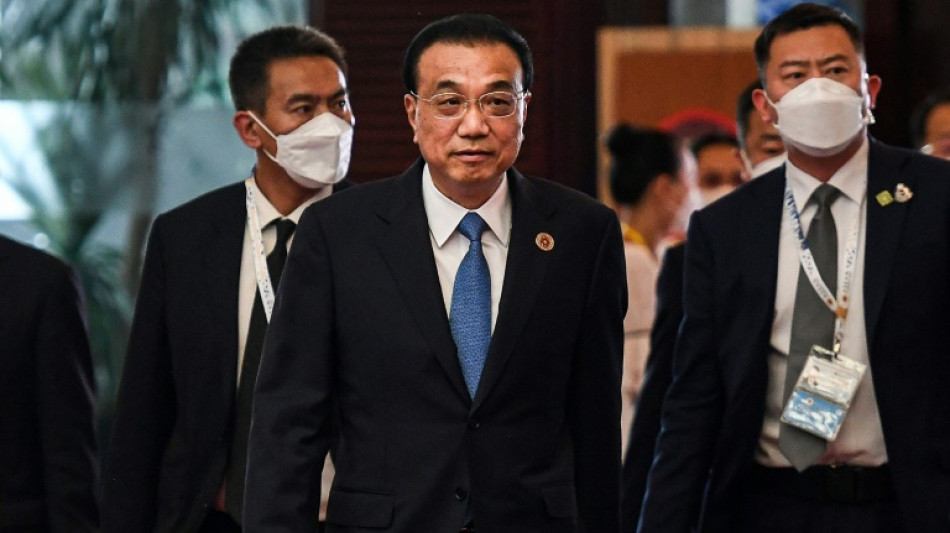
Former Chinese premier Li Keqiang dies at 68 / Photo: © AFP/File

 Bybit Expands Beyond Crypto as CEO Outlines Next Phase of Financial Platform

 Bayern held by Viking after 'super dumb' Olise red in Champions League

 Why AI makes computer worms harder to stop

 US fines Bank of America $1.2 bn for anti-money laundering violations

 Bayern held by Viking after Olise sees red in Champions League

 Atletico down Carrick's struggling Man United
 Croatia trials full driverless robotaxi service
 US stocks dip ahead of inflation data as tech sell-off hits Asia

 No lights, no friends: Cuban youth grapple with loneliness

 Saudi coalition strikes Yemen oil sites after Houthi attacks

 French economy minister denies country caught in debt 'snowball'

 Judge extends halt to Trump's golf course tree-cutting

 Milan's Saelemaekers set for lenghty spell out after ankle surgery
 Nvidia says to invest in French medical website

 Real Madrid's Mourinho has 'trust' in referees despite complaints

 Mendis, Shanaka star in Sri Lanka consolation T20I win

 Demonstrations backing France's protesting students gather strength

 Trump says US Senate as hard to defend as House in midterms

 Suspected Russian drones hit two ships off Bulgaria, 11 missing

 Tech stocks slide on AI jitters

 Trump asks Greece ambassador to resign amid ethics scandal

 New White House spokeswoman heavy on Trump praise, light on questions in debut

 Emery urges Villa to make most of reduced home comfort

 Flavio Bolsonaro visits father under house arrest ahead of Brazil runoff

 France, Eq. Guinea in standoff over luxury Paris mansion

Former Chinese premier Li Keqiang, a reform-minded bureaucrat once tipped as the country's future leader only to be eclipsed by President Xi Jinping, died Friday. He was 68.
He had a heart attack on Thursday and passed away in Shanghai just after midnight, state-run news agency Xinhua said.
During his 10-year tenure as premier under Xi, Li cultivated an image as a more modern Communist Party loyalist compared to his stiffer colleagues.
A career bureaucrat who spoke fluent English, he voiced support for economic reforms during his time in office.
The son of a minor party official in eastern China's poor Anhui province, Li was sent to the countryside to work as a manual labourer during the tumultuous Cultural Revolution of 1966 to 1976.
He went on to gain a law degree from Peking University, where classmates say he embraced Western and liberal political theory, translating a book on the law by a British judge.
But he became more orthodox after joining the ranks of officialdom in the mid-1980s, working as a bureaucrat while his former classmates protested in Tiananmen Square in 1989.
Li rose to become the ruling Communist Party's top official in Henan province, and in Liaoning in the northeast -- both of which saw economic growth.
But his reputation was damaged by his handling of an HIV/AIDS epidemic stemming from a tainted blood donation programme while he was party boss in Henan.
Later, Li was promoted to become a deputy to then-premier Wen Jiabao.
His attempts at tackling China's deep economic challenges were curtailed by the overwhelming authority of Xi, with whom he was once seen as a rival for the country's leadership.
Praised for helping to steer the country through the global financial crisis relatively unscathed, his time in office saw a dramatic shift in power in China from the more consensus-based rule associated with former leader Hu Jintao and his predecessors, to the more concentrated power of Xi.
"People always debated whether (China's) institutions would... determine the outcomes, as opposed to just raw power," Victor Shih, an expert on China's elite politics at the University of California San Diego, told AFP.
"And of course, recent events show that raw power still matters more."
- 'Derailed agenda' -
Li's tenure also saw China's economy begin to slow from the dizzying heights experienced in the 1990s and 2000s.
"He always struck me as very committed to China's development, intellectually curious, with a highly sophisticated understanding of the Chinese economy," Bert Hofman, director of the East Asian Institute at the National University of Singapore, told AFP.
"Events derailed some of his agenda in the past 10 years, but his thinking is still very much relevant today."
Former Peking University classmate Guoguang Wu, now a senior research scholar at Stanford, told AFP that Li "was someone with an ability for independent thought" during their time together.
"Afterwards, he became a government official, and this ability seemed to disappear," he said.
"I don't believe he has left a political legacy. History will soon forget him."
When Li left office, the country was experiencing some of its lowest growth in decades, battered by a Covid-induced slowdown and a crisis in the housing market.
The appointment of Xi ally Li Qiang -- a former Shanghai party boss -- as his successor this year was seen as a sign that his reformist agenda had fallen by the wayside as Beijing tightens its grip over its slowing economy.
But in his final speech as outgoing premier, Li struck a bullish tone, saying China's economy was "staging a steady recovery and demonstrating vast potential and momentum for further growth".
"Overcoming great difficulties and challenges, we succeeded in maintaining overall stable economic performance."
A.Gasser--BTB