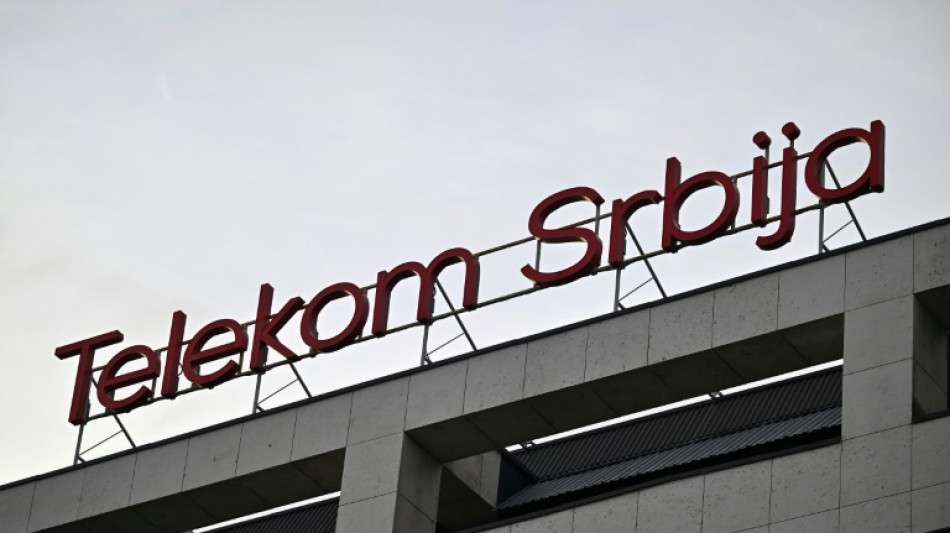
Fears grow of tighter state grip on Serbian media / Photo: © AFP

 Saudi employee arrested for allegedly bugging OpenAI office
 Atletico sink Man Utd as Viking deny Bayern in Champions League

 Man United's Martinez blasts board's lack of investment
 Meet A7 International, an Innovative Global Platform Designed to Reinvent the International Payments Market

 Shakhtar hope London move a reminder of Ukraine conflict

 Tresoldi hat-trick fires Brugge past Inter Milan

 Rams axe kicker Mevis after misses cost victory over Bills: reports

 Yamal stays cool at boiling Galatasaray to lift Barcelona to victory

 Arsenal cruise past Lille into share of Champions League lead

 Trump ousts Greece ambassador over ethics scandal
 Reese Witherspoon, France's Mediawan to buy Hello Sunshine

 Bipartisan US senators urge Trump to scrap Russian diesel deal
 Ex-gang leader sentenced to minimum 40 years for Tupac murder
 Cornell suspends frat parties after alleged gang rape

 Man City deserve to keep titles, says PSG's Luis Enrique

 Regulator 'will resign' if any political interference in Man City case

 Microsoft's Brad Smith calls for 'real and effective' AI safety standards
 Anthropic warns of AI 'worms' spreading across smart gadgets
 Big US banks report strong earnings and stay bullish on AI
 Iraola backs Barcola, Wirtz to come good for Liverpool
 In a first, AI helps UK lawmaker find her voice in parliament

 Pope Leo in Rome hospital for lung operation
 EU watchdog says smart glasses must give 'clear warnings' when recording
 Houthis say Saudi Arabia strikes oil site in Yemen's capital
 France roiled by marches in support of protesting students

Two controversial bills backed by Serbian lawmakers this week have sparked fears of more state control over the media and another setback for press freedom in the Balkan nation.
Parliament approved a law on public information and the media as well as another on electronic media on Thursday.
If President Aleksandar Vucic signs the legislation into law, it will notably enable state-owned telecoms provider Telekom Srbija to acquire media outlets -- something that was prohibited up to now.
The votes raise "fears of state influence and state pressure" on the media, the president of the European Federation of Journalists, Maja Sever, told AFP.
The intention of the authorities is to "legalise the role of the state... in (the) media market", opposition MP Robert Kozma, of the Green-Left Front party, told AFP after the vote.
"And that means only one thing -- the spread of media darkness," he said.
The information and communications ministry called the adoption of the two laws an "important step towards the further improvement of the media scene in Serbia".
The government said earlier this month that the new laws guaranteed freedom of opinion, expression and press "in line with the highest international standards".
- 'Dominant market position' -
Telekom Srbija is the largest telecommunications operator in the country with nearly 53 percent of users, official figures show.
But it does not offer the independent N1 or Nova S television channels.
The European Parliament in May voiced concern about the "dominant market position of Telekom Srbija, where the majority stakeholder is the state".
It also noted allegations "that the ruling party is using it to increase its influence over the media market in Serbia".
By allowing Telekom Srbija to establish and buy media outlets, Serbia, which aspires to join the European Union, has shown it still "selectively accepts European values and principles", said the Independent Journalists' Association of Serbia (NUNS).
Opponents to Vucic, whose conservative Serbian Progressive Party dominates parliament, have accused him of relying on harsh measures to keep the opposition in disarray and media outlets under his thumb.
From September to mid-October, Vucic occupied 39 percent of primetime political news programmes on national television and N1, according to BIROD, a social research think thank.
In its final report on Serbia's April 2022 general elections, the Organization for Security and Cooperation in Europe noted that the public media provided "uncritical" news coverage.
Private TV channels with national coverage "allocated some 90 percent of coverage in news programmes to the president and government officials", it added.
- Inefficient regulator -
One of the most controversial points of the two bills relates to the Regulatory Authority for Electronic Media (REM), which is responsible for media monitoring.
The European Parliament has urged the Serbian government to ensure the body's independence.
But the two bills did not "oblige the REM to monitor whether the president... and other officials appear in the most-watched media during the (election) campaign and inform people about it", NUNS said after the vote.
Last year, the regulatory body awarded all four national frequencies, for an eight-year period, to the "same television channels as in the previous period", the European Commission said in an October 2022 report on Serbia.
All of those channels had received warnings from the REM due to "violation of their legal obligations", it added.
And since the bills do not oblige the REM to act upon viewers' complaints, it can "continue to turn a blind eye to violations of all the rules of the profession and the spread of violence in interest of the big media", NUNS warned.
Serbia ranked 91st in the 2023 World Press Freedom Index published by Reporters Without Borders, down from 79th last year.
Y.Bouchard--BTB