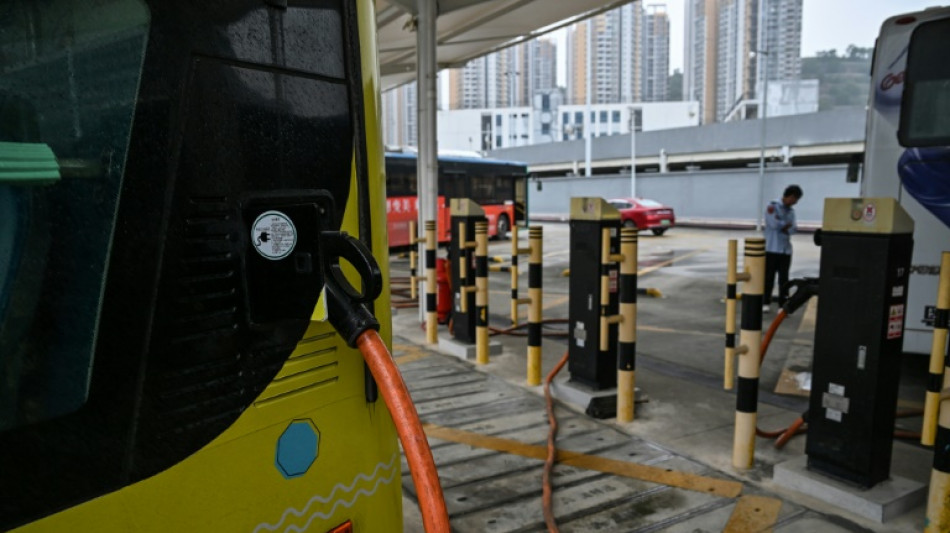
China's electric bus revolution glides on / Photo: © AFP

 Saudi employee arrested for allegedly bugging OpenAI office
 Atletico sink Man Utd as Viking deny Bayern in Champions League

 Man United's Martinez blasts board's lack of investment

 Meet A7 International, an Innovative Global Platform Designed to Reinvent the International Payments Market

 Shakhtar hope London move a reminder of Ukraine conflict
 Tresoldi hat-trick fires Brugge past Inter Milan

 Rams axe kicker Mevis after misses cost victory over Bills: reports

 Yamal stays cool at boiling Galatasaray to lift Barcelona to victory

 Arsenal cruise past Lille into share of Champions League lead
 Trump ousts Greece ambassador over ethics scandal

 Reese Witherspoon, France's Mediawan to buy Hello Sunshine

 Bipartisan US senators urge Trump to scrap Russian diesel deal
 Ex-gang leader sentenced to minimum 40 years for Tupac murder

 Cornell suspends frat parties after alleged gang rape

 Man City deserve to keep titles, says PSG's Luis Enrique

 Regulator 'will resign' if any political interference in Man City case

 Microsoft's Brad Smith calls for 'real and effective' AI safety standards

 Anthropic warns of AI 'worms' spreading across smart gadgets

 Big US banks report strong earnings and stay bullish on AI

 Iraola backs Barcola, Wirtz to come good for Liverpool
 In a first, AI helps UK lawmaker find her voice in parliament

 Pope Leo in Rome hospital for lung operation

 EU watchdog says smart glasses must give 'clear warnings' when recording

 Houthis say Saudi Arabia strikes oil site in Yemen's capital

 France roiled by marches in support of protesting students

On a rainy afternoon in Shenzhen, damp passengers jostle their way onto the megacity's buses, the quiet foot soldiers of an electric revolution for coal-guzzling China's public transport network.
Shenzhen ditched diesel buses and went fully electric in 2017 -- a world first -- with its taxi fleet not far behind.
Other Chinese cities have since followed suit, with many aiming to fully switch their systems before 2025.
"Electrification is one of the most important strategies" for reaching net-zero carbon emissions by 2050, according to the International Energy Agency (IEA), with bus decarbonisation representing around five percent of cumulative emissions reductions in transport.
But so far China is an outlier, accounting for over 90 percent of the world's electric buses and trucks in 2021, according to the International Council on Clean Transportation (ICCT).
"It didn't happen in a night," EV specialist Elliot Richards told AFP.
"It was many years of planning and huge amounts of infrastructure work. But it's made such a huge difference in terms of global awareness."
Wrangling over the path to a net-zero future will be at the heart of the United Nations' upcoming COP28 climate summit in oil-producer Dubai, which begins in late November.
So far though, budget and planning constraints, a lack of knowledge and the difficulty of rejigging infrastructure in older cities have prevented others from replicating China's experience, Richards said.
- Step-by-step -
At a Shenzhen bus depot, driver Ou Zhenjian told AFP he had been ferrying passengers around the city for 18 years and saw a "big difference" with the shift to electric.
"It is really comfortable to drive... easy to operate, and environmentally friendly. It's soundless too -- it's great to drive like this."
"At the beginning of the service, we had to step-by-step solve problems," Ethan Ma, deputy general manager of the Shenzhen Bus Group (SZBG), told AFP.
"Now we can say we almost have the same technical performance of our e-buses compared to diesel buses in the past."
There have been other, more obvious benefits.
For a huge metropolis crisscrossed by four-to-five lane avenues, traffic noise is noticeably subdued.
"(Diesel buses) emitted a lot of exhaust... Especially when walking on the road, the smell made me very uncomfortable, but now it's gone," a young male passenger told AFP as the bus purred through the city.
- 'Political will' -
A World Bank case study on SZBG, the city's largest public transport operator, found emissions from an e-bus over its service time were 52 percent that of a diesel bus.
The analysis takes into account the fact that the local grid generates about half its electricity from coal, and found the switch had saved 194,000 tonnes of carbon dioxide annually.
Pollution in Chinese cities was a major factor pushing the central government to prioritise the switch in public transport, said Tu Le, managing director of Sino Auto Insights.
And that top-down directive was key, with the World Bank noting transition "not only depends on technology but also political will".
"They were thinking about this way before any other country was even considering it," said Le.
Strong government financial support and close collaboration with automaker BYD -- then a fledgling, now a giant in the global EV field -- greatly contributed to success in Shenzhen.
By 2021 China supplied more than 90 percent of the world's e-buses, according to the ICCT.
The changes are already having a measurable effect.
In September, the IEA chief said the growth of electric vehicles globally -- especially in China -- meant oil demand was on course to peak before 2030, and coal "in the next few years".
- Coal-sourced electricity -
However, China remains the world's largest emitter, with the IEA predicting it will account for 45 percent of the global total from now until 2050, and the country relies on coal for nearly 60 percent of its electricity.
Last year, Beijing approved the largest expansion of coal-fired power plants since 2015, despite President Xi Jinping pledging to peak CO2 emissions between 2026 and 2030.
China is investing heavily in renewable energy, but "they need the coal to cover the gaps in the grid for the time being", said Richards.
"Even 100 percent coal-fired power (for EV charging) wins over gasoline though" in terms of emissions, said David Fishman, energy consultant at The Lantau Group.
For SZBG's Ma, the switch to electric has given the company a new outlook.
"We don't consider ourselves anymore as a pure bus operator, but a new energy service operator or provider," he said.
Bus systems in 10 other cities in Guangdong province are now fully electric, as is the eastern city of Hangzhou's.
And over 90 percent of the bus systems in major cities like Beijing and Shanghai have made the switch.
Less developed power grids and charging infrastructure, as well as maintenance issues, have slowed progress in smaller cities, said Sino Auto Insights' Le.
Still, he predicts seeing "a high percentage -- in the 70s -- of the whole country's networks electrified by 2030, no problem".
I.Meyer--BTB