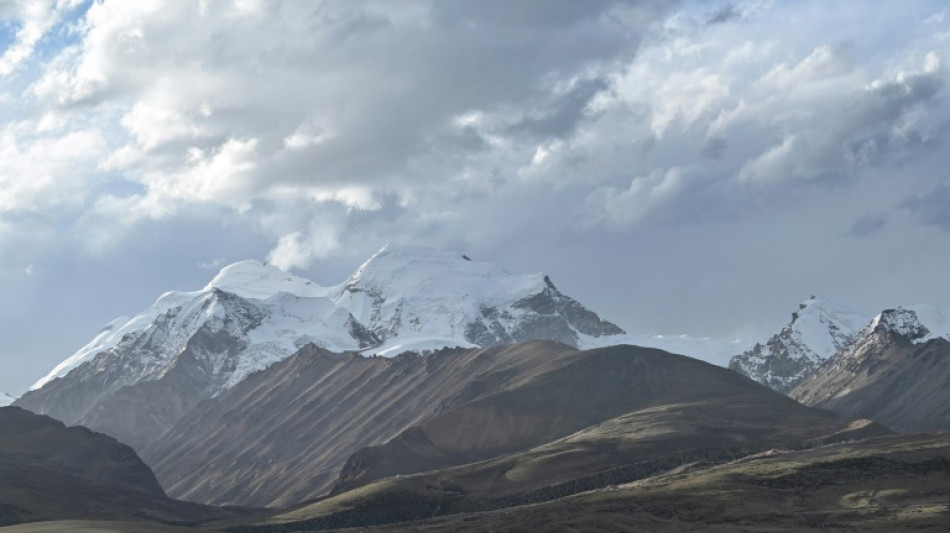
China lithium boom harming fragile Tibetan plateau: report / Photo: © AFP/File

 Saudi employee arrested for allegedly bugging OpenAI office
 Atletico sink Man Utd as Viking deny Bayern in Champions League
 Man United's Martinez blasts board's lack of investment

 Meet A7 International, an Innovative Global Platform Designed to Reinvent the International Payments Market

 Shakhtar hope London move a reminder of Ukraine conflict

 Tresoldi hat-trick fires Brugge past Inter Milan

 Rams axe kicker Mevis after misses cost victory over Bills: reports

 Yamal stays cool at boiling Galatasaray to lift Barcelona to victory

 Arsenal cruise past Lille into share of Champions League lead
 Trump ousts Greece ambassador over ethics scandal

 Reese Witherspoon, France's Mediawan to buy Hello Sunshine
 Bipartisan US senators urge Trump to scrap Russian diesel deal
 Ex-gang leader sentenced to minimum 40 years for Tupac murder

 Cornell suspends frat parties after alleged gang rape

 Man City deserve to keep titles, says PSG's Luis Enrique

 Regulator 'will resign' if any political interference in Man City case

 Microsoft's Brad Smith calls for 'real and effective' AI safety standards

 Anthropic warns of AI 'worms' spreading across smart gadgets

 Big US banks report strong earnings and stay bullish on AI

 Iraola backs Barcola, Wirtz to come good for Liverpool
 In a first, AI helps UK lawmaker find her voice in parliament

 Pope Leo in Rome hospital for lung operation

 EU watchdog says smart glasses must give 'clear warnings' when recording

 Houthis say Saudi Arabia strikes oil site in Yemen's capital

 France roiled by marches in support of protesting students

China's booming electric vehicle industry is fuelling a lithium rush in the Tibetan plateau that risks damaging the troubled region's fragile ecology and deepening rights violations, research published Wednesday said.
China is the world's biggest EV market but largely relies on other countries to supply the lithium used in the batteries that power low-carbon vehicles.
That is set to change as Beijing begins to exploit vast deposits on the Tibetan plateau -- around 85 percent of the country's total lithium reserves.
But this "white gold rush" has led to Chinese miners polluting the local environment with "quick, cheap and dirty" extraction and processing techniques, according to the report by Turquoise Roof, a network of Tibetan researchers.
The group used satellite data and public resources to chart the impact of lithium mining in culturally Tibetan areas and its links to carmakers, including Elon Musk's Tesla and its Chinese competitor BYD.
Those firms, it said, are "increasingly reliant on Tibet's lithium exploitation".
"Bigger, faster electric cars require larger capacity lithium batteries -- which cannot be done without a hidden footprint in Tibet," it said.
Citing Chinese geological research, Turquoise Roof said about 3.6 million tons of China's lithium lies in hard rock deposits in Tibet and the adjacent provinces of Sichuan and Qinghai.
Miners exploiting those resources risk creating "devastating" pollution in biodiverse regions particularly vulnerable to climate change, the report says.
It pointed to a mine in Sichuan whose activities reportedly killed thousands of fish in a local river and harmed grasslands home to Tibetan herders.
"Tibetans have no voice in this latest rush to riches... there can be no informed local consideration of whether there should be extraction," it says.
In one example, the report cites a patch of land in a Tibetan autonomous county in Sichuan province found to have rich lithium deposits that sparked a bidding war between firms, eventually won by Chinese battery giant CATL.
But local Tibetans, it said, "were not informed that their hill pastures were being sold, let alone consulted in any way about the land being drilled beneath their feet."
Tibet has alternated over the centuries between independence and control by China, which says it has brought infrastructure and education since taking over the region in 1951.
But many exiled Tibetans accuse China's ruling Communist Party of repression, torture and eroding their culture, with rights groups and some Western governments backing their claims.
About a million Tibetan children have been separated from their families and put through "forced assimilation" at Chinese residential schools, UN experts have said.
Wednesday's report comes as China seeks to shore up domestic supplies of critical minerals in the face of fraying ties with Western exporters.
Beijing imposed curbs on the graphite used to make EV batteries after the United States restricted outflows of high-tech microchips to China.
The European Union has also angered China by launching a probe into Beijing's subsidies for its homegrown EVs.
T.Bondarenko--BTB