The tech to recycle clothes is only just being invented / Photo: © AFP

 Saudi employee arrested for allegedly bugging OpenAI office

 Atletico sink Man Utd as Viking deny Bayern in Champions League

 Man United's Martinez blasts board's lack of investment

 Meet A7 International, an Innovative Global Platform Designed to Reinvent the International Payments Market

 Shakhtar hope London move a reminder of Ukraine conflict

 Tresoldi hat-trick fires Brugge past Inter Milan

 Rams axe kicker Mevis after misses cost victory over Bills: reports

 Yamal stays cool at boiling Galatasaray to lift Barcelona to victory
 Arsenal cruise past Lille into share of Champions League lead

 Trump ousts Greece ambassador over ethics scandal

 Reese Witherspoon, France's Mediawan to buy Hello Sunshine

 Bipartisan US senators urge Trump to scrap Russian diesel deal

 Ex-gang leader sentenced to minimum 40 years for Tupac murder

 Cornell suspends frat parties after alleged gang rape

 Man City deserve to keep titles, says PSG's Luis Enrique

 Regulator 'will resign' if any political interference in Man City case

 Microsoft's Brad Smith calls for 'real and effective' AI safety standards

 Anthropic warns of AI 'worms' spreading across smart gadgets

 Big US banks report strong earnings and stay bullish on AI

 Iraola backs Barcola, Wirtz to come good for Liverpool
 In a first, AI helps UK lawmaker find her voice in parliament

 Pope Leo in Rome hospital for lung operation

 EU watchdog says smart glasses must give 'clear warnings' when recording

 Houthis say Saudi Arabia strikes oil site in Yemen's capital

 France roiled by marches in support of protesting students

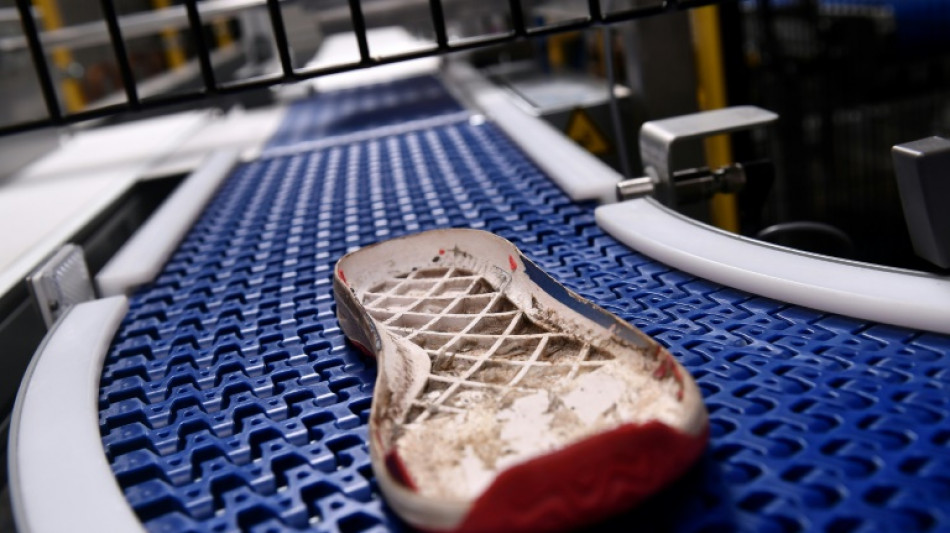
The vast waste and pollution caused by the fashion industry has made recycling clothes a top priority, but only now are simple tasks like pulling the sole off a shoe being done by machines.
CETIA, a company in the southwest of France is finally offering some mechanical solutions to the challenges of recycling clothes.
Its research team has invented a machine that uses artificial intelligence to scan garments, identify hard elements like zippers and buttons, and use a laser to cut them out.
It has also built a machine that grabs shoes in a large mechanical arm and yanks off the soles.
In a world of space travel and vaccines, that may seem a relatively rudimentary piece of technology, but it had simply never been done before.
"It was a chicken and egg question. No one was recycling soles because we couldn't separate them from the shoe, and no one was separating them because there was no recycling," said Chloe Salmon Legagneur, director of CETIA.
Previously, recyclers had to bake the shoes for many hours to melt the glue and then pull the sole off by hand.
"There's nothing spectacular in what we've done," Legagneur said.
"But we've done it."
For now, barely one percent of textiles in Europe are turned back into new clothes.
Most end up as housing insulation, padding or asphalt for paving roads.
That is because clothes are usually a complex mix of materials that must be separated carefully to keep the fibres in good condition if there is any hope of respinning them into new garments.
Usually done by hand, CETIA says its AI-laser machine can do this at a much faster rate that is rapidly evolving as it perfects the technology.
It also has machines that can sort clothes by colour and composition at a rate of one per second.
- Incentives -
The reason these inventions are finally emerging is that tough new European rules are imminent that will force clothing companies to use a set amount of recycled fibres in their garments.
CETIA's work is backed by big retailers like Decathlon and Zalando who are urgently looking for industrial-scale solutions.
There are also political incentives.
The French government sees the potential for new manufacturing jobs if recycling technology allows it to deal with some of the 200,000 tonnes of textile waste currently being shipped abroad each year.
CETIA's focus is on preparing textiles for reuse. Other companies must now start melting down the separated soles and turning them into new ones.
But it is an important first step.
"As long as we do not have systems to prepare materials for recycling, we will not have a recycling sector in France," said Veronique Allaire-Spitzer, of Refashion, which coordinates waste management.
It injected 900,000 euros into Cetia with a similar contribution from the regional government.
"None of this is a magic idea. It's just common sense," said Legagneur.
"But it's about putting together the engineers and the financing and the companies who need these solutions, and it's only now that these things are coming together. Ten years ago, no one wanted it."
F.Pavlenko--BTB