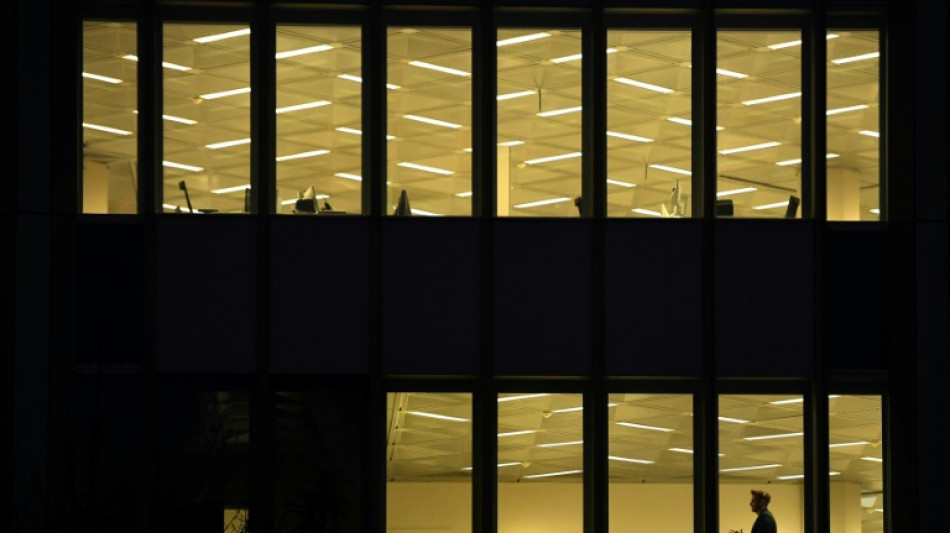
Europe's economic powerhouse tests a shorter working week / Photo: © AFP

 Saudi employee arrested for allegedly bugging OpenAI office

 Atletico sink Man Utd as Viking deny Bayern in Champions League

 Man United's Martinez blasts board's lack of investment

 Meet A7 International, an Innovative Global Platform Designed to Reinvent the International Payments Market

 Shakhtar hope London move a reminder of Ukraine conflict

 Tresoldi hat-trick fires Brugge past Inter Milan

 Rams axe kicker Mevis after misses cost victory over Bills: reports

 Yamal stays cool at boiling Galatasaray to lift Barcelona to victory

 Arsenal cruise past Lille into share of Champions League lead

 Trump ousts Greece ambassador over ethics scandal
 Reese Witherspoon, France's Mediawan to buy Hello Sunshine

 Bipartisan US senators urge Trump to scrap Russian diesel deal

 Ex-gang leader sentenced to minimum 40 years for Tupac murder
 Cornell suspends frat parties after alleged gang rape

 Man City deserve to keep titles, says PSG's Luis Enrique

 Regulator 'will resign' if any political interference in Man City case

 Microsoft's Brad Smith calls for 'real and effective' AI safety standards

 Anthropic warns of AI 'worms' spreading across smart gadgets

 Big US banks report strong earnings and stay bullish on AI

 Iraola backs Barcola, Wirtz to come good for Liverpool
 In a first, AI helps UK lawmaker find her voice in parliament

 Pope Leo in Rome hospital for lung operation
 EU watchdog says smart glasses must give 'clear warnings' when recording
 Houthis say Saudi Arabia strikes oil site in Yemen's capital

 France roiled by marches in support of protesting students

Maximilian Hermann's weekend starts on Friday morning, when he puts his motorcycle helmet on and takes his bike out for a ride to the southern German Alps.
Like all his colleagues, the 29-year-old project manager shifted to a four-day week at the beginning of the year and is making the most of it.
His new, shorter working hours are part of a trend that is gaining traction in Germany, where companies are looking to balance between worker shortages and the need to stay competitive.
Among the pioneers of the four-day week is Hermann's employer KlimaShop, a purveyor of heat pumps and air-conditioning systems based near Augsburg in southern Germany.
Instead of working 40 hours a week across five days, Hermann now spends a total of 38 hours at work over four working days.
Otherwise put, each of KlimaShop's 30 employees works an hour-and-a-half more for each day they are in the office, while having an extra day to themselves each week.
Hermann's colleague Michael Pankoke sees the shift switch as "big progress".
"You work much more intensely, everything you do is more precise," the 58-year-old customer advisor told AFP.
- Test run -
Management consultancy Intraprenoer is leading the first large-scale experiment with the shorter schedule in Germany together with the organisation 4 Day Week Global, which has already run similar trials in other countries, such as the United Kingdom.
Starting in 2024, up to 50 companies of varying size are set to test the new hours, with the aim of avoiding a drop-off in productivity.
Intraprenoer, which already "abolished Friday" for its workers in 2016, said it has 33 interested candidates for the trial.
But an increasing number of businesses in Europe's largest economy have already taken the leap.
Wolfgang Schmidt, the founder of a manufacturing business near Hamburg, in the north, said he flipped his staff onto a four-day week at the end of 2022 to save his employees, some of whom commute long distances, "fuel and money".
In nearby Wedel, the town administration has introduced a four-day week to attract more "competent and motivated" workers.
During the annual round of wage negotiations in the steel industry, starting in November, Germany's biggest union IG Metall will call for the introduction of a four-day week with hours reduced from 35 to 32, for the same pay.
Beyond a better work-life balance and increased productivity, the move would reduce "one of the highest rates of part-time employees of Europe", said Sophie Jaenicke, working time lead at IG Metall.
According to a study by the Hans-Boeckler foundation, fully 81 percent of Germans would support a shift to a four-day week.
- Lukewarm -
While in Belgium workers have had the right to ask for a four-day week with the same number of hours since the end of 2022, in Germany, workers and employers agree their own work times up to a maximum 48 hours a week.
Enthusiasm for the idea of a shorter week is lukewarm among many managers and economists, however. A 20 percent reduction in working hours would have "a disastrous economic impact", according to economist Holger Schaefer.
While "limiting unproductive activities and condensing work" is still feasible in the office, all the options for increasing productivity in industry have already been exhausted, said Schaefer from the IW economic institute in Cologne.
With the labour supply already stretched by the exit of the baby-boomer generation from the work force, cutting hours would lead "inevitably to a reduction in the amount of goods and services produced", he warned.
A shorter week was, in short, an "unrealistic dream", said Michael Huether, also of the IW economic institute in Cologne. Instead the solution to labour shortages would be longer, not shorter hours, he said.
B.Shevchenko--BTB