Italy's olive growers lament poor harvests from extreme weather / Photo: © AFP

 Deluge by design: Thai villages flooded to protect capital

 Ivan Deforge, the French 'bison tamer' in Moscow

 Indonesians on fire-ravaged island sue state for clean air

 Trump, White House post video of UK man killed by tiger
 Saudi employee arrested for allegedly bugging OpenAI office

 Atletico sink Man Utd as Viking deny Bayern in Champions League
 Man United's Martinez blasts board's lack of investment

 Meet A7 International, an Innovative Global Platform Designed to Reinvent the International Payments Market

 Shakhtar hope London move a reminder of Ukraine conflict

 Tresoldi hat-trick fires Brugge past Inter Milan

 Rams axe kicker Mevis after misses cost victory over Bills: reports

 Yamal stays cool at boiling Galatasaray to lift Barcelona to victory

 Arsenal cruise past Lille into share of Champions League lead

 Trump ousts Greece ambassador over ethics scandal

 Reese Witherspoon, France's Mediawan to buy Hello Sunshine

 Bipartisan US senators urge Trump to scrap Russian diesel deal

 Ex-gang leader sentenced to minimum 40 years for Tupac murder

 Cornell suspends frat parties after alleged gang rape

 Man City deserve to keep titles, says PSG's Luis Enrique

 Regulator 'will resign' if any political interference in Man City case

 Microsoft's Brad Smith calls for 'real and effective' AI safety standards

 Anthropic warns of AI 'worms' spreading across smart gadgets

 Big US banks report strong earnings and stay bullish on AI

 Iraola backs Barcola, Wirtz to come good for Liverpool

 In a first, AI helps UK lawmaker find her voice in parliament

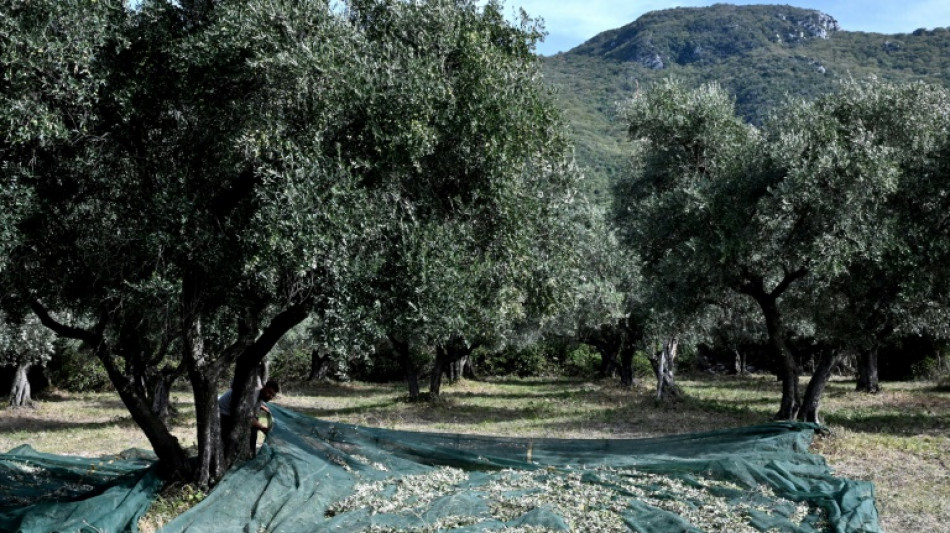
At this time of year, the trees on Alan Risolo's land in central Italy should be groaning with olives. But extreme weather blamed on climate change has ruined his harvest.
"Production has fallen by 80 percent," said the 43-year-old farmer from Sabina, north of Rome, despondently holding up a branch with only a few shrivelled green and black olives on it.
Known since Roman times for its olive groves, this region boasts trees said to be hundreds, even thousands, of years old.
But changing weather patterns are proving hugely challenging.
"For several years, our land has really suffered from climate change," Risolo told AFP, citing torrential rain contrasted with "long periods of heat lasting into the autumn".
Normally, he and his workers would be in coats for the autumn harvest, when they use electric devices to shake the trees so the fruit falls onto tarpaulins below.
Earlier this week they were collecting the olives while wearing T-shirts, as the thermostat hit 29 degrees Celsius (84 degrees Fahrenheit).
The cut in production has affected not just Sabina, but most of the central and northern regions of Italy, the world's second-largest producer of olive oil after Spain.
This year national production is estimated to be 290,000 tonnes, down from 315,000 in 2022 and the lowest figure in the last four years, according to agricultural association Coldiretti.
- More uncertain than ever -
When harvested, Risolo's olives go to the "OP Latium" mill, where they and others from the area are washed, sorted and then crushed into a greenish paste from which the precious extra virgin oil is extracted.
The smell is glorious, and the equipment is state-of-the-art. But all the technology in the world cannot squeeze oil from olives that don't exist.
Agronomist Stefano Cifeca, who is responsible for quality control on site, confirmed this year's meagre harvest.
"Unfortunately this year climate change meant that in April and May (the flowering months)... we had heavy rainfall that washed away the pollen," hindering fertilisation and the development of olives, he said.
Faced with increasingly hot summers and long periods without rain, Unaprol, the national association of olive oil producers, is calling for a national plan to help save water.
Cifeca backs this idea at a local level, urging the creation of basins to collect water in winter that can then be reused when drought hits.
Farmers here are used to tough times. In 2018, Risolo recalls, a frost wiped out his harvest.
But he warned that agriculture faces "a more uncertain future than ever, because we cannot accurately predict these changes in the climate".
- Saved by the south -
The stakes are high. Italy has 150 million olive trees representing three billion euros ($3.19 billion) in annual turnover and supporting 400,000 businesses, according to Coldiretti.
The risk is that some farmers switch to other crops, although Cifeca insists this is not yet necessary.
"Luckily the olive tree is a very robust plant that can adapt to changes in climate and different territories," he said.
Despite the poor performance in the centre and north, Italian production this year was saved by its southern regions, both Puglia -- which makes half of Italy's oil -- and Calabria.
Farmers have also been helped by rising prices in the global market for olive oil, as production in Spain, which normally produces half of the world's supply, has also suffered.
Production in Spain fell 34 percent compared to the average over the last four years, according to Coldiretti figures from September, due to a prolonged drought.
But the rising prices are bad news for consumers -- including in Italy, which consumes 15 percent of olive oil produced worldwide.
E.Schubert--BTB