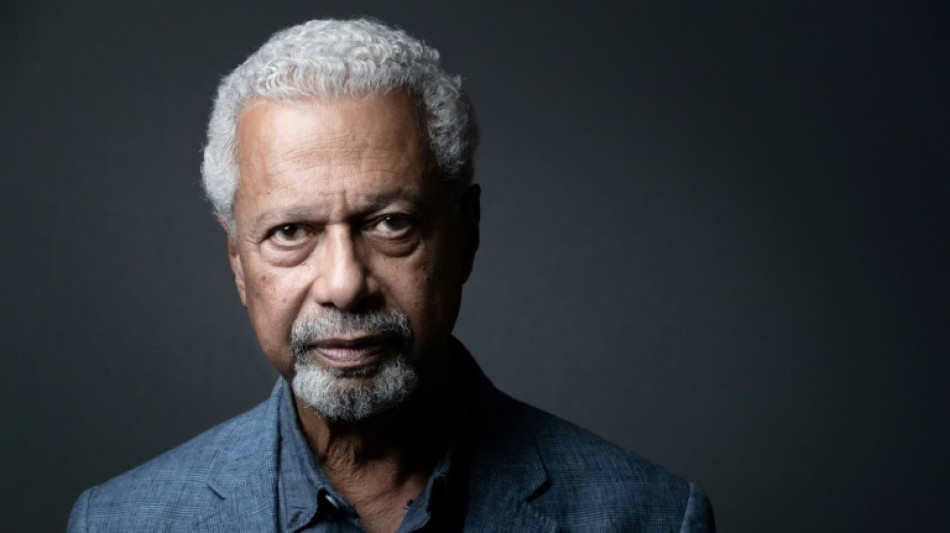
Nobel-winner Gurnah: UK imperial literature was openly racist / Photo: © AFP/File

 Deluge by design: Thai villages flooded to protect capital

 Ivan Deforge, the French 'bison tamer' in Moscow

 Indonesians on fire-ravaged island sue state for clean air

 Trump, White House post video of UK man killed by tiger

 Saudi employee arrested for allegedly bugging OpenAI office

 Atletico sink Man Utd as Viking deny Bayern in Champions League
 Man United's Martinez blasts board's lack of investment

 Meet A7 International, an Innovative Global Platform Designed to Reinvent the International Payments Market

 Shakhtar hope London move a reminder of Ukraine conflict

 Tresoldi hat-trick fires Brugge past Inter Milan

 Rams axe kicker Mevis after misses cost victory over Bills: reports

 Yamal stays cool at boiling Galatasaray to lift Barcelona to victory

 Arsenal cruise past Lille into share of Champions League lead

 Trump ousts Greece ambassador over ethics scandal

 Reese Witherspoon, France's Mediawan to buy Hello Sunshine

 Bipartisan US senators urge Trump to scrap Russian diesel deal

 Ex-gang leader sentenced to minimum 40 years for Tupac murder

 Cornell suspends frat parties after alleged gang rape

 Man City deserve to keep titles, says PSG's Luis Enrique

 Regulator 'will resign' if any political interference in Man City case

 Microsoft's Brad Smith calls for 'real and effective' AI safety standards

 Anthropic warns of AI 'worms' spreading across smart gadgets

 Big US banks report strong earnings and stay bullish on AI

 Iraola backs Barcola, Wirtz to come good for Liverpool
 In a first, AI helps UK lawmaker find her voice in parliament

Nobel-winning writer Abdulrazak Gurnah says removing offensive words from the likes of Agatha Christie is "futile", but says Britain did produce openly racist literature during the last century of its empire.
The British-Tanzanian author won the 2021 Nobel Prize for books such as "Paradise" and "Memory of Departure" exploring Europe's colonial legacy.
He is also a professor of English and post-colonial literature at Britain's University of Kent.
Asked by AFP about the recent trend of publishers rewriting books by Christie, Roald Dahl and James Bond author Ian Fleming to remove racist and other possibly offensive words, Gurnah was ambivalent.
"Certainly as a scholar, I think it's a futile thing to do," he said.
"I suppose one of the reasons why they're doing it is that the publisher wants to make their product more respectable."
Ultimately, he said, "I think there are bigger issues in the world to worry about."
While the current culture wars focus on tweaks to celebrity writers and hysteria over "cancel culture", Gurnah is more interested in the much more extreme racism that appeared in British literature when its empire was under threat.
"There is a certain period during imperialism when the language used to describe the colonised became harsher and harsher," he said.
He cited a study linking this shift to the mutiny in India in 1857, an uprising that showed Britain it was unwanted and vulnerable, and which sparked a brutal crackdown on dissent.
"There's a kind of out-of-control rage with which the British responded," Gurnah said.
"This is also a turning point in the way the language changes... There is a period from the early and mid-19th century, right through the middle of the 20th century, when there was no self-consciousness about being racist, and using racist language," he added.
Gurnah's response has not been to call for revisions to the past -- though he admits it can be "very hard" to read the racist literature of this period.
Rather he looks to augment our understanding of this period with his work.
He spoke to AFP in Paris for the launch of the French translation of "Afterlives".
It tells the story of a young boy stolen from his parents by German colonial troops in East Africa.
"When an account is incomplete, because it is only seeing one side, you can add to that... that is my idea," said Gurnah.
O.Lorenz--BTB