Picture this: how a throwaway camera helps Europe's homeless / Photo: © AFP

 Deluge by design: Thai villages flooded to protect capital
 Ivan Deforge, the French 'bison tamer' in Moscow
 Indonesians on fire-ravaged island sue state for clean air
 Trump, White House post video of UK man killed by tiger

 Saudi employee arrested for allegedly bugging OpenAI office
 Atletico sink Man Utd as Viking deny Bayern in Champions League
 Man United's Martinez blasts board's lack of investment

 Meet A7 International, an Innovative Global Platform Designed to Reinvent the International Payments Market

 Shakhtar hope London move a reminder of Ukraine conflict

 Tresoldi hat-trick fires Brugge past Inter Milan

 Rams axe kicker Mevis after misses cost victory over Bills: reports

 Yamal stays cool at boiling Galatasaray to lift Barcelona to victory

 Arsenal cruise past Lille into share of Champions League lead

 Trump ousts Greece ambassador over ethics scandal

 Reese Witherspoon, France's Mediawan to buy Hello Sunshine

 Bipartisan US senators urge Trump to scrap Russian diesel deal

 Ex-gang leader sentenced to minimum 40 years for Tupac murder

 Cornell suspends frat parties after alleged gang rape

 Man City deserve to keep titles, says PSG's Luis Enrique

 Regulator 'will resign' if any political interference in Man City case

 Microsoft's Brad Smith calls for 'real and effective' AI safety standards

 Anthropic warns of AI 'worms' spreading across smart gadgets

 Big US banks report strong earnings and stay bullish on AI

 Iraola backs Barcola, Wirtz to come good for Liverpool

 In a first, AI helps UK lawmaker find her voice in parliament

A disposable camera gave Daniel Skupio a voice as he kept his mind off drugs and alcohol and built a new life.
Pouring over a table covered with analog photos, the 27-year-old picked a highlight from the project that captured Central Europe through homeless eyes.
The picture showed his cousin with arms outstretched, smiling into the sun.
"She was standing on a pile of sand and I asked her to pose for a picture against the sky," Skupio, speaking through the chipped teeth that epitomise his years of hard living, told AFP.
"It's black and white but still shows a moment of joy, freedom."
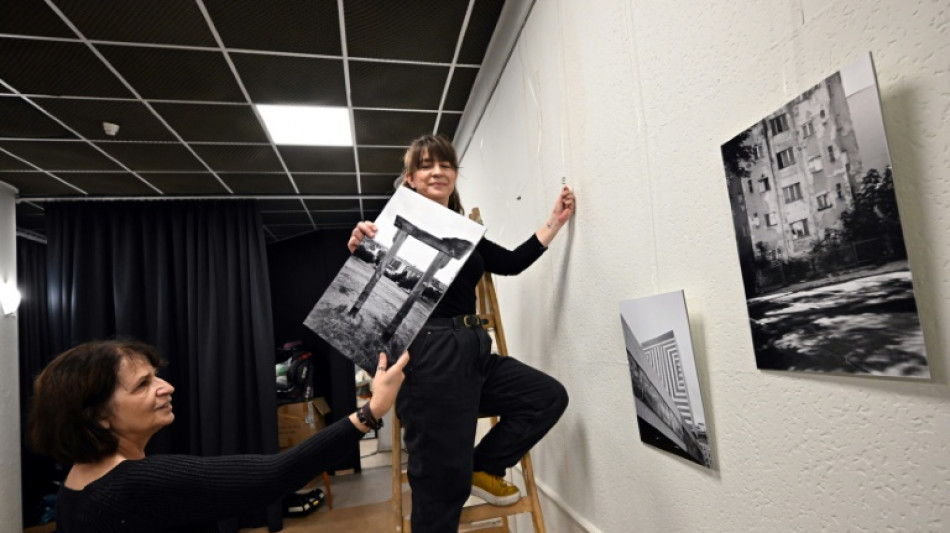
Skupio participated in "Picture it!", a Central European initiative that handed out one-use cameras to dozens of homeless in Poland, Czech Republic, Hungary and Slovakia.
They captured everything from shared meals and playful pets to puddle reflections.
Skupio's picture is part of an exhibition in Budapest until November 27, aiming to change perceptions of homelessness.
Each person was given one or two disposable cameras and about three weeks to take pictures.
- 'Not heard or seen' -
Skupio was one of the more snap-happy, running out of film within days.
In his worst times, Skupio was drinking vodka, feasting on drugs, picking fights and sleeping rough.
Now sober for six years, looking after a stray cat, studying for a high school diploma and waiting to move into social housing, he said projects like "Picture It!" had been a major boost to his reform campaign.
"I'm really proud of myself for getting by. For looking for these ways to spend time so that I don't get any stupid ideas," said Skupio.
"I'm living proof that you can pull yourself out of anything. You can quit any substance and start your life anew."
The goal of the photo initiative had been to decrease prejudice against the homeless -- to show the positives that tend to be invisible for others.
"Most of the time these people are not heard or seen or even when they are seen it is in a very negative light," project coordinator Nora Bagdi told AFP.
"And based on the photos, we can look into their private life, which is full of colour and love and trips around the city."
Spearheaded by the Menhely Foundation -- a Hungarian non-profit to help the homeless -- the project was supported by the International Visegrad Fund.
- 'Me, photos?' -
When the organisers first distributed the cameras, some of the participants were ready for the challenge. Others felt they had nothing to offer.
"They were like, 'Me, photos? Why? What am I supposed to show?' Again, it was that lack of confidence," said Izabela Kruzynska, the local coordinator in Poland.
"We had to lift the burden off their shoulders, tell them that whatever's around you and catches your eye is fine... This is about your perspective."
Skupio and Slawomir Plichta knew each other from a now defunct theatre troupe for the homeless that -- like the photo project -- gave them respite from their problems.
A black and white photo by Plichta shows a ground view of a bike rack, the metal arches forming a tunnel with a tiny person at the end.
"I practically didn't part with the camera the whole time... Just rode around looking for interesting things to photograph," the 54-year-old recovering alcoholic told AFP.
That would not have been the case had he still been finishing bottles and sleeping rough.
"I'll be honest: I'm not sure the camera would've made it back. I would've either sold it or just left it somewhere," he said.
Now one year sober and recently back in his own apartment, Plichta is careful not to take his abstinence for granted -- "never say never" -- though he calls himself "a new person, open to people, smiling".
"Things are 150,000 times better now. I prefer this world. Not that one. I've left that one behind."
Y.Bouchard--BTB