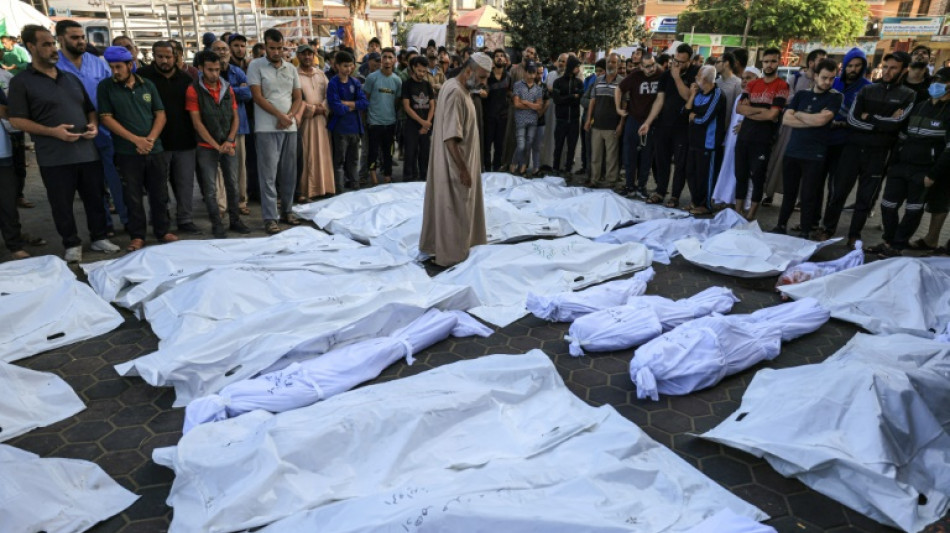
Gazans bury their dead in orchards and football fields / Photo: © AFP/File

 Seeing pivotal election, Israelis fly from around world to vote
 South Korea's Eom 'racially abused' in England's Championship: club
 Asian markets mixed as tech firms claw back some losses

 India shuts down iconic Delhi protest site after three decades
 Japan urges Russia for 'impartial treatment' of arrested journalist
 Lula, Bolsonaro ordered to call off attempts at online censorship
 EU takes a page from Ireland's AI playbook

 Global deforestation slowed in 2025 but surged in Congo basin: study

 Saudi says Houthi attacks sparked Aramco fire, wounded 4 in Riyadh

 Few buyers for starving cattle in El Nino parched El Salvador

 Bybit Expands Beyond Crypto as CEO Outlines Next Phase of Financial Platform

 Bayern held by Viking after 'super dumb' Olise red in Champions League

 Why AI makes computer worms harder to stop

 US fines Bank of America $1.2 bn for anti-money laundering violations
 Bayern held by Viking after Olise sees red in Champions League

 Atletico down Carrick's struggling Man United

 Croatia trials full driverless robotaxi service

 US stocks dip ahead of inflation data as tech sell-off hits Asia

 No lights, no friends: Cuban youth grapple with loneliness

 Saudi coalition strikes Yemen oil sites after Houthi attacks
 French economy minister denies country caught in debt 'snowball'
 Judge extends halt to Trump's golf course tree-cutting

 Milan's Saelemaekers set for lenghty spell out after ankle surgery

 Nvidia says to invest in French medical website

 Real Madrid's Mourinho has 'trust' in referees despite complaints

Before he fled his home in northern Gaza, where intense fighting now rages between Israel and Hamas, Mahmud al-Masri had a grim job to do: bury his three brothers and their five children in a nearby citrus orchard.
With his home area turned into a war zone, the bereaved 60-year-old farmer had no choice but to dig makeshift graves and hastily bid farewell to his relatives killed in an Israeli strike.
"We had to bury them there in the orchard because the cemetery is in the border zone where tanks are coming in, and it's very dangerous," Masri said.
"I will transfer the bodies when the war is over."
Masri, who is now holed up with his family in a hospital in southern Gaza, lived in a two-storey house in Beit Hanoun in the semi-rural northeast of the Gaza Strip, not far from the border fence with Israel.
Masri decided initially to ignore Israeli warnings to flee south when war broke out after the October 7 Hamas attacks that killed 1,400 people inside Israel, mostly civilians, and saw about 240 hostages taken, according to Israeli officials.
Two weeks of heavy bombardment changed his mind and he resolved to get his wife and children out when the fighting intensified and fears of a massive ground invasion grew day by day.
Now -- more than four weeks into the brutal war -- upwards of 10,500 people, again mainly civilians, have been killed in Israeli bombardments of Gaza, according to the Hamas-run health ministry.
Masri told his story to AFP as he and his immediate family sheltered in an overcrowded hospital in the south.
He recalled that he was forced to bury his brothers and nephews in the orchard because the incessant bombing and incursions by Israeli soldiers meant his family could not reach Beit Hanoun's cemetery.
He put bricks on the ground to mark where his relatives lay.
But he added that he had since learned that Israeli military bulldozers had destroyed his house and said: "I don't know if the graves are still there as nothing is being spared."
- Mass graves -
The October 7 attack was the worst in Israeli history, and the Gaza war it unleashed has been the bloodiest yet in the long-blockaded Palestinian territory of 2.4 million.
Bodies have piled up outside hospitals, on roads and in parks, in refrigerated trucks and even in a repurposed ice cream van.
Most cemeteries are either full or inaccessible because of Israeli strikes, and so families of the dead have to improvise when burying their loved ones.
When dozens of people were killed in a bombardment at the Jabalia refugee camp in early November, around 50 bodies were stacked up in the rear of a pick-up truck and taken to a local hospital.
From there they were transported, some in donkey-drawn carts, towards a cemetery for burial.
But because of a lack of space there, relatives had to dig a communal mass grave at a dirt football field where local teams used to play, an AFP photographer said.
The sports ground is bordered on three sides by schools run by the UN agency for Palestinian refugees, UNRWA, which are now shelters for internally displaced Gazans.
Men using picks and shovels dug a rectangular pit in the football field before burying the bodies, AFPTV footage showed.
In the hole, men were laid on one side and women on the other. Corrugated iron sheeting was placed on top and then covered with a layer of earth.
Shihteh Nasser, 48, helped in the burial.
"We bury the dead in football fields and other vacant lots because the proper burial grounds are full," he said.
"Sometimes the bodies are taken there in carts because there's no fuel anymore for cars."
I.Meyer--BTB