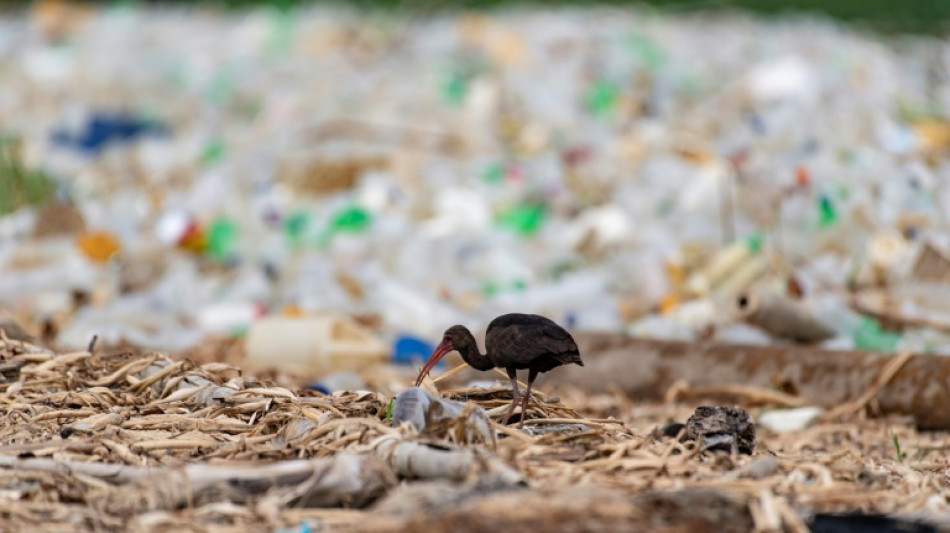
Battle looms over renewed plastic treaty negotiations / Photo: © AFP/File

 Seeing pivotal election, Israelis fly from around world to vote

 South Korea's Eom 'racially abused' in England's Championship: club

 Asian markets mixed as tech firms claw back some losses
 India shuts down iconic Delhi protest site after three decades
 Japan urges Russia for 'impartial treatment' of arrested journalist

 Lula, Bolsonaro ordered to call off attempts at online censorship

 EU takes a page from Ireland's AI playbook
 Global deforestation slowed in 2025 but surged in Congo basin: study

 Saudi says Houthi attacks sparked Aramco fire, wounded 4 in Riyadh

 Few buyers for starving cattle in El Nino parched El Salvador

 Bybit Expands Beyond Crypto as CEO Outlines Next Phase of Financial Platform

 Bayern held by Viking after 'super dumb' Olise red in Champions League

 Why AI makes computer worms harder to stop

 US fines Bank of America $1.2 bn for anti-money laundering violations

 Bayern held by Viking after Olise sees red in Champions League

 Atletico down Carrick's struggling Man United

 Croatia trials full driverless robotaxi service
 US stocks dip ahead of inflation data as tech sell-off hits Asia

 No lights, no friends: Cuban youth grapple with loneliness

 Saudi coalition strikes Yemen oil sites after Houthi attacks

 French economy minister denies country caught in debt 'snowball'

 Judge extends halt to Trump's golf course tree-cutting

 Milan's Saelemaekers set for lenghty spell out after ankle surgery

 Nvidia says to invest in French medical website

 Real Madrid's Mourinho has 'trust' in referees despite complaints

Representatives from 175 nations meet in Nairobi from Monday to negotiate for the first time what concrete measures should be included in a binding global treaty to end plastic pollution.
Nations agreed last year to finalise by 2024 a world-first UN treaty to address the scourge of plastics found everywhere from mountain tops to ocean depths, and within human blood and breast milk.
Negotiators have met twice already but Nairobi is the first opportunity to debate a draft treaty published in September that outlines the many pathways to tackling the plastic problem.
The material made from fossil fuels is pervasive in the modern world, sparking growing alarm in recent years.
The meeting to debate its future comes just before crucial climate talks in the oil-rich United Arab Emirates later this month, where discussions over fossil fuels and their planet-heating emissions are due to dominate the agenda.
While there is broad consensus a plastics treaty is needed, there are very different opinions about what should be in it.
"That's the big battle we will see now," said Eirik Lindebjerg from the World Wide Fund for Nature (WWF), who will be among thousands of attendees at the high-stakes talks at the UN Environment Programme (UNEP) global headquarters in Nairobi.
A number of countries and environment groups want the treaty to ban single-use products and impose strict rules limiting how much new plastic can actually be made, among other so-called "high ambition" measures.
Industry bodies and major plastic-producing economies have been advocating for years for measures that focus on improving waste management and reusing and recycling their products, rather than addressing their origin.
- Make or break -
The "zero draft" underpinning the weeklong talks puts all options on the table and negotiations are expected to get heated as competing positions finally go head-to-head.
The treaty could be a pact for nature or "a cosy accommodation with the plastic industry" depending what direction the negotiations take, Peter Thomson, the UN secretary-general's special envoy for the ocean, said last month.
Bottles and shopping bags choke waterways while tiny pieces of microplastics show up in food and throughout the bodies of animals and humans.
Plastic also contributes to global warming, accounting for 3.4 percent of global emissions in 2019, according to the OECD.
Despite growing awareness of the problem, the amount of new plastic being made is exploding: annual production is on track to triple within four decades, though less than 10 percent is recycled.
Ahead of Nairobi, around 60 nations voiced collective alarm about this trend and called for "binding provisions in the treaty to restrain and reduce the consumption and production" of plastic.
Graham Forbes from Greenpeace USA said the treaty "will succeed or fail based on how it restricts upstream plastic production".
"You can't stop the bathtub from overflowing until you turn off the tap," said Forbes, who will also be in Nairobi.
- 'Emotional ideology' -
Many countries are reluctant to back absolute cuts in production, including China, the United States, Saudi Arabia and other OPEC countries, which all have large petrochemical industries.
The EPS Industry Alliance, a North American trade association for expanded polystyrene businesses, said the treaty had suffered a "lack of independent scientific review" and warned of "unintended consequences" from some proposals.
"There is a tremendous amount of rhetoric surrounding plastic that is riddled with emotional ideology aimed at inanimate objects," said alliance executive director Betsy Bowers, who will be in Nairobi.
The November 13-19 meeting is the third of five sessions in a fast-tracked process aiming to conclude negotiations next year so the treaty can be adopted by mid-2025.
At the last talks in Paris, campaigners accused large plastic-producing nations of deliberately stalling after two days were lost debating procedural points.
This time around, the sessions have been extended by two days but there are still concerns a weaker treaty could emerge if time for detailed discussion is swallowed up going in circles.
"If they can't make progress here, it will be a very intense 2024 if they are to agree to a meaningful treaty by the end," said Lindebjerg.
G.Schulte--BTB