'King of Lake Ohrid': the fight to save a Balkan trout
/ Photo: © AFP

 IMF chief says Saudi attacks could have negative spillover 'everywhere'
 Premier League move a Sage decision for new Palace boss
 South Korean FA condemns 'personal attacks' as rift rumours grow
 Japan urges 'impartial treatment' of journalist arrested in Russia

 What we know about Pope Leo XIV's lung cancer operation

 Advanced economies must 'act now' to lower debt as bond yields spike: IMF

 Deluge by design: Thai villages flooded to protect capital

 Ivan Deforge, the French 'bison tamer' in Moscow

 Indonesians on fire-ravaged island sue state for clean air

 Trump, White House post video of UK man killed by tiger
 Saudi employee arrested for allegedly bugging OpenAI office
 Atletico sink Man Utd as Viking deny Bayern in Champions League
 Man United's Martinez blasts board's lack of investment

 Meet A7 International, an Innovative Global Platform Designed to Reinvent the International Payments Market

 Shakhtar hope London move a reminder of Ukraine conflict

 Tresoldi hat-trick fires Brugge past Inter Milan

 Rams axe kicker Mevis after misses cost victory over Bills: reports

 Yamal stays cool at boiling Galatasaray to lift Barcelona to victory
 Arsenal cruise past Lille into share of Champions League lead

 Trump ousts Greece ambassador over ethics scandal

 Reese Witherspoon, France's Mediawan to buy Hello Sunshine

 Bipartisan US senators urge Trump to scrap Russian diesel deal

 Ex-gang leader sentenced to minimum 40 years for Tupac murder

 Cornell suspends frat parties after alleged gang rape

 Man City deserve to keep titles, says PSG's Luis Enrique

Along the picturesque shores of Lake Ohrid, things have taken on a frantic pace at the Lin Hatchery in Albania's Pogradec, as a team of specialists races to release the final batch of newly spawned trout this season.
The hatchery specialises in breeding the "Ohrid Trout" -- an indigenous species in the ancient lake that has struggled for years to maintain a healthy population amid habitat destruction, overfishing, and rampant pollution.
Albania and Northern Macedonia, which both border Lake Ohrid, have signed agreements to ensure the trout's survival, as a major uptick in tourism in the area has seen large amounts of development along the banks.
Known as "Koran" in Albania and "Ohridska pastrmka" in North Macedonia, the Ohrid Trout has long been a staple in the lake's crystal-clear waters.
"It doesn't matter what Albanians or Macedonians call it," said fisherman Artan Male.
"They all agree: this fish, which needs neither a passport nor an identity card to cross borders, is known as the King of Lake Ohrid, one of the oldest in the world."
- 'Any mistake could be fatal' -
To maintain the population, Albanian public and private organisations have increased operations at fisheries to produce 1.7 million hatchlings this year alone.
"You have to take care of everything. You have to respect schedules and dates. Any mistake could be fatal and could lead to the death of the small fish," said Kopi Bici, who works at the hatchery.
The work to repopulate Lake Ohrid along its Albanian shoreline is a year-round affair. From December 1 to early March, fishing is prohibited in Lake Ohrid to prevent the disruption of the trout's breeding cycle.
During this period, a group of around 60 specially trained fishermen are authorised to cast nets to help harvest the eggs of the females and the sperm of the males.
"Mixed with fresh water, this fertilises the eggs," said Martin Jace, who oversees Albania's Fishermen's Association.
The fertilised eggs are then allowed to incubate, followed by the hatching of the larvae that are then carefully raised to the fry stage, which live for six months in the freshwater of the breeding centre's ponds before being released back into the lake.
The cycle from egg to a newly spawned trout is a delicate journey with every step of the process carefully monitored, including oxygen levels, food intake, and water temperature.
But there is still a risk of death to the spawns.
This year, to produce 1.7 million spawns, farmers and fishermen recovered 200 kilogrammes of eggs to produce just 3,000 kilogrammes of adult fish.
- 'Our babies' -
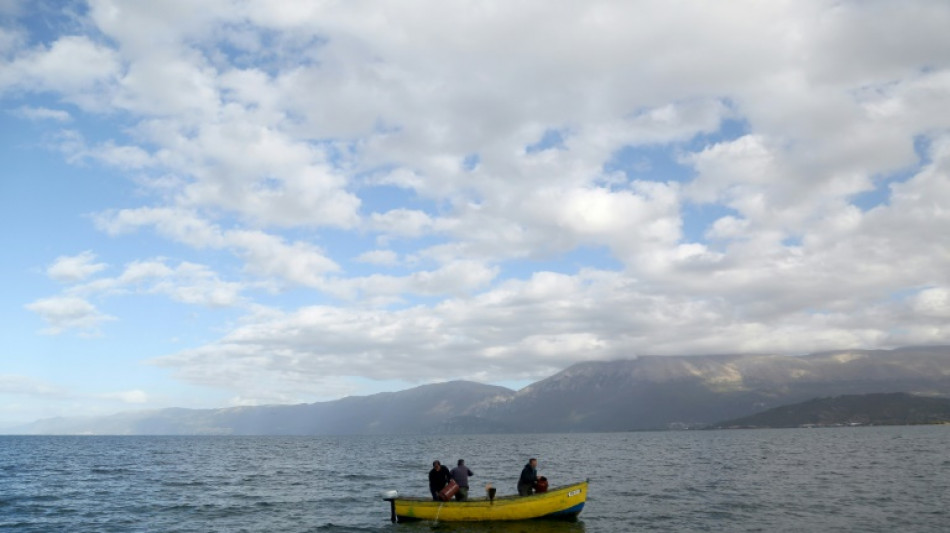
To bring the young fish back into the lake, employees from the hatchery brave Ohrid's choppy waters and often heavy showers to release the spawns.
"These are our babies, and they need to be in good physiological condition to withstand their new life in the lake," said Jovan Bale, as he scooped up young fish at the hatchery's pond and that are later placed in plastic containers filled with water.
The fish are then transported to the edge of the lake, hoisted onto a boat and released into its deeper waters.
Time is of the essence during the trip -- the containers that carry the new spawns are stuffed with the young fish, meaning there is little oxygen for the hatchlings.
"It's a race against time, the fish have to be released very quickly. Any delay would be fatal. If the water heats up and they lack oxygen, they die," said Jace, adding that the cool waters during October and November were optimal to release the spawn.
But any effort to preserve the trout's population will likely be futile if the underlying issues threatening the fish and the lake's other 145 endemic species are not addressed.
"If we don't want to lose the Ohrid trout forever, we need to join forces," said Blerina Turshina, a chef at a restaurant in Tushemisht on the Albanian side of the lake.
The trout remains a culinary delicacy in the area and has attracted tourists from across southeastern Europe who are keen to sample the tasty, red-spotted fish, which has long been rumoured to have been a favourite of the late Queen Elizabeth II.
"Grilled or baked, with onions, spices and nuts or with a white lemon sauce, [the trout] is the king of dishes," said Turshina.
And in a region where nationalism is often at a low boil, fights over the fish's true origins have been known to be a topic of conversation -- something Turshina and others are quick to laugh off.
"It doesn't matter," said Turshina. "It's the Ohrid trout".
W.Lapointe--BTB