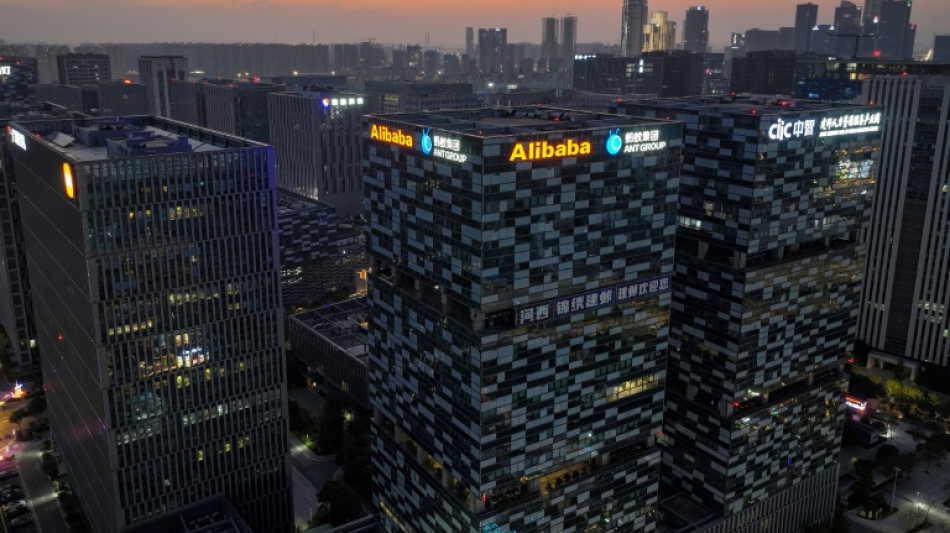
US chip curbs trip up China's AI-hungry tech giants / Photo: © AFP/File

 IMF chief says Saudi attacks could have negative spillover 'everywhere'

 Premier League move a Sage decision for new Palace boss

 South Korean FA condemns 'personal attacks' as rift rumours grow

 Japan urges 'impartial treatment' of journalist arrested in Russia

 What we know about Pope Leo XIV's lung cancer operation

 Advanced economies must 'act now' to lower debt as bond yields spike: IMF

 Deluge by design: Thai villages flooded to protect capital

 Ivan Deforge, the French 'bison tamer' in Moscow

 Indonesians on fire-ravaged island sue state for clean air

 Trump, White House post video of UK man killed by tiger

 Saudi employee arrested for allegedly bugging OpenAI office

 Atletico sink Man Utd as Viking deny Bayern in Champions League

 Man United's Martinez blasts board's lack of investment

 Meet A7 International, an Innovative Global Platform Designed to Reinvent the International Payments Market

 Shakhtar hope London move a reminder of Ukraine conflict

 Tresoldi hat-trick fires Brugge past Inter Milan

 Rams axe kicker Mevis after misses cost victory over Bills: reports

 Yamal stays cool at boiling Galatasaray to lift Barcelona to victory

 Arsenal cruise past Lille into share of Champions League lead

 Trump ousts Greece ambassador over ethics scandal
 Reese Witherspoon, France's Mediawan to buy Hello Sunshine

 Bipartisan US senators urge Trump to scrap Russian diesel deal

 Ex-gang leader sentenced to minimum 40 years for Tupac murder

 Cornell suspends frat parties after alleged gang rape

 Man City deserve to keep titles, says PSG's Luis Enrique

US restrictions on advanced computer chips are forcing China's tech giants to rethink their ambitious AI-powered projects, analysts say.
E-commerce titan Alibaba on Thursday became the latest Chinese firm to admit to feeling the bite of US sanctions, as it abandoned a plan to spin off its multi-billion-dollar cloud computing arm.
It followed gaming giant Tencent's acknowledgement this week that its ability to sell advanced cloud services has been hit by the restrictions, which were introduced by Washington last year to prevent China's access to cutting-edge chips.
"What this (Alibaba) episode tells us is that US restrictions of chip supply to Chinese tech firms will have the potential of disrupting consequential business decisions," Ni Tao, founder of the Chinese robotics and automation portal cnrobopedia.com, told AFP.
"This is a rude awakening that they will have to speed up adjustment of their operations to offset the blow of a chip crunch, which will only become more acute going forward."
Washington has said the export controls are a national security measure, aimed at cutting off China's access to advanced chips critical to the development of AI tech as well as cutting-edge weapons such as hypersonic missiles and stealth fighter jets.
Beijing has dismissed these concerns, with President Xi Jinping telling US President Joe Biden this week that such actions "seriously hurt China's legitimate interests".
The chip controls were strengthened on October 17 to close loopholes that had allowed Chinese firms to acquire chips that were powered down to stay within the limits imposed by Washington.
The curbs now also target cloud computing to prevent Chinese companies from accessing powerful AI chips hosted elsewhere.
"The US is sending a clear signal to the world's cutting-edge chip developers: don't even bother... developing a high-performance computing chip for the China market. The rules will catch up," the research firm Rhodium Group said in a report this month.
"China's tech champions face an uncertain future in the wake of the October 17 controls."
- 'Recalibrate their bombasts' -
The US chip controls are yet another blow to China's tech sector, which was already suffering from the economic impact of the Covid pandemic and Beijing's regulatory crackdown against some of the country's biggest firms.
They have kneecapped the AI-driven ambitions of many companies, which had relied on a steady supply of powerful imported chips to train their AI models and develop advanced cloud-based products.
Alibaba said Thursday that US controls have not only hit its lucrative cloud business, but will also limit its ability to upgrade technologies in the future.
And despite boasting one of the largest inventories of AI chips in China, Tencent -- operator of the super-app WeChat -- admitted in an earnings call this week that it will need to find ways to use them more efficiently and seek other sources.
Advanced cloud services, however, are an important business alongside the large sums they are investing in AI models to rival the likes of ChatGPT.
Bloomberg News quoted Alibaba's Joseph Tsai as saying last month that its cloud arm hosts half of the generative AI firms in China.
While US curbs have put Chinese companies at a major disadvantage, analysts said their AI and cloud businesses could bounce back in the longer term, pointing to the billions being spent by the government to develop the domestic chip industry.
But the impact of the sanctions has been brought into sharp focus by the cloud spinoff scrapping by Alibaba, and China's once high-flying tech companies are facing major uncertainty going forward.
"With tensions between the US and China unlikely to abate significantly anytime soon... and heightened regulatory oversight at home and not to mention an economy in a downward spiral, they cannot but scale back their ambitions and recalibrate their bombasts to their real capabilities," said cnrobopedia's Ni.
T.Bondarenko--BTB