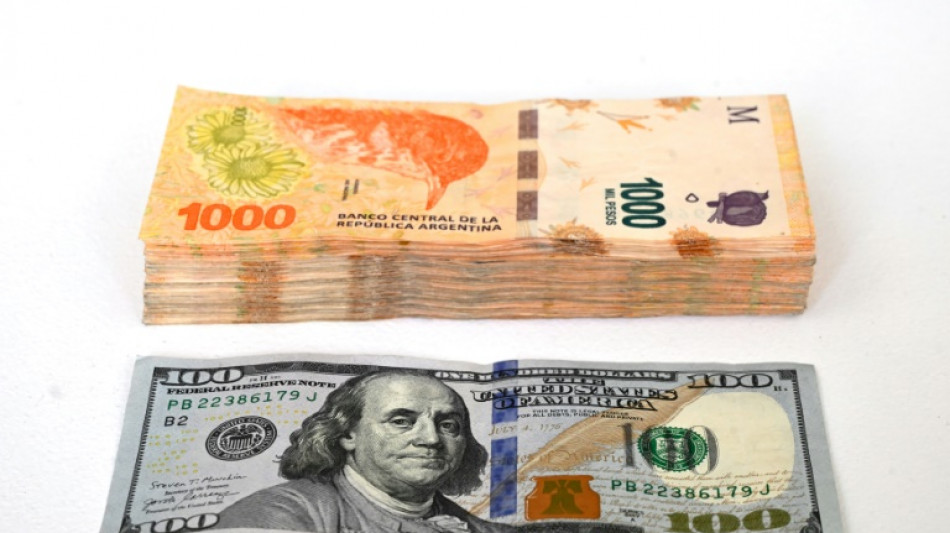
Milei's Argentina dollarization plan has Latin American precursors / Photo: © AFP/File

 Zelensky accuses Putin of disrespecting Trump after latest attacks
 Japan PM says housework makes her busier than male predecessors

 Top Indian 'cockroach' leaders sent to jail after protest
 Ukraine ex-military officer to stand trial over Nord Stream sabotage
 IMF chief says Saudi attacks could have negative spillover 'everywhere'
 Premier League move a Sage decision for new Palace boss

 South Korean FA condemns 'personal attacks' as rift rumours grow
 Japan urges 'impartial treatment' of journalist arrested in Russia

 What we know about Pope Leo XIV's lung cancer operation
 Advanced economies must 'act now' to lower debt as bond yields spike: IMF
 Deluge by design: Thai villages flooded to protect capital
 Ivan Deforge, the French 'bison tamer' in Moscow
 Indonesians on fire-ravaged island sue state for clean air
 Trump, White House post video of UK man killed by tiger
 Saudi employee arrested for allegedly bugging OpenAI office
 Atletico sink Man Utd as Viking deny Bayern in Champions League
 Man United's Martinez blasts board's lack of investment
 Meet A7 International, an Innovative Global Platform Designed to Reinvent the International Payments Market

 Shakhtar hope London move a reminder of Ukraine conflict

 Tresoldi hat-trick fires Brugge past Inter Milan
 Rams axe kicker Mevis after misses cost victory over Bills: reports

 Yamal stays cool at boiling Galatasaray to lift Barcelona to victory

 Arsenal cruise past Lille into share of Champions League lead

 Trump ousts Greece ambassador over ethics scandal

 Reese Witherspoon, France's Mediawan to buy Hello Sunshine
Argentine president-elect Javier Milei ran his campaign on promises to ditch the peso for the US dollar and do away with a central bank -- all in the name of subduing rampant inflation.
The far-right outsider is hoping to reign in inflation that has hit 140 percent, bedeviling the South American country as it struggles with a deep economic crisis.
Several Latin American countries have already officially or unofficially dollarized their economies, hoping to usher in new eras of economic and financial stability that could not be achieved using their own currencies.
The following are a few examples of dollarization in the region, along with how and why these countries made the switch to the American greenback.
- Ecuador -
Ecuador adopted the dollar in March 2000, hoping to shake off a profound banking crisis that had caused $5 billion in losses and left thousands of people bankrupt. The ensuing price increases threatened to accelerate into runaway hyperinflation.
The transition from the sucre to the dollar came after a bank holiday coupled with a temporary freeze to half of all deposits -- emergency steps that seemed to work.
Inflation levels came down rapidly, with Ecuador sometimes even veering into periods of deflation. The country's 2023 annual inflation is expected to sit at 3.1 percent.
- El Salvador -
The dollar became the official currency of El Salvador on January 1, 2001. The government of then-president Francisco Flores argued the changeover would make the country more attractive to foreign investments and trade, plus reduce the risk of devaluation and allow local banks to provide better credit offers.
But "dollarization had adverse effects," according to independent economist Cesar Villalona.
"It increased the cost of living. Upon the switch to the dollar, the prices of goods and services skyrocketed, and those who continue to pay for that situation are the poorest," he said.
El Salvador "does not have (its own) monetary policy, since we depend on what the United States does with its currency."
In 2021, El Salvador also made bitcoin an official currency, part of the campaign platform of President Nayib Bukele.
The country's annual inflation reached 7.32 percent in 2022, but is predicted to come down to 3.3 percent for 2023.
- Panama -
The dollar has circulated as the official currency of Panama for longer than any other Latin American country, alongside the local balboa.
US bills have been used in Panama since 1904, shortly after the country's independence from Colombia and around the time the United States began construction on the Panama Canal.
The balboa is only issued in metal coins and not paper bills, and the public sector only uses the currency for accounting purposes.
Panama usually sees annual inflation levels under 3 percent.
- Venezuela: de-facto dollarization -
The dollarization process in Venezuela has been more informal.
In 2018, as the country faced its first year of hyperinflation following the reelection of President Nicolas Maduro -- widely unrecognized by the international community -- government officials relaxed certain currency exchange controls in an effort to combat the crisis created by a shortage of the local bolivar.
"It was a combination of general factors that lead to de-facto dollarization," according to Albusdata economic analyst Henkel Garcia. "Structurally, it was high inflation, but there were also other forces like the situation with the electricity crisis," he added.
Without power, card payment points stopped working -- and without enough physical bolivars -- as giant stacks of cash became necessary to pay for goods and services -- the dollar became the clear alternative.
The country finally escaped hyperinflation in 2022, though it still faces one of the highest inflation rates in the world. Until September, Venezuela's annual inflation rate was 317 percent, according to its central bank.
US dollars -- a symbol of "American imperialism" -- have paradoxically become the most-circulated currency in Venezuela, according to economists.
- Dual-currency economies –
In some Latin American countries such as Peru and Uruguay, the dollar is used to pay for certain consumer goods and services -- like rent, real estate, vehicles and household appliances -- and US bills can be withdrawn from ATMs and used to open bank accounts, even though the official currency for government affairs remains fixed in local money.
J.Fankhauser--BTB