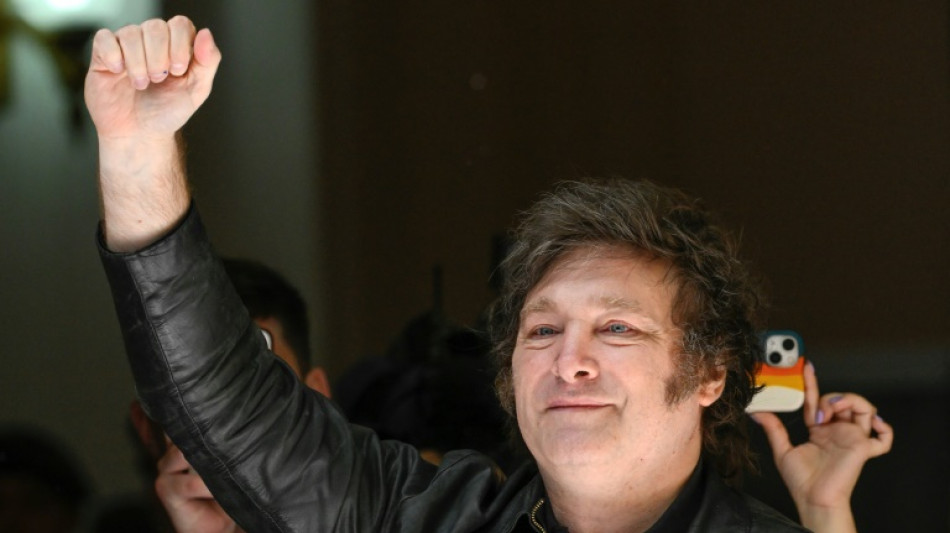
Argentina's Milei may find an unexpected friend in the IMF / Photo: © AFP

 Zelensky accuses Putin of disrespecting Trump after latest attacks
 Japan PM says housework makes her busier than male predecessors

 Top Indian 'cockroach' leaders sent to jail after protest

 Ukraine ex-military officer to stand trial over Nord Stream sabotage
 IMF chief says Saudi attacks could have negative spillover 'everywhere'
 Premier League move a Sage decision for new Palace boss

 South Korean FA condemns 'personal attacks' as rift rumours grow
 Japan urges 'impartial treatment' of journalist arrested in Russia

 What we know about Pope Leo XIV's lung cancer operation
 Advanced economies must 'act now' to lower debt as bond yields spike: IMF
 Deluge by design: Thai villages flooded to protect capital

 Ivan Deforge, the French 'bison tamer' in Moscow
 Indonesians on fire-ravaged island sue state for clean air

 Trump, White House post video of UK man killed by tiger
 Saudi employee arrested for allegedly bugging OpenAI office
 Atletico sink Man Utd as Viking deny Bayern in Champions League
 Man United's Martinez blasts board's lack of investment

 Meet A7 International, an Innovative Global Platform Designed to Reinvent the International Payments Market

 Shakhtar hope London move a reminder of Ukraine conflict

 Tresoldi hat-trick fires Brugge past Inter Milan

 Rams axe kicker Mevis after misses cost victory over Bills: reports

 Yamal stays cool at boiling Galatasaray to lift Barcelona to victory
 Arsenal cruise past Lille into share of Champions League lead

 Trump ousts Greece ambassador over ethics scandal

 Reese Witherspoon, France's Mediawan to buy Hello Sunshine
What will the relationship be like between Javier Milei, Argentina's new self-described "anarcho-capitalist" president, and the IMF, with which the Latin American country has an ongoing $44 billion loan agreement?
While it's difficult to say, some analysts believe the dialogue could be relatively easy, as Milei is promising even greater adjustments to government spending than those requested by the International Monetary Fund.
The victory of the 53-year-old ultra-liberal economist in the Argentinian presidential elections on Sunday was like a tsunami in a country that has a complicated relationship with the IMF, to which it has turned more than 20 times in search of financial assistance since 1956.
With inflation running at an annual rate of more than 140 percent, and 40 percent of the population living in poverty, Milei is clear that his priority is the economy, which he hopes to improve by drastically cutting public spending.
During the last few months he has promised an adjustment "much tougher than that of the Fund," which he defines as a "perverse mechanism that favors irresponsible governments."
- 'Derailed' -
Arturo Porzecanski, a researcher at the Wilson Center in Washington believes that "the trend is so bad that it fully justifies a major adjustment" at the fiscal level.
The $44 billion program between Argentina and the IMF has been "derailed because the outgoing government violated its fiscal and other targets, largely due to the 'Plan Platita' of tax cuts and extra public spending carried out to try to popularize the candidacy" of Peronist Economy Minister Sergio Massa, Porzecanski told AFP.
As a result, "the IMF will most likely not approve" the next disbursement, which means that the new government will have to seek funds from elsewhere to pay what it owes the international financial institution, he added.
For the moment, everything is up in the air.
Milei's triumph "creates uncertainty because it is not known exactly what he will do" once he takes office in December, Claudio Loser, president of the consulting firm Centennial America Latina and a former director of the IMF's Americas Department, told AFP.
"The important thing is to formulate the details of his program," he added.
On Monday, IMF managing director Kristalina Georgieva congratulated Milei in a social media post on X, formerly Twitter.
"We look forward to working closely with him and his administration in the period ahead to develop and implement a strong plan to safeguard macroeconomic stability and strengthen inclusive growth for all Argentinians," she said.
The dialogue between the IMF and the president-elect "will be relatively easy," according to Loser.
However, while Milei will arrive at the Casa Rosada with the intention of making some big changes, many of his plans could come to nothing without the support of Congress, where his party, La Libertad Avanza, has only seven of the 72 senators and 38 of the 257 deputies.
To succeed, he will have to form political alliances with other parties, which could prove challenging for him.
- Dollarization, yes or no? -
Among Milei's plans for reform are proposals to privatize many state-run institutions.
"Everything that can be in the hands of the private sector will be in the hands of the private sector," Milei said Monday.
However, he has been more ambiguous in recent days about one of his most controversial campaign pledges: switching from the Argentine peso to the US dollar through a process known as "dollarizing."
"The core objective is to close the Central Bank, then the currency will be the one freely chosen by the Argentines," he limited himself to say.
Despite its appeal as a quick fix, "dollarization will not solve Argentina's problems, just as it did not do so in Ecuador and El Salvador," according to Loser, because "there is a lack of significant support from abroad" for the measures.
Porzecanski said he thinks dollarization it is "a good idea," but agrees that during the next months "the new government will not have the necessary dollars" to carry out the reforms.
As an "intermediate step," Milei should legalize "the holding, saving and transactions made with dollars, moving to a dual exchange regime where pesos and dollars circulate simultaneously," and Argentines can use either currency to make payments, he explained.
In Argentina, where dollars are scarce and the Central Bank's reserves are very low or even negative according to some economists -- including the president-elect -- more than a dozen exchange rates coexist for different activities. There are also restrictions on Argentines' access to the US dollar.
Now that Milei has revolutionized politics with his election, everyone is wondering who he will appoint as Minister of Economy.
It's a mystery that Argentina's financial markets -- which have so far responded positively to Milei's election -- will hope is revealed soon.
C.Meier--BTB