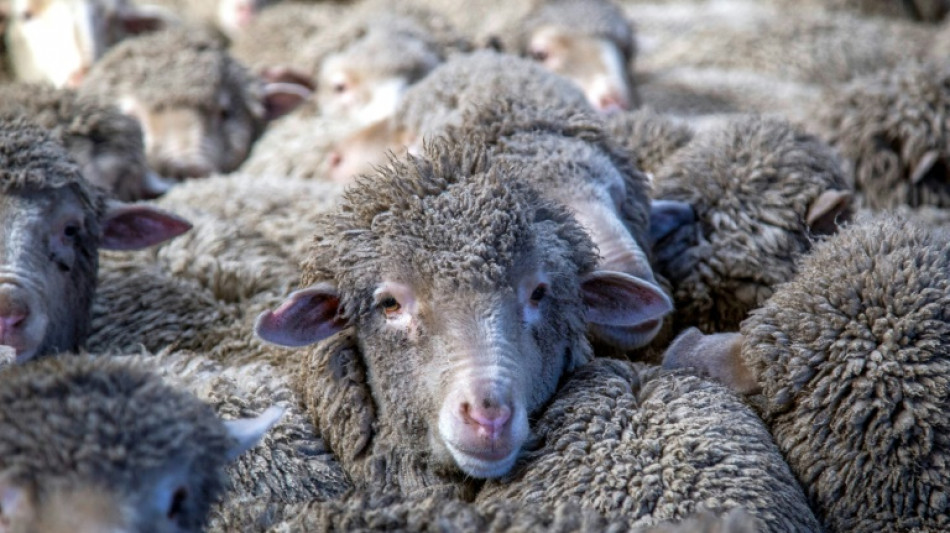
Shear bliss for New Zealand's pampered sheep / Photo: © AFP

 Zelensky accuses Putin of disrespecting Trump after latest attacks

 Japan PM says housework makes her busier than male predecessors

 Top Indian 'cockroach' leaders sent to jail after protest

 Ukraine ex-military officer to stand trial over Nord Stream sabotage

 IMF chief says Saudi attacks could have negative spillover 'everywhere'

 Premier League move a Sage decision for new Palace boss

 South Korean FA condemns 'personal attacks' as rift rumours grow

 Japan urges 'impartial treatment' of journalist arrested in Russia

 What we know about Pope Leo XIV's lung cancer operation

 Advanced economies must 'act now' to lower debt as bond yields spike: IMF

 Deluge by design: Thai villages flooded to protect capital

 Ivan Deforge, the French 'bison tamer' in Moscow

 Indonesians on fire-ravaged island sue state for clean air

 Trump, White House post video of UK man killed by tiger

 Saudi employee arrested for allegedly bugging OpenAI office

 Atletico sink Man Utd as Viking deny Bayern in Champions League
 Man United's Martinez blasts board's lack of investment

 Meet A7 International, an Innovative Global Platform Designed to Reinvent the International Payments Market

 Shakhtar hope London move a reminder of Ukraine conflict

 Tresoldi hat-trick fires Brugge past Inter Milan

 Rams axe kicker Mevis after misses cost victory over Bills: reports

 Yamal stays cool at boiling Galatasaray to lift Barcelona to victory

 Arsenal cruise past Lille into share of Champions League lead

 Trump ousts Greece ambassador over ethics scandal

 Reese Witherspoon, France's Mediawan to buy Hello Sunshine
Classical music, soft mattresses and the gentlest touch of a wool clipper: welcome to the New Zealand farm indulging what may be the world's most pampered sheep.
Forget any preconceptions of rough-hewn shearers manhandling the flock as they quickly deprive them of their fleece in crowded, noisy wool-sheds.
At Lake Hawea Station on New Zealand's South Island, owners Geoff and Justine Ross are advocates of the gentler, more soothing art of "slow-shearing".
The sounds of Debussy, Vivaldi and Mozart may be wafting through the shed as shearers usher the ewes from their pens before trimming off their thick wool with slow, methodical strokes of the clippers.
Shearers are paid according to the sheep's overall experience: stress, bruises and cuts can lead to lower wages.
The trimming is performed on pristine whitewashed boards, to better reveal any nicks inflicted on the sheep's skin.
Once shorn, each sheep is guided towards a chute, where it slides into a holding pen -- landing not on gravel but on a soft mattress.
It's sheep shearing, reconsidered from the sheep's perspective.
"It came first from a place of care for the animal," Justine Ross told AFP.
"We're all about having happier, calmer sheep. That starts with the way we treat them.
"We raised lambs in our first season. Once you see their personality and their unique character, you know the great responsibility of their care. And we have 10,000."
- Silence for the lambs -
On the station, there are "silent yards" where working dogs are trained not to bark while moving the merino flock.
In the hospital paddock, sick sheep get extra nutrition and medical treatment.
"You lose animals in farming, that's a fact, but sometimes with a little extra love and care, they come good," Ross said.
After reading that cows produce more milk if played classical music, Ross decided to make additions to the playlist in the shearing shed, where high-tempo rock, pop or rap is typically heard.
"We sometimes play Mozart. Some dairy farmers use it as a way to calm the animals," Ross said.
"Vivaldi's 'Four Seasons' is probably my favourite. We're just trying stuff to build a case for less stress for the animal and a calmer, happier shed."
New Zealand is home to five million people and 25 million sheep.
It is one of the world's main wool exporters, sending 84 million tonnes, worth US$232 million, overseas in the last financial year.
Shearing, meanwhile, is hard, physical work.
It demands skill and stamina to handle the sheep. Each weighs up to 60 kilograms (132 pounds) and can give the occasional painful kick. A good shearer trims several hundred sheep per day.
Traditionally, shearing was about speed, with little concern given to the occasional cut.
Nowadays, animal welfare is a key factor, Carolyn Clegg from New Zealand's shearing association told AFP.
The priority remains trimming the best quality wool, she said, "but that extends to the sheep -- you don't want them cut up or under stress, because that affects their welfare".
- 'Relaxed at all times' -
On the Lake Hawea station, farm manager Jack Mansfield said he likes to see "a nice slow, tidy job with the sheep relaxed at all times".
Pay is based on how the sheep are handled -- known as stockmanship -- and whether they are free of scratches, with the extra care coming at the cost of volume.
"We're possibly down 50 sheep a day, which probably ends up being a couple of NZ$100 out of our back pockets," said shearing gang leader Kevin Patrick O'Neill.
"That is replaced with a bonus from the farmer."
The slower pace also means the sheep are less inclined to wriggle or kick.
"If we're calm and relaxed, the sheep are too," O'Neill added.
After selling their successful vodka business to an international spirits company, Geoff and Justine Ross bought the sheep station in 2017, determined to make it sustainable.
It was the first New Zealand farm to be certified as carbon clear by a government research institute.
In addition to keeping emissions down, the couple also wanted to reduce stress on their sheep.
And focusing on animal welfare has business benefits too, said Justine Ross.
"Our clients are demanding animal welfare credentials as part of their fibre purchasing. If an animal isn't stressed -- full of that fight-or-flight energy -- then they will use that energy to grow more wool," she said.
UK-based merino knitwear firm Sheep Inc. is one of the companies that buys their wool.
Co-founder Edzard van der Wyck said they were drawn to Lake Hawea because of its carbon-clear status and animal welfare policy.
"If you bring less stress into a sheep's life, there is less breakages in the wool fibre, so the quality sustains itself," he said.
M.Odermatt--BTB