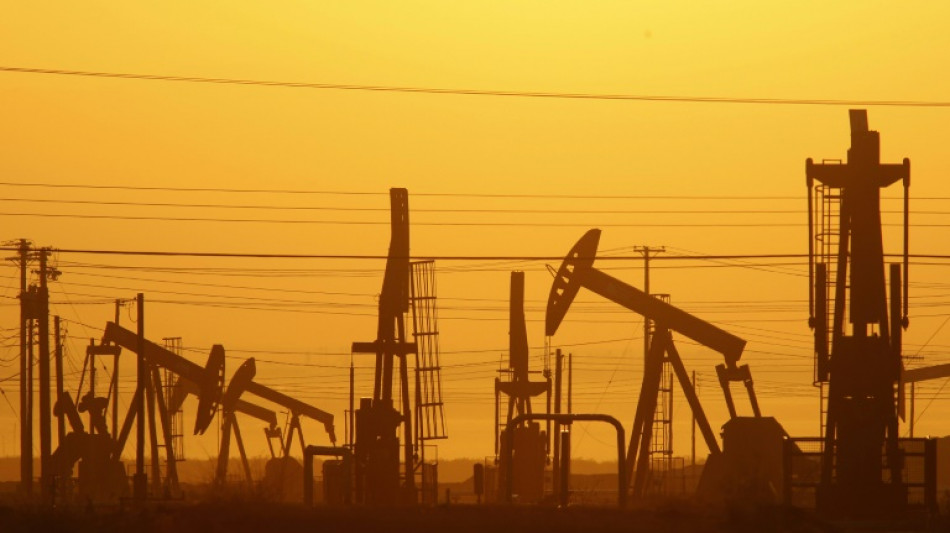
OPEC+ slashes oil output further to boost flagging prices / Photo: © GETTY IMAGES NORTH AMERICA/AFP/File

 Drone hits data centre of Russia's largest bank

 Bivial AG Brings Its Complete Dashboard to Mobile

 Mont Blanc nearly two metres taller than in 2023: French surveyors

 Pope recovering after lung cancer operation that rattles Church

 Indonesia haze spikes Singapore pollution, shuts East Timor schools
 Higher borrowing costs an 'alarm signal' for France: finance minister
 Zelensky accuses Putin of disrespecting Trump after latest attacks

 Japan PM says housework makes her busier than male predecessors

 Top Indian 'cockroach' leaders sent to jail after protest

 Ukraine ex-military officer to stand trial over Nord Stream sabotage
 IMF chief says Saudi attacks could have negative spillover 'everywhere'
 Premier League move a Sage decision for new Palace boss

 South Korean FA condemns 'personal attacks' as rift rumours grow
 Japan urges 'impartial treatment' of journalist arrested in Russia

 What we know about Pope Leo XIV's lung cancer operation

 Advanced economies must 'act now' to lower debt as bond yields spike: IMF

 Deluge by design: Thai villages flooded to protect capital

 Ivan Deforge, the French 'bison tamer' in Moscow

 Indonesians on fire-ravaged island sue state for clean air

 Trump, White House post video of UK man killed by tiger

 Saudi employee arrested for allegedly bugging OpenAI office

 Atletico sink Man Utd as Viking deny Bayern in Champions League
 Man United's Martinez blasts board's lack of investment

 Meet A7 International, an Innovative Global Platform Designed to Reinvent the International Payments Market

 Shakhtar hope London move a reminder of Ukraine conflict

Major oil-producing nations Saudi Arabia and Russia on Thursday announced they would further slash production in an effort to prop up volatile prices following an OPEC+ meeting.
The meeting also saw major producer Brazil declared as joining the grouping from next year, according to a statement by the Organization of the Petroleum Exporting Countries (OPEC).
Brazil's Energy Minister Alexandre Silveira, who attended the meeting, called it a "historic moment for Brazil", but added his ministry still needed to study "in detail" the invitation to join the group.
Following the virtual meeting of ministers from the 23-member OPEC+ alliance, Riyadh announced it would extend its voluntary oil production cut of one million barrels per day until March 2024.
Moscow said it would slash oil exports by 500,000 barrels a day -- up from 300,000 barrels a day so far -- until March, following tough, hours-long talks.
Other countries, such as the United Arab Emirates, Kuwait, Kazakhstan, Algeria and Oman, will also make smaller cuts, according to the Bloomberg news agency.
Amid stuttering global economic growth, analysts had largely expected OPEC+ producers to extend or deepen production cuts into next year to halt the recent slump in prices.
Around 1730 GMT, the price of Brent, the European benchmark for crude, fell by 0.31 percent to $82.84 per barrel, while that of WTI, its American equivalent, dropped by 2.47 percent to $75.94 despite the announcements.
- Intense negotiations -
Intense negotiations have continued in recent days as Saudi Arabia, which has borne the brunt of the supply cuts, sought to convince African countries to chip in by accepting lower production quotas.
But Angola and Nigeria were among those countries reluctant to sign up, seeking to step up production to secure vital foreign currency after they agreed in June to reduce their quotas.
At the June meeting, the United Arab Emirates received authorisation to increase production.
Since the end of 2022, the alliance has implemented supply cuts of about five million barrels per day (bpd).
In a boost to the grouping, OPEC said Brazil would join from next year. Brazil is among the world's top 10 producers and has been the largest oil producer in Latin America since 2016.
OPEC+ was born in late 2016 when Russia and nine others joined forces with the Saudi-led OPEC to prop up falling prices.
The cartel faced its biggest crisis in 2020 as countries locked down due to the Covid pandemic, sending oil demand plunging.
The group agreed in April 2020 to slash output by 9.7 million barrels per day in order to boost sagging prices.
It began to raise production again in 2021 as the market improved.
In the most recent meetings amid plunging prices, OPEC+ members have announced voluntary cuts to boost prices.
- Power balance shift -
But investors have warned that cutting production might not be enough to prevent prices from plummeting.
Oil prices are far from the near-$140 a barrel peak reached after the Russian invasion of Ukraine.
But they remain above the average of the last five years, currently hovering at around $80 per barrel after nearly striking $100 in September.
Concerns among producers persist about demand softening owing to slowing economies, particularly China's -- the world's biggest importer of crude -- amid mixed signals emerging from Europe and the United States.
On the supply side, crude production in the US and Brazil reached record levels, triggering what some analysts called a shift in the balance of power.
According to analyst Neil Wilson of Finalto, OPEC "doesn't have the iron grip on the market it once commanded".
K.Thomson--BTB