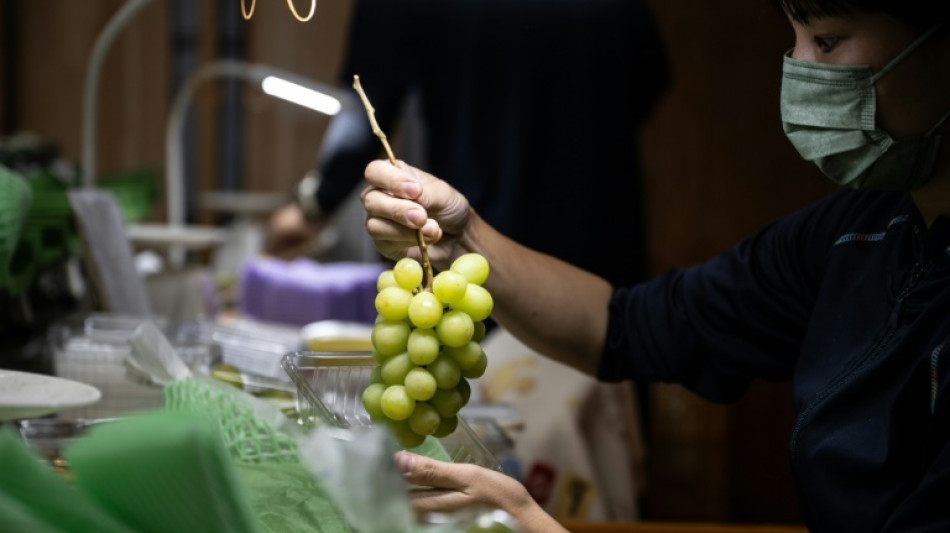
Sour grapes: Japan battles to protect premium fruits / Photo: © AFP

 Fuel shortage triggers queues on Indonesia's Bali island

 Evolution Metals & Technologies Corp. Reaffirms $400 Million to $460 Million FY2027 Revenue Guidance, Unveils Eight Sintered Magnet Grades Covering an Estimated 75% of Global NdFeB Revenue, and Moves to Answer U.S. Army Call for Rare Earth Magnets

 Trial defence says Russia used Nord Stream pipelines as 'weapon'

 Israeli settlers set fire to mosque in occupied West Bank

 Macron says French student protesters 'exploited' by political forces: spokeswoman

 Stocks diverge ahead of key US inflation data
 Japan summons Russian ambassador to protest journalist's arrest

 Workers to strike at world's largest copper mine in Chile

 Ukraine accuses US of helping Russia as missiles hit Kyiv

 Drone hits data centre of Russia's largest bank

 Bivial AG Brings Its Complete Dashboard to Mobile

 Mont Blanc nearly two metres taller than in 2023: French surveyors

 Pope recovering after lung cancer operation that rattles Church

 Indonesia haze spikes Singapore pollution, shuts East Timor schools
 Higher borrowing costs an 'alarm signal' for France: finance minister
 Zelensky accuses Putin of disrespecting Trump after latest attacks

 Japan PM says housework makes her busier than male predecessors

 Top Indian 'cockroach' leaders sent to jail after protest

 Ukraine ex-military officer to stand trial over Nord Stream sabotage

 IMF chief says Saudi attacks could have negative spillover 'everywhere'

 Premier League move a Sage decision for new Palace boss

 South Korean FA condemns 'personal attacks' as rift rumours grow

 Japan urges 'impartial treatment' of journalist arrested in Russia

 What we know about Pope Leo XIV's lung cancer operation

 Advanced economies must 'act now' to lower debt as bond yields spike: IMF

The variety of juicy grape that Yuki Nakamura is harvesting as the sun rises over his farm took scientists 33 years to develop and can sell for $100 a bunch in Tokyo department stores.
But in the view of Japanese farmers and officials, the chunky emerald-green Shine Muscat, one of many fruit varieties created by Japan, has been "stolen" by China and South Korea.
"The great things about Shine Muscat are that each grape berry becomes big, it's easy to grow, and it's sweet but not too much," Nakamura told AFP in the country's central Nagano region.
Calling the grapes his "partner", the 35-year-old said he wants to export to places such as Hong Kong and Thailand, where Japanese fruits are popular.
But waiting on the shelves there -- and online -- are copycats grown by China and South Korea that are nearly the same as Shine Muscat grapes, but much cheaper.
According to the Japanese government, China and South Korea took Shine Muscat seedlings out of Japan and grafted them onto local vines to produce fruit that looks and tastes -- almost -- as good.
Customers definitely "look at the prices", said Sau, a fruit vendor in a busy market in Hong Kong where Japanese Shine Muscats often cost two or three times as much as their Chinese counterparts, even with a weak yen making Japanese imports cheaper.
"But you can taste the difference," the vendor, who only gave her first name, told AFP.
"Japanese Shine Muscats are refreshing, sweet, and have stronger grape flavour. Chinese ones are sweet, but lack the grape flavour."
- 'Fruits are special' -
The Chinese Shine Muscat copycats were discovered in 2016, a decade after the variety's registration in Japan, when the National Agriculture and Food Research Organization (NARO) investigated samples.
But Japan cannot stop China or South Korea from growing the fruit because Tokyo -- some say naively -- failed to register the variety overseas within the six years required under international rules.
This was confirmed by South Korea's agriculture ministry, which told AFP that the "current situation permits Shine Muscat grapes to be grown and distributed here without royalty requirements".
Chinese authorities did not respond to requests to comment.
Japan cannot export grapes to China itself because of Beijing's quarantine rules, so Chinese growers are not technically cannibalising Japanese sales.
"But we would expect licensing fees... would be over 10 billion yen ($69 million) a year, assuming we obtained rights in China," Yasunori Ebihara, director of plant trademark protection at the Japanese agriculture ministry, told AFP.
The ministry admits that Japan also failed to register new kinds of Japanese-origin strawberry, cherry and citrus varieties that have been found in China, South Korea and also Australia.
The first auctions for seasonal fruits routinely attract massive sums in Japan, with a single pair of premium melons fetching five million yen (then $45,500) in 2019.
"Fruits are special for Japanese people," Ebihara said.
"Japanese consumers seek sweet, big, beautiful fruits in a fancy box," he said.
"Therefore, Japanese farmers make efforts to produce better quality, sweeter and more delicious fruits."
- Testing times -
Japan has been developing new fruit varieties since the 1920s.
Fuji apples -- named for Japan's famous volcano -- emerged in the 1930s as a cross between two varieties and are now among the world's most popular.
But the full-scale mission started after World War II, and continues to this day at NARO's research sites across the country.
On a recent sunny autumn day, researchers were harvesting dozens of new pear varieties, measuring their sweetness and hardness with special equipment, as well as with the occasional bite.
Takehiko Shimada, head of NARO's fruit variety research unit, said it takes years of painstaking work to develop a new variety fit to hit stores.
"It's normal" that it took over 30 years to produce the Shine Muscat, he said.
The research organisation has begun using DNA analysis to try to catch copycats of new fruit varieties.
"There are genome sequences that only the Shine Muscat has, so we can check whether (a grape) has such a sequence and determine whether it is a Shine Muscat," Shimada said.
Japan tightened its rules in 2020, prohibiting registered seeds and seedlings from being taken abroad.
Violators can face a prison term of up to 10 years or a fine of up to 10 million yen ($69,000).
Japan is also making efforts to better protect domestic growers against foreign copycats.
Back on the farm, Nakamura is happy that Shine Muscats are well-known across Asia.
"But I don't like it when I see that something Japan worked so hard to produce is easily brought overseas and sold there."
burs-nf/stu/tym/aha
J.Horn--BTB