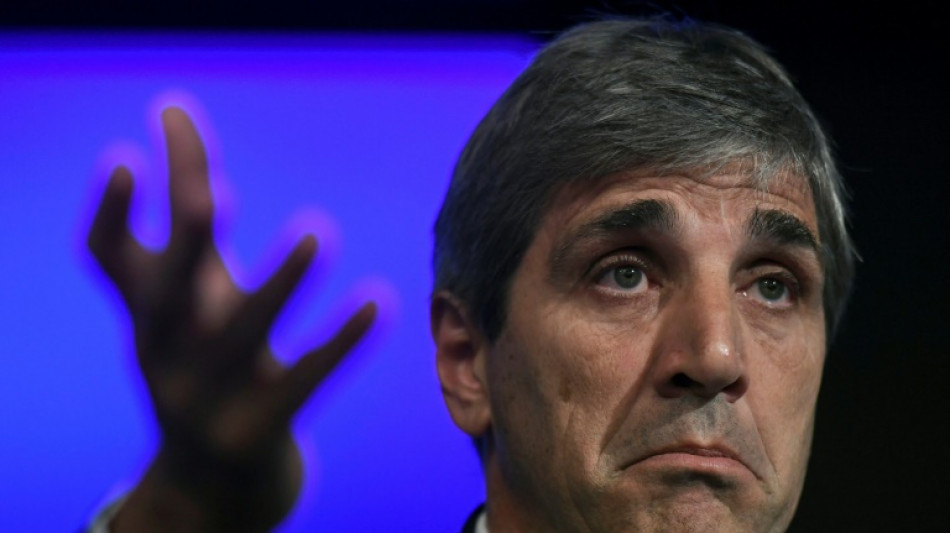
Argentina devalues peso, unveils measures to avoid 'hyperinflation' / Photo: © AFP/File

 US consumer inflation hotter than expected as midterms loom

 INmune Bio Inc. and Quantum Computing Inc. Partner to Apply Quantum Optimization and AI to Advance Alzheimer’s Drug Research and Explore New Applications for XPro

 Hot US inflation data dents Wall Street stocks

 India sends 'cockroach' leaders to jail after protest

 'Sinners' director Ryan Coogler to reboot 'X-Files' for Disney

 Lufthansa wins contest for TAP Air Portugal stake

 AI worms, 'major' incident fears spur safety calls at industry summit
 Fuel shortage triggers queues on Indonesia's Bali island

 Evolution Metals & Technologies Corp. Reaffirms $400 Million to $460 Million FY2027 Revenue Guidance, Unveils Eight Sintered Magnet Grades Covering an Estimated 75% of Global NdFeB Revenue, and Moves to Answer U.S. Army Call for Rare Earth Magnets

 Trial defence says Russia used Nord Stream pipelines as 'weapon'

 Israeli settlers set fire to mosque in occupied West Bank

 Macron says French student protesters 'exploited' by political forces: spokeswoman

 Stocks diverge ahead of key US inflation data
 Japan summons Russian ambassador to protest journalist's arrest

 Workers to strike at world's largest copper mine in Chile
 Ukraine accuses US of helping Russia as missiles hit Kyiv

 Drone hits data centre of Russia's largest bank

 Bivial AG Brings Its Complete Dashboard to Mobile

 Mont Blanc nearly two metres taller than in 2023: French surveyors

 Pope recovering after lung cancer operation that rattles Church
 Indonesia haze spikes Singapore pollution, shuts East Timor schools
 Higher borrowing costs an 'alarm signal' for France: finance minister
 Zelensky accuses Putin of disrespecting Trump after latest attacks
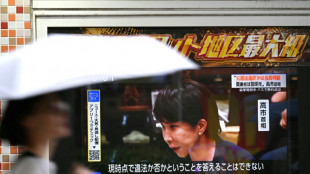 Japan PM says housework makes her busier than male predecessors

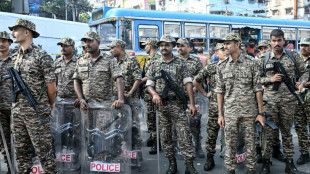 Top Indian 'cockroach' leaders sent to jail after protest

Argentina devalued its currency by more than 50 percent Tuesday in a set of "shock" measures aimed at reviving a crumbling economy and tackling triple-digit inflation.
The government of President Javier Milei, a libertarian who swept from obscurity to the top office vowing to chainsaw spending, also announced cuts to generous state subsidies and a halt to all new public construction projects.
In a pre-recorded video message, Economy Minister Luis Caputo took pains to explain to Argentines the causes of their decades of recurrent economic crises, debt, inflation and fiscal deficits.
Annual inflation is currently at 140 percent and poverty levels at 40 percent in Latin America's third-biggest economy.
The government coffers are also empty, and Milei has repeatedly said: "There is no money."
Caputo said the country had an "addiction" to spending to more than it earns, and had posted a fiscal deficit for 113 of the past 123 years.
"If we continue as we are, we are inevitably heading towards hyperinflation," said Caputo, adding that for the first time the government would tackle the problem "at its roots."
This is "precisely so that we do not have to suffer these consequences anymore, so that we do not have to suffer more inflation, so that we do not have to suffer more poverty," said Caputo.
The International Monetary Fund (IMF) -- to which Argentina owes $44 billion -- welcomed the measures.
"These bold initial actions aim to significantly improve public finances in a manner that protects the most vulnerable in society and strengthen the foreign exchange regime," the IMF said in a statement.
- 'Inflation to worsen' -
Caputo announced the exchange rate would slide to 800 pesos to the dollar, from about 391 in recent days, a devaluation of a little over 50 percent
The Argentine government has for years strictly controlled the exchange rate of the peso to the dollar, which analysts have derided as an expensive fiction.
There was no immediate mention of lifting the controls which have birthed a multitude of dollar exchanges and a thriving black-market where the dollar has sold for up to three times the official rate at times.
"The devaluation was much, much more than I think most people had expected," said Nicolas Saldias, a senior analyst with the Economist Intelligence Unit, adding this would have "significant impacts on inflation."
Milei and his government have doubled down on the message that inflation, and the general economic situation, will worsen significantly before they get better.
"We are going to be in poverty, and the situation is going to be much harder," said teacher Gabriel Alvarez, 57, reacting to the announcements.
Caputo also announced a reduction in the state's generous subsidies of fuel and transport -- with bus tickets costing only a few cents -- without saying by how much.
He said politicians had long supported the subsidies to "deceive people into believing that they are putting money in their pockets. But as all Argentines will have already realized, these subsidies are not free, but are paid with inflation."
- 'There is no money' -
Other spending cuts he announced include the suspension of all state advertising for a year -- which he said had cost 34 billion pesos in 2023.
In addition "The state will not tender any more new public works, and will cancel approved tenders whose development has not yet begun.
"The reality is that there is no money to pay for more public works that, as all Argentines know, often end up in the pockets of politicians or businessmen on duty."
He said infrastructure projects would be carried out by the private sector in future.
Another measure would be canceling the renewal of public jobs contracts that were less than a year old.
Milei has already slashed nine government ministries, which Caputo said would cut 34 percent of all political jobs.
However, in line with his promise to maintain welfare to the poorest, his government increased a child allowance and food card by 50 percent.
Saldias said this was "a really clear signal of how severe the inflationary crisis is going to be."
Argentines remain haunted by hyperinflation of up to 3,000 percent in 1989/1990 and a dramatic economic implosion in 2001.
M.Odermatt--BTB