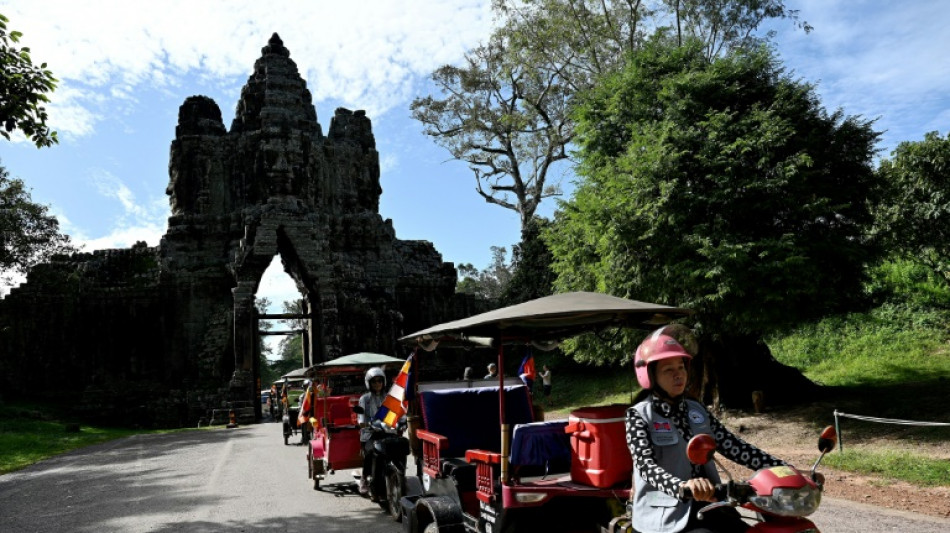
Cambodia's women tuk-tuk drivers fighting prejudice / Photo: © AFP

 US consumer inflation hotter than expected as midterms loom

 INmune Bio Inc. and Quantum Computing Inc. Partner to Apply Quantum Optimization and AI to Advance Alzheimer’s Drug Research and Explore New Applications for XPro

 Hot US inflation data dents Wall Street stocks

 India sends 'cockroach' leaders to jail after protest

 'Sinners' director Ryan Coogler to reboot 'X-Files' for Disney

 Lufthansa wins contest for TAP Air Portugal stake

 AI worms, 'major' incident fears spur safety calls at industry summit

 Fuel shortage triggers queues on Indonesia's Bali island

 Evolution Metals & Technologies Corp. Reaffirms $400 Million to $460 Million FY2027 Revenue Guidance, Unveils Eight Sintered Magnet Grades Covering an Estimated 75% of Global NdFeB Revenue, and Moves to Answer U.S. Army Call for Rare Earth Magnets

 Trial defence says Russia used Nord Stream pipelines as 'weapon'

 Israeli settlers set fire to mosque in occupied West Bank

 Macron says French student protesters 'exploited' by political forces: spokeswoman

 Stocks diverge ahead of key US inflation data

 Japan summons Russian ambassador to protest journalist's arrest

 Workers to strike at world's largest copper mine in Chile

 Ukraine accuses US of helping Russia as missiles hit Kyiv

 Drone hits data centre of Russia's largest bank

 Bivial AG Brings Its Complete Dashboard to Mobile

 Mont Blanc nearly two metres taller than in 2023: French surveyors

 Pope recovering after lung cancer operation that rattles Church
 Indonesia haze spikes Singapore pollution, shuts East Timor schools
 Higher borrowing costs an 'alarm signal' for France: finance minister

 Zelensky accuses Putin of disrespecting Trump after latest attacks

 Japan PM says housework makes her busier than male predecessors

 Top Indian 'cockroach' leaders sent to jail after protest

Every day Roeung Sorphy deftly weaves through the streets of Siem Reap, zigzagging past cars, motorbikes and the occasional stray dog as she shepherds tourists to the famed Angkor Wat temple complex.
But on the road to becoming one of Cambodia's tiny number of female tuk-tuk drivers, the 37-year-old who goes by the nickname Sopy has to dodge not only other road users, but also a barrage of taunts, misogyny and prejudice.
Cambodia has taken legal and practical steps towards gender equality, but it remains a conservative, patriarchal society. Women are expected to run the home and family rather than seek paid work.
When Sopy first took to the streets, it was tough.
"At first, they (male drivers) looked down on me... They said we women should stay at home and clean dishes," she told AFP, describing how she was verbally harassed and assaulted when competing for fares.
"But we keep persevering," she said after she finished cleaning her tuk-tuk, passionately decorating it with blooming white lotus flowers.
She got her start after borrowing $3,000 to buy her tuk-tuk, and has now been driving through the shaded roads of Angkor Park for more than three years.
"We cannot just rely on husbands," she said, urging more women to join the profession.
"We will be strong like men," said Sopy, whose husband is also a tuk-tuk driver.
She charges roughly $15 per passenger for a tour around Angkor, a sprawling UNESCO World Heritage site.
After years, her male colleagues have finally accepted her.
"We have won their hearts, they've stopped discriminating against us. They think we are the same."
"I love the job. I think all women can do it."
- Still difficult -
A 2020 US Agency for International Development report said women were being held back by low wages, poor working conditions, a lack of childcare and limited access to finance and training.
To help women in the male-dominated field, well-known driver Kim Sokleang -- better known as Tuk-Tuk Lady -- last year founded the Siem Reap Remorque Driver Association.
Her group includes 20 female drivers, six of whom, like her, are single mothers.
"Discrimination against Cambodian women still exists," Kim told AFP while waiting for passengers at the Bayon temple.
After getting a divorce in 2013, Kim began driving a rickshaw in the capital Phnom Penh to feed her two sons.
"On the first day, I did not have any passengers," Kim said, recalling how one woman refused to ride with her.
Finding Phnom Penh tough, the 39-year-old moved to Siem Reap in 2015 to drive tourists.
Initially it was rough, Kim said, describing how she would sob in her tuk-tuk when she failed to get a fare.
"They think women are too weak to hold the steering wheel, and women cannot work like others," said Kim.
But her perseverance paid off: Tuk-Tuk Lady is now lauded by local and foreign tourists visiting Cambodia's top tourism destination.
Norwegian visitor Stine Solheim and a friend said they felt "safe" with Kim driving them, and were impressed with her efforts to stand up for women.
"They are really passionate about what they do and they really enjoy it and feel proud," she told AFP.
- Challenging stereotypes -
Two-wheeled carriages pulled by a motorbike, tuk-tuks are one of Cambodia's most famous means of transport.
No official statistics exist, but NGO Independent Democracy of Informal Economy Association, estimates there are tens of thousands of tuk-tuk drivers working across Cambodia.
"At first, as a woman, it was difficult to accept myself being a tuk-tuk driver. I never thought I could do it," said Sieng Meng, 36.
Part of that is down to the lack of government support, said Kim.
"If Cambodian leaders come and ride Tuk Tuks," it would help fight prejudices, she said.
Kim would like to see more women take up the career, and she plans to open a tuk-tuk restaurant when her team members retire.
"I've been really successful being a tuk-tuk driver," she said.
K.Thomson--BTB