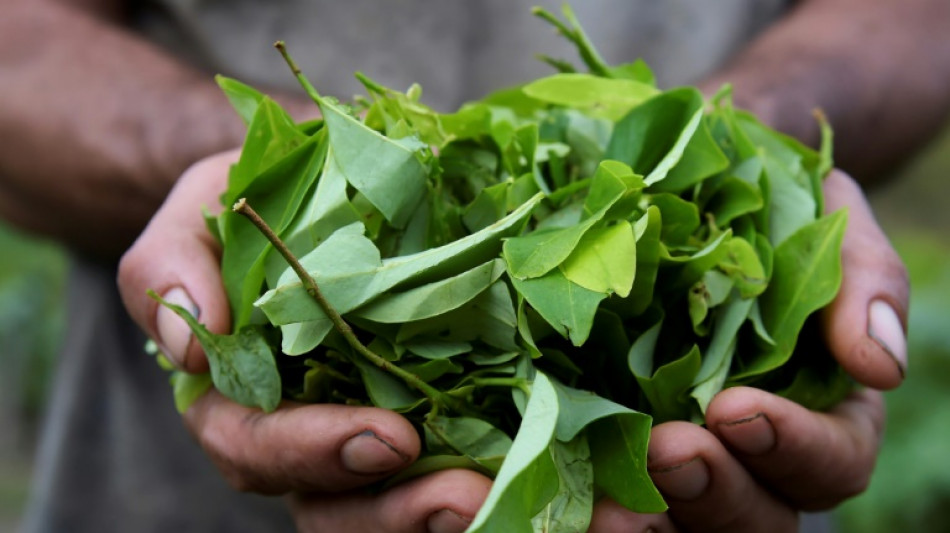
Cocaine market sees new players, bananas and Amazon submarines: report / Photo: © AFP/File

 Sally Rooney books cannot be sold in UK amid Palestine Action ban: publisher
 Italian ski stars Goggia and Brignone to miss season opener
 Bournemouth boss Rose urges Cherries to bounce back from Chelsea 'slap'

 Top seed Sabalenka falls at first hurdle in Wuhan

 FX Junction Brings Copy Trading to Everyone, While Their Money Never Leaves With Their Broker

 Brighton defender Struijk's red card overturned

 Saudi league postpones three matches after Houthi attacks

 US consumer inflation up more than expected as midterms loom

 Canadian publisher supports novelist Orelien after AI denial
 Medvedev sees off Tsitsipas to reach Shanghai Masters quarters
 Louvre boss warns of closure risk without major renovations
 Lawes and Genge urge England to end ban on overseas-based players

 Metrika Selected by OCC to Support Stablecoin Supervisory Framework Under the GENIUS Act

 Kenya hosting 2029 World Championships will help doping fight, says Coe
 UK prosecutor tells jury Russell Brand a 'sexual predator'

 Fulham manager Arbeloa fined £25,000 after Man Utd outburst

 Nepal flood triggered by rock and ice avalanche: report

 'Distressed' family of UK man killed by tiger urge end to online posts
 Regulator expects Man City appeal to be heard by January

 Rising Spanish tennis star handed code violation for swearing at ballboy

 Last of the French musketeers Monfils officially retired from tennis

 Ukraine ex-military officer stands trial over Nord Stream sabotage

 British and Irish Lions to play first women's match against France

 Fuel shortage triggers queues on resort island Bali
 Sao Tome's niche vanilla finds far-away fans
The global cocaine market is changing.
Colombia is still the biggest producer of the drug, but other actors are taking an ever bigger role in manufacturing and distributing it, according to a report based on thousands of Colombian prosecutor's files leaked by hackers.
A group of around a hundred journalists has deciphered some seven million emails and 38,000 files leaked by the Guacamaya hacktivist group which in 2022 broke into the computer systems of security agencies and armies from Mexico, Chile, Peru, Salvador and Colombia.
The so-called "Narcofiles" report outlines the networks of cocaine production and trafficking around the world.
"The market is changing," Nathan Jaccard, Latin America editor for the Organized Crime and Corruption Reporting Project (OCCRP), a consortium of investigative journalists which accessed the files, told AFP.
Colombia cultivated a record 230,000 hectares of coca leaf in 2022, and produced 1,738 tonnes of cocaine, according to the United Nations.
However, the country's cocaine trade has been hard hit by falling coca leaf prices and the emergence of new, synthetic drugs such as fentanyl.
The "Narcofiles" report shows that Mexican, Albanian, Brazilian, Ecuadorian and Israeli groups are starting to gain power in the global drug trade.
"Colombia no longer plays a leading role in the international drug trafficking chain," explains Elizabeth Dickinson, an analyst at Crisis Group.
A leaked memorandum between Colombia and Israel describes a "significant increase" in crimes committed in the South American country by Israelis attracted by sex tourism and linked, according to local authorities, to cocaine trafficking.
- Bananas and submarines -
The "Narcofiles" also revealed the growing role of the banana industry in the export of cocaine, and an increase in trafficking along routes such as the Amazon River, from which more and more submarines loaded with cocaine head to the Atlantic.
According to the European Commission, 70 percent of drug seizures in Europe take place at ports. Traffickers use banana shipments to hide their goods, as fresh produce passes customs checks more quickly.
Another new hotspot in the cocaine market is the triple border point where Peru, Colombia and Brazil meet in the Amazon.
This region was "relatively calm 15 years ago", said Jaccard.
The report also reveals that coca leaf plantations have multiplied in Central America and Mexico, while coca paste is increasingly being processed in laboratories in Europe.
"Drug traffickers are deciding to move closer to the markets" to reduce costs and risks, while maximizing profits, Jaccard explained.
Some of the changes mean that Colombian cartels and their kingpins, the likes of Pablo Escobar, no longer "run the show," said Dickinson.
Although large criminal structures such as the Clan del Golfo, the world's leading producer of cocaine, continue to operate in the country, "we are witnessing a process of atomization of groups" which reduces their power, said Jaccard.
C.Meier--BTB