Myanmar military's beer sales tumble after junta boycott / Photo: ©

 Ethiopia's conflict: the regional dimension
 Life expectancy almost back to pre-Covid levels, says WHO
 Turkey's football referee chief faces judge in graft probe
 Verstappen goes own way to avoid the rain
 Oil slides, bonds steady as EU addresses diesel price surge
 Spain housing package at risk in parliament, as protests mount

 Swedish Social Democrats leader to make new bid to form government
 North Korea calls Seoul 'despicable' after DMZ apology demand
 Taiwan boxer Lin wins gold as virtual taekwondo makes Games debut
 Man City face appeal deadline after explosive financial verdict
 Pole vault superstar Duplantis to skip indoor season
 Sri Lanka drop Asalanka from T20 against Pakistan
 Disney president says layoffs 'extremely painful' but necessary
 Indian flydubai pilot opened cockpit door to save passengers
 Alex Marquez clocks record lap at MotoGP Japan practice
 Tom Kim leads Asian Games golf in chase to avoid military service
 Asian stocks hit as oil spike fans rate hike bets, eyes on US jobs

 'We're losing our scientists': west Africa's STEM struggle
 World powers gather in Pacific to chart climate battle
 Return of swarming moth spectacle has Australia in a flutter

 Browns snuff out Rodgers fightback to beat Steelers 27-24
 Braves power past Phillies to set up Dodgers showdown
 Asian stocks drop as oil spike fans rate hike bets, eyes on US jobs
 Viral anti-vax posts weaponise Philippine inoculation fears
 Saudi coalition accuses Houthis of drone attack on Medina
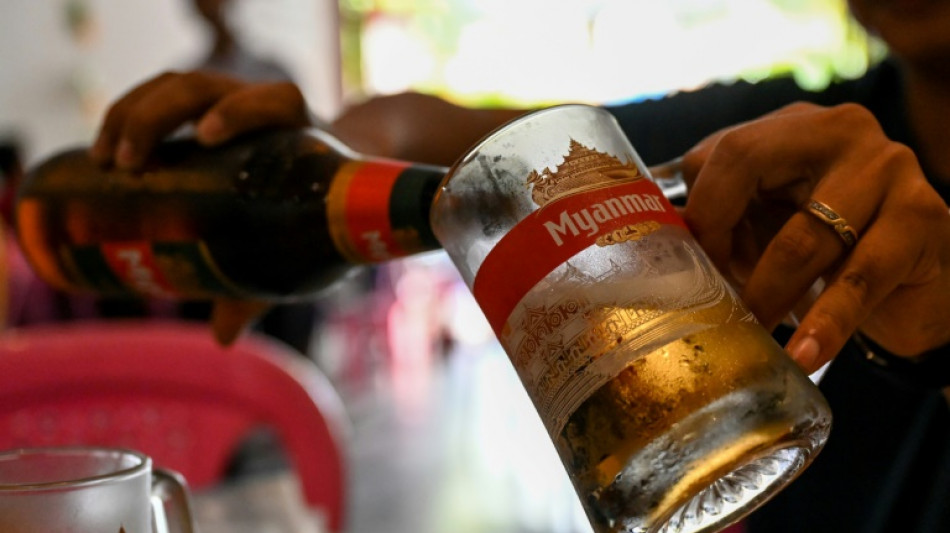
When Japanese brewing giant Kirin called time on its Myanmar operations last month, the news made little difference to Kyaw Gyi -- like many drinkers, he had long boycotted the beer it produced with a military conglomerate.
For years, Myanmar Beer dominated bars and supermarket shelves, its Japanese backing a sign of the economic liberalisation washing into the Southeast Asian country after the military relaxed its iron grip on power in 2011.
But after the generals ousted Aung San Suu Kyi's civilian government in February last year, many turned their backs on the brew, along with a host of other goods made by companies linked to the armed forces, from soap to coffee.
"We know other beer brands are paying tax to the military, but we don't want all of our money going to them," said sailor Kyaw Gyi, sitting outside a bar on Yangon's 19th Street, a popular drinking haunt.
"We avoid it. If there is only Myanmar Beer in the restaurant, then we don't drink beer," he said, using a pseudonym.
Farther along the street in Yangon's bustling downtown, restaurant manager Zaw Naing said his establishment hadn't sold the light, five percent brew since April last year.
It was not just the beer orders they had cancelled, he added -- they also asked the brand to take back all the chairs, tables and umbrellas that bore its red, white and gold emblem.
"If people see the Myanmar Beer logo with our restaurant name, they won't come," he said, also asking to use a pseudonym.
- Demand down -
As anger seethes at the military's crackdown on dissent -- which a local monitoring group says has killed more than 1,700 people -- establishments still serving the beer have faced more serious consequences.
In early March, bombs were set off outside two Yangon bars and a restaurant in second city Mandalay that were still selling the beer, according to local media.
Drivers transporting the beer in the rural central plains have also been stopped by local anti-coup groups and their cargoes trashed, according to local media reports.
Myanmar Brewery -- the firm run by Kirin and military conglomerate Myanma Economic Holdings -- enjoyed a market share of nearly 80 percent, according to figures published by Kirin in 2018.
Following months of Covid- and coup-related disruption in 2021, its year-end operating profit was just 6.6 billion yen ($54 million) -- compared with 13.8 billion the previous year.
In February, after months of trying to dissolve its partnership with the military-backed firm, and as pressure from rights groups escalated, the Japanese giant announced it would leave Myanmar.
The boycott and its upcoming exit is leaving rivals Heineken, Carlsberg and Thailand's Chang eyeing the market gap.
The three breweries "have picked up market share from Myanmar Beer, particularly in the cities", said a Yangon-based market observer who did not want to be named.
AFP has contacted Carlsberg for comment.
A representative for Heineken who requested anonymity said it was "too early to assess and comment on consumer purchasing habits".
- 'We keep drinking' -
But back on 19th Street, Aung Myo said customers had long switched to beers untainted by connections to military-backed firms, like Chang, Tiger -- owned by Heineken -- and Carlsberg's Tuborg.
"People don't want to drink Myanmar Beer even though it tastes good," he told AFP.
"The demand is definitely down."
In Myanmar's complex political landscape, there are still some areas where punters can enjoy a Myanmar Beer in peace.
Crowded bars in the military-built capital Naypyidaw were still serving it on a recent Saturday night, and the brew is reportedly still available in further-flung rural areas that have seen little coup-related violence.
The boycott has also been rebuffed in Rakhine in the west, where a truce between the junta and Arakan Army (AA) rebels fighting for greater autonomy has insulated the state from the turmoil gripping much of the rest of Myanmar.
"We don't see any boycott movement here," said government employee Htun Htun, 28, at a bar in state capital Sittwe, where billboards for the beer still lined the streets.
"So, we keep drinking it... The alcohol rate is not too high and the taste is good."
Analysts say the AA is taking advantage of the calm to expand its presence in the state, setting up its own courts and administration while the junta battles anti-coup dissidents elsewhere.
Clashes between the AA and the military in 2019 displaced more than 200,000 people across the state, one of Myanmar's poorest.
While the current peace lasts, Nyi Nyi, 27, said he would not be looking to change.
"If there's no problem with the military, we will still choose our usual Myanmar Beer," he said.
H.Seidel--BTB