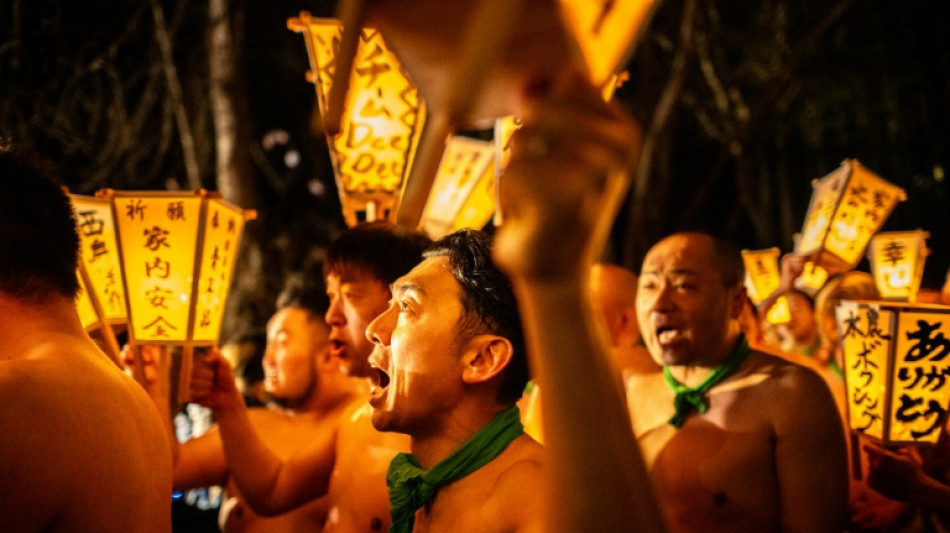
Japan's 'naked men' festival succumbs to population ageing / Photo: © AFP

 Brazil forward Antony says home burgled during Betis match

 Ravens face familiar foe in Browns coach Monken

 France, Germany reach deal on future of car industry

 Carney campaigns for Canadian unity before Alberta secession vote

 ATP proposes rankings system changes, extra player bonuses

 Russell Brand was 'monster-like', alleged victim tells UK court

 Crowded Launches Crowded MCP, Bringing Nonprofit Financial Operations Into ChatGPT and Claude

 Albanian PM condemns 'chaos' as violent unrest spreads

 Italian football suffers new blow with Champions League misery

 Trump scraps plan to livestream execution after broad backlash

 Seven missing off Romania after latest Black Sea drone attacks

 ARKBRIDGE Outlines Jonathan Morelli’s “Picks and Shovels” AI Infrastructure Investment Strategy

 Tech sell-off rolls on as hot inflation data stokes rate worries
 McIlroy makes 'solid' start in rain-hit Delhi as Norgaard leads

 Seven missing after fire on vessel in Black Sea off Romania

 'Severe drought' declared in parts of UK

 IUX Announces New Web Client Portal Built for Enhanced Browser-Based Trading

 School roof collapse kills teacher, 32 children in NW Pakistan

 Inter skipper Martinez facing month out with thigh injury

 Spanish prosecutors back abuse probe into Julio Iglesias

 Tech sell-off deepens as US inflation sparks AI jitters

 Southgate does not forsee a return to management

 Two dead as Istanbul endures heaviest rainfall in 80 years

 After latest Nepal flood, survivors fear for future

 EU leaders clash over budget as spectre of French elections looms

A steam of sweat rose as hundreds of naked men tussled over a bag of wooden talismans, performing a dramatic end to a thousand-year-old ritual in Japan that took place for the last time.
Their passionate chants of "jasso, joyasa" (meaning "evil, be gone") echoed through a ceder forest of the northern Japan's Iwate region, where the secluded Kokuseki Temple has decided to end the popular annual rite.
Organising the event, which draws hundreds of participants and thousands of tourists every year, has become a heavy burden for the ageing local faithful, who find it hard to keep up with the rigours of the ritual.
The "Sominsai" festival, regarded as one of the strangest festivals in Japan, is the latest tradition impacted by the country's ageing population crisis that has hit rural communities hard.
"It is very difficult to organise a festival of this scale," said Daigo Fujinami, a resident monk of the temple that opened in 729.
"I cannot be blind to the difficult reality."
- Ageing population -
Japan's society has aged more rapidly than most other countries'. The trend has forced countless schools, shops and services to close, particularly in small or rural communities.
Kokuseki Temple's Sominsai festival used to take place from the seventh day of Lunar New Year through to the following morning.
But during the Covid pandemic, it was scaled down to prayer ceremonies and smaller rituals.
The final festival was a shortened version, ending around 11:00 pm, but it drew the biggest crowd in recent memory, local residents said.
As the sun set, men in white loincloths came to the mountainous temple, bathed in a creek and marched around temple's ground.
They clenched their fists against the chill of a winter breeze, all the while chanting "jasso joyasa".
Some held small cameras to record their experience, while dozens of television crews followed the men through the temple's stone steps and dirt pathways.
As the festival reached its climax, hundreds of men packed inside the wooden temple shouting, chanting and aggressively jostling over a bag of talismans.
- Changing norms -
Toshiaki Kikuchi, a local resident who claimed the talismans and who helped organise the festival for years, said he hoped the ritual will return in the future.
"Even under a different format, I hope to maintain this tradition," he said after the festival.
"There are many things that you can appreciate only if you take part."
Many participants and visitors voiced both sadness and understanding about the festival's ending.
"This is the last of this great festival that has lasted 1,000 years. I really wanted to participate in this festival," Yasuo Nishimura, 49, a caregiver from Osaka, told AFP.
Other temples across Japan continue to host similar festivals where men wear loincloths and bathe in freezing water or fight over talismans.
Some festivals are adjusting their rules in line with changing democraphics and social norms so that they can continue to exist -- such as letting women take part in previously male-only ceremonies.
From next year, Kokuseki Temple will replace the festival with prayer ceremonies and other ways to continue its spiritual practices.
"Japan is facing a falling birthrate, ageing population, and lack of young people to continue various things," Nishimura said.
"Perhaps it is difficult to continue the same way as in the past."
I.Meyer--BTB