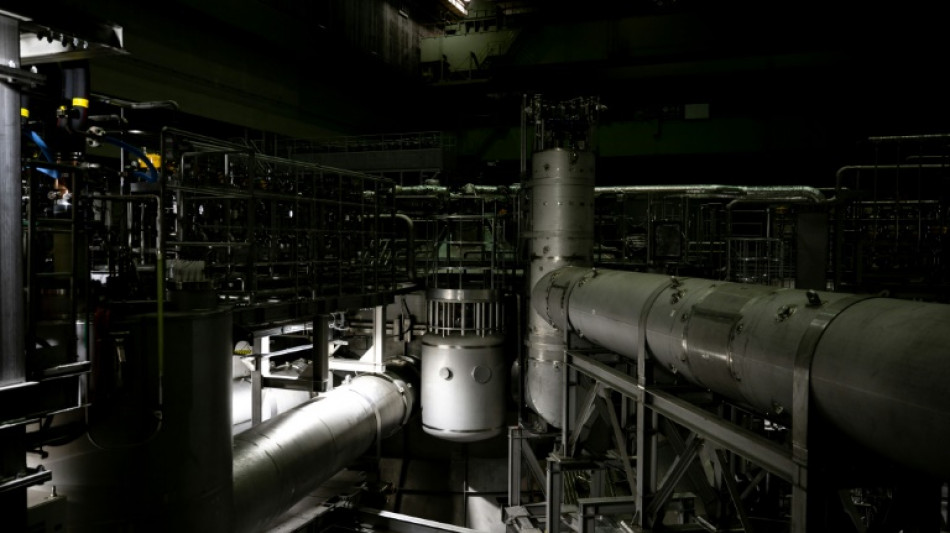
In a doughnut in Japan, unlocking the power of the Sun / Photo: © AFP

 Brazil forward Antony says home burgled during Betis match

 Ravens face familiar foe in Browns coach Monken

 France, Germany reach deal on future of car industry

 Carney campaigns for Canadian unity before Alberta secession vote

 ATP proposes rankings system changes, extra player bonuses

 Russell Brand was 'monster-like', alleged victim tells UK court

 Crowded Launches Crowded MCP, Bringing Nonprofit Financial Operations Into ChatGPT and Claude

 Albanian PM condemns 'chaos' as violent unrest spreads

 Italian football suffers new blow with Champions League misery

 Trump scraps plan to livestream execution after broad backlash

 Seven missing off Romania after latest Black Sea drone attacks

 ARKBRIDGE Outlines Jonathan Morelli’s “Picks and Shovels” AI Infrastructure Investment Strategy

 Tech sell-off rolls on as hot inflation data stokes rate worries

 McIlroy makes 'solid' start in rain-hit Delhi as Norgaard leads
 Seven missing after fire on vessel in Black Sea off Romania

 'Severe drought' declared in parts of UK

 IUX Announces New Web Client Portal Built for Enhanced Browser-Based Trading

 School roof collapse kills teacher, 32 children in NW Pakistan

 Inter skipper Martinez facing month out with thigh injury

 Spanish prosecutors back abuse probe into Julio Iglesias

 Tech sell-off deepens as US inflation sparks AI jitters

 Southgate does not forsee a return to management

 Two dead as Istanbul endures heaviest rainfall in 80 years
 After latest Nepal flood, survivors fear for future

 EU leaders clash over budget as spectre of French elections looms
With its tangle of pipes and pumps leading to a metal pot the size of a five-storey building, Japan's JT-60SA machine looks to the untrained eye like a contraption from 1970s sci-fi.
But inside it is a doughnut-shaped vessel where experiments done at millions of degrees could help unlock a carbon-free, inexhaustible and safe power source for the future: nuclear fusion.
"Fusion energy, the power behind the Sun and the stars, has been a great prize for energy research for decades, ever since it was first attempted in the 1950s and 60s to find some way to reproduce this power of the Sun here on Earth," project leader Sam Davis told AFP on a recent tour.
"Not only is (fusion) free from greenhouse gases and free from long-lived nuclear waste, but it's compact, doesn't cover the whole landscape, and can generate industrially useful quantities of power," the British-German engineer said.
Unlike fission, the technique currently used in nuclear power plants, fusion involves combining two atomic nuclei instead of splitting one, generating vast amounts of energy.
The process is safe and there are no nasty by-products like fissile material for a nuclear weapon or hazardous radioactive waste that takes thousands of years to degrade, its proponents say.
- Swirling plasma -
Taking 15 years to build in Naka, northeast of Tokyo, the JT-60SA is 15.5 metres (51 feet) tall and 13.7 metres (45 feet) wide, comprising a so-called tokamak vessel able to contain swirling plasma heated to millions of degrees.
Inside the facility, which was inaugurated in December, the aim is to get nuclei of hydrogen isotopes to fuse into an atom of helium, releasing energy, and mimicking the process that takes place inside the Sun and stars.
"With only one gram (0.04 ounces) of a mixed fuel... we can obtain an energy equivalent to eight tonnes of oil," said Takahiro Suzuki, deputy project manager for the Japan side of the joint project with the European Union.
But despite decades of efforts, the technology remains in its infancy and is very expensive.
Currently the largest such facility in operation, the JT-60SA is the little brother and guinea pig of the International Thermonuclear Experimental Reactor (ITER) being built in France.
According to media reports, ITER -- a project run by six countries and the European Union -- is years behind schedule and could end up costing as much as 40 billion euros ($42.3 billion), far more than first projected.
The holy grail of both projects, as well as others around the world, is to develop technology that releases more energy than is needed to fuel it -- and at a large scale and for a sustained period.
The feat of "net energy gain" was managed in December 2022 at the National Ignition Facility at Lawrence Livermore National Laboratory in the United States, home to the world's largest laser.
- 'Flash in a can' -
But the US facility uses a different method from ITER and the JT-60SA known as inertial confinement fusion, in which high-energy lasers are directed simultaneously into a thimble-sized cylinder containing hydrogen.
"Magnetic confinement, and in particular, tokamaks, of the kind that JT-60SA is, are much more applicable to running a steady state power plant, to steady energy production as we would need," Davis said.
"This is not just a flash in a can."
But with the world record set by China for heating plasma to the required temperature -- 120 million degrees Celsius (216 million degrees Fahrenheit) -- currently just 101 seconds, there is still a long path ahead.
"Nuclear fusion can certainly contribute to a future energy mix. Exactly on what timescale is very hard to say. It will come down ultimately to how much is invested in the field (and) how much society wants to pursue this as a solution," Davis said.
J.Fankhauser--BTB