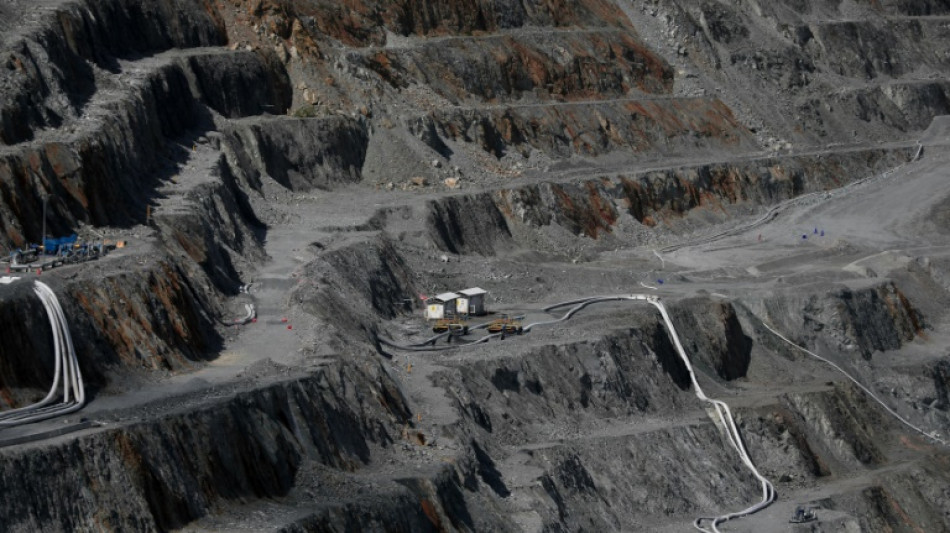
World resource extraction could surge 60% by 2060, UN warns / Photo: © AFP

 ChangeNOW Announces NOW AI After Resolving Website Integration Vulnerability

 Argentine demonstration over education cuts ends in clashes

 Argentine protesters, police clash at demo over university funding

 US stocks end higher as AI shares stabilize

 School roof collapse kills 32 children, teacher in Pakistan

 Lyon down Palace in Europa League, Sunderland leave it late

 UniCredit says receives ECB green light for Commerzbank takeover

 New York City pension fund asks Anthropic to delay IPO

 Venezuela's Maduro denies US torture charges as 'false accusations'

 Somalia sets May presidential election despite insecurity

 Chelsea's Caicedo eager to be more of a leader

 Rahm reaches separation deal with LIV in bankruptcy court

 UN chief urges nations to end 'war on nature'

 Newcastle boss Jaissle says Fernandez-Pardo just needs a goal

 Infantino offers apology but 'no answers' at FIFA meeting over World Cup plan

 Don't exclude Turkey from 'Made in Europe' plan: minister to AFP

 French duo Justice to score 'GTA VI': game maker

 El Nino a 'terrifying' threat to coral reefs: UN biodiversity expert

 Barcola must get used to Liverpool highs and lows, says Iraola

 Versus Trade Wins Best ECN/STP Broker APAC 2026, Marking Third UF Awards Recognition

 Three dead as Istanbul sees heaviest rainfall in 80 years

 US producer prices see biggest jump since 2022 in added challenge to Trump

 Swiatek avoids seed exodus to breeze into Wuhan last eight

 PM condemns 'chaos' as violent protests grip Albania

 'I couldn't breathe', Russell Brand's alleged rape victim says

Extraction of Earth's natural resources could surge 60 percent by 2060, imperilling climate goals and economic prosperity, the UN said Friday, calling for dramatic changes in energy, food, transport and housing.
Enormous expansion of infrastructure, energy demand and consumer consumption over the last half century, particularly in wealthier countries, has driven a tripling of the world's use of materials, according to the 2024 Global Resource Outlook by the UN Environment Programme's International Resource Panel.
And the hunger for natural resources -- everything from food to fossil fuels -- keeps growing by an average of more than 2.3 per cent per year, it said.
People in wealthy countries drive most of that demand, using six times more materials and responsible for ten times more climate impacts than those in low-income countries, according to the analysis.
Extraction and processing of the huge amount of resources accounts for over 60 percent of planet-warming emissions, the report said, as well as devastating ecosystems and harming human health.
Lead author Hans Bruyninckx said the current trajectory would cause the world to far exceed the temperature limits set out in the 2015 Paris Agreement, in which countries agreed to cap global warming "well below" two degrees Celsius and preferably at 1.5C.
"You've got resource use that is increasing, too much impact on Earth systems that is not tenable," he told AFP, adding that unequal access to resources across the world was also "untenable".
But he acknowledged that natural resources will be needed "to turn things around", both to boost development in poorer nations and to provide the minerals and metals needed for the energy transition.
The report follows an agreement by countries at UN climate negotiations last year in Dubai, to triple global renewable energy capacity this decade and "transition away" from polluting fossil fuels.
- 'Unprecedented scale and speed' -
Without sweeping change, the report warned, the exploitation of Earth's resources will continue, with computer modelling suggesting an increase by almost 60 per cent by 2060 from 2020 levels, from 100 to 160 billion tonnes.
"The only choice is to stabilise and balance the human relationship with the rest of nature," the report said.
"Weak, partial, fragmented or slow policies will not work. This can only be possible with far-reaching and truly systemic shifts in energy, food, mobility and the built environment implemented at an unprecedented scale and speed."
It said policy changes, focused on high-consumption countries, could reduce the projected growth in resource use by a third, slash greenhouse gas emissions 80 percent and improve health -- while still allowing economic growth.
Recommended actions, particularly in richer countries, include dietary changes that would reduce food waste and cut back on animal protein, more efficient transport systems, and denser housing using recycled building materials.
In developing countries where more resources are needed to improve lives, the report said the emphasis should be on maximising the benefits and minimising environmental and health impacts.
The report also called for the environmental costs of resource extraction to be priced into commodities and included in trade agreements.
"The economy is human made, it doesn't follow the laws of physics," Bruyninckx said.
"We made it in a certain direction, we can use the same government capacities to move it in a different direction."
C.Kovalenko--BTB