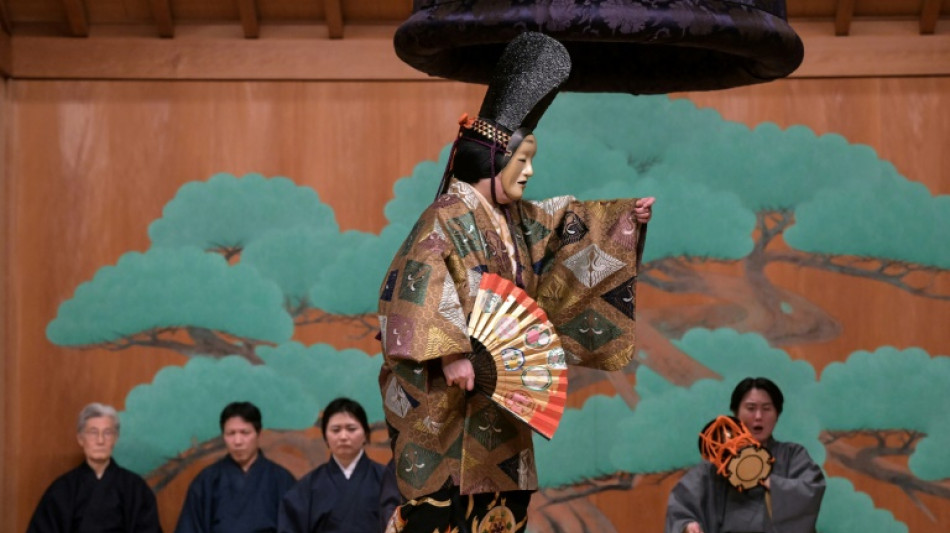
Women break into Japan's 'masculine' Noh theatre / Photo: © AFP

 Asian stocks rise as tech bounces from rout, eyes on Warsh
 Saudi organisers say 2027 Asian Cup 'on schedule' after attacks

 Right-wing Brazil influencers on 'mission' to seal Bolsonaro win

 Using AI to help find Mexico's legions of missing children

 Fiji to deploy solar-powered Australian military drones at sea

 'Multiple victims' in Oregon elementary school shooting, police say

 'Multiple victims' in Oregon elementary school shooting: police

 ChangeNOW Announces NOW AI After Resolving Website Integration Vulnerability

 Argentine demonstration over education cuts ends in clashes

 Argentine protesters, police clash at demo over university funding

 US stocks end higher as AI shares stabilize

 School roof collapse kills 32 children, teacher in Pakistan

 Lyon down Palace in Europa League, Sunderland leave it late

 UniCredit says receives ECB green light for Commerzbank takeover

 New York City pension fund asks Anthropic to delay IPO

 Venezuela's Maduro denies US torture charges as 'false accusations'

 Somalia sets May presidential election despite insecurity

 Chelsea's Caicedo eager to be more of a leader

 Rahm reaches separation deal with LIV in bankruptcy court

 UN chief urges nations to end 'war on nature'

 Newcastle boss Jaissle says Fernandez-Pardo just needs a goal

 Infantino offers apology but 'no answers' at FIFA meeting over World Cup plan

 Don't exclude Turkey from 'Made in Europe' plan: minister to AFP

 French duo Justice to score 'GTA VI': game maker

 El Nino a 'terrifying' threat to coral reefs: UN biodiversity expert

Kimono-clad Mayuko Kashiwazaki delivers her lines in guttural tones and transforms into an evil snake in the lead role of a Japanese Noh play where, unusually, most of the cast are women.
Noh, with its elaborate layered costumes and hand-crafted masks, is one of the most ancient surviving forms of theatre, with origins dating back to the eighth century.
Unlike kabuki, another type of classical Japanese theatre, or sumo wrestling -- both steadfastly male -- Noh has been open to performers of both genders for over a century.
But women are still a rarity in the traditional Noh world, where fathers often pass the vocation to their sons.
Women represent just 15 percent of the 1,039 actors and musicians registered with the professional Nohgaku Performers' Association.
And their opportunities to appear on stage are "relatively limited", 43-year-old Kashiwazaki told AFP.
"One reason is that Noh audiences are generally older, and often see Noh as a masculine art form," she said.
But now it's time "for women to reflect on their future in Noh, and to play a role in building that future".
Kashiwazaki acted the principal part in "Dojoji", a famous drama about the revenge of a betrayed woman, at Tokyo's National Noh Theatre last weekend.
Twirling a fan, and wearing a heavy kimono embroidered with a crane motif, the masked actor belted out her lines in an archaic, warbling style as the story slowly unfolded.
After hiding under a prop representing the bell of a Buddhist temple, she emerged transformed as a demonic serpent character with wild, fiery tufts of red hair.
- 'Beauty and power' -
Kashiwazaki, encouraged by her Noh mentor, tried to find as many women as possible to participate in the production.
"'Dojoji' is an extremely important piece for Noh actors," Kashiwazaki said, and "you have to be very lucky to get a chance to perform it, even once in your life".
"Because I was lucky enough to have this opportunity, I thought it would be great to stage it with other female Noh actors."
Yoko Oyama, who played a handheld drum in the show, said it was unusual to see "so many women in the chorus and among the musicians on stage".
"It's not only the fact that they are women, but also that most of them are young for Noh performers, which makes the show even more special," she said.
However, for some parts, including the supporting actor or "waki" in Noh -- often a monk or priest character -- there were no women to fill the role, so it was played by a man.
"There are no women performing waki... it has always been that way," Kashiwazaki's mentor, 72-year-old Yasuaki Komparu, told AFP.
While Komparu is the scion of one of five prominent Noh families that have bred generations of actors, Kashiwazaki first discovered Noh as a student.
She was charmed by its lyrical dramas and the heavily stylised acting in a minimal setting. A painting of a pine tree behind the stage is usually the only decoration.
"I was fascinated by how cool this Japanese art form looked, and thought I could only truly understand it by taking part myself," she said.
- 'Vicious cycle' -
Kashiwazaki's first mentor tried to dissuade her from becoming a Noh actor, having experienced herself the difficulties women face in the ancient art.
Now recognised by UNESCO as "intangible cultural heritage", Noh developed towards its current form in Japan's Muromachi era from 1336-1573, a period when the performers included women among their ranks.
In the Edo era from 1603 to 1868, patronage from shoguns helped Noh's popularity grow.
But women were banned from the stage under government morality rules that repressed individual liberties.
Only at the end of the 19th century were women once again allowed to act in Noh, but they had to wait until 1948 to be recognised as professionals.
"There are extraordinary Noh actors, men and women, but the public tends to seek out a particular type of Noh, with a fixed idea of what it should be," Kashiwazaki said.
That lack of opportunities creates a "vicious cycle" because actors can't build up the experience to progress their careers, she said.
After Saturday's show, audience member Kazuaki Ieda, 40, said he was "very interested and excited" by the performance.
"I think this may be the future of Noh in Japan," Ieda said.
L.Janezki--BTB