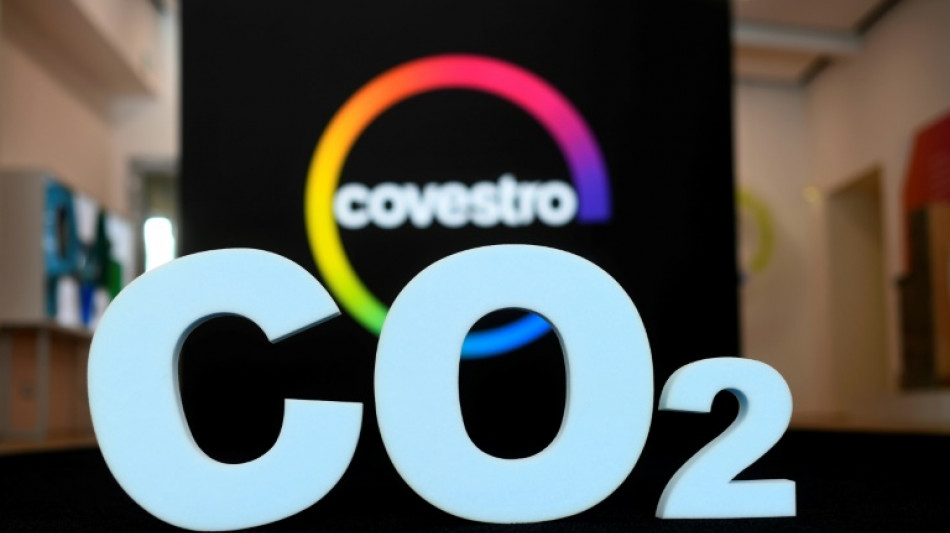
In climate push, German chemical maker swaps oil for sugar / Photo: © AFP

 New Zealand star Ponga breaks arm in Rugby League World Cup opener

 Indonesian stocks dive 11% as MSCI weighs market reclassification

 Seoul dismisses Pyongyang's scepticism over hypersonic weapon test

 Yamal on song as entertainers Barcelona face Betis challenge

 Wong weighs haze prosecutions as Singapore air quality worsens

 Brush fire prompts an evacuation order along Los Angeles coast

 'Mixed feelings': AI cracks centuries-old ciphers

 Le Pen looms large as Macron enters final months on EU stage

 Three children, one teacher killed in Oregon elementary school shooting

 Man Utd teetering towards crisis as Man City cloud hangs over Premier League

 Trump's new press secretary defends 'lawyer' title

 Wallabies coach has 'faith' as All Blacks juggernaut awaits

 Ailing UK director Mike Leigh wishes he could make '100 more films'

 Pixagram Announces Free Account Creation for 250 New Users Daily Through 2026

 Macron warns urgent to strike EU budget deal before French vote runup

 Zelensky rallies European allies as Trump ties slump

 Guardians edge Rays to seize MLB playoff series lead

 Trump scraps plan to livestream execution after fierce backlash

 Martinez apologises for outburst at Man Utd hierarchy

 Houthis launch deadly attack on presidential palace in Yemen's Aden

 Brazil forward Antony says home burgled during Betis match

 Ravens face familiar foe in Browns coach Monken

 France, Germany reach deal on future of car industry

 Carney campaigns for Canadian unity before Alberta secession vote

 ATP proposes rankings system changes, extra player bonuses

At one of Europe's largest chemical complexes, German group Covestro is trialling the manufacture of a key product using sugar as a base material instead of oil, as the industry seeks to reduce its carbon footprint.
The pilot project involves producing "aniline", a chemical used in making foams -- used widely in mattresses and armchairs, as well as building insulation.
While large-scale, commercial production is probably years away, the experiment marks a small step in the chemical industry's battle to slash carbon emissions as Earth faces a dire climate emergency.
Of the 100 million barrels of oil produced worldwide every day, "a quarter goes directly into the chemical industry," said Walter Leitner, from Aachen University, which has been involved in the aniline project for a decade.
"The chemical industry needs to be completely rebuilt."
Plastics manufacturer Covestro -- a former division of chemical giant Bayer -- started trials at its complex in the western city of Leverkusen at the end of 2023, after laboratory tests.
In a 100-square-metre (1,080-square-foot) room, aniline, a transparent fluid, is extracted from a 600-metre network of intertwined pipes.
Using a process developed by University of Stuttgart researchers, fermented sugar is treated with chemicals to make the product.
Aniline is used as the base ingredient for chemical MDI, which is an essential material in manufacturing foams.
Traditionally, aniline has been obtained from crude oil derivatives like naphtha and benzene, but producing it emits large quantities of carbon dioxide, a key greenhouse gas.
Around six million tonnes of aniline are produced globally a year, around one million tonnes of it by Covestro.
So far, the pilot project in Leverkusen produces just a tiny part of this, extracting just half a tonne of aniline a day.
- Punishing energy costs -
Some experts are sceptical about such an approach.
The use of plant matter in manufacturing may cut out fossil fuels but whether it can lead to carbon neutrality "is often questionable", Jens Guenther, from Germany's Federal Environment Agency, told AFP.
This is particularly the case when it comes to the use of "so-called cultivated biomass like maize, sugar cane and sugar beet," he said.
Janine Korduan, from environmental NGO BUND, pointed out that industrial agriculture generates "CO2 and methane emissions through land conversion and the production of fertilisers and pesticides", and also leads to "major losses of biodiversity and high water consumption".
Nevertheless, Guenther said the use of plant matter in production processes would likely produce significantly lower greenhouse gas emissions than using fossil fuels, although opting for waste materials rather than crops produced in large-scale farming would be preferable.
Other German companies are experimenting in the area.
Chemical giant BASF is seeking to use organic waste, agricultural products or vegetable oils to produce basic chemicals like aniline.
There are many barriers to taking such projects further, however.
These range from the availability of the necessary organic matter, which is in great demand as the green transition gathers pace, to higher costs when compared to producing such chemicals with oil.
Scaling up the process will only be justified if it leads to "significant CO2 savings" in the manufacturing process, said Thorsten Dreier, a member of Covestro's management board who is overseeing the technology.
There will also need to be proof that money "can be made in a competitive environment, in order to finance research here", he said.
And for Germany, a major challenge will be persuading manufacturers to set up costly new sites for processing chemicals.
The energy-intensive chemicals sector in Europe's top economy has been facing a crisis since Moscow's invasion of Ukraine curtailed cheap Russian gas imports, sending power costs soaring.
Many companies are now more focused on shifting production to cheaper locations overseas, rather than expanding at home.
"Energy costs in Germany are currently three to four times higher than in the United States," while a bloated bureaucracy is also weighing on industry, warned Dreier.
C.Kovalenko--BTB