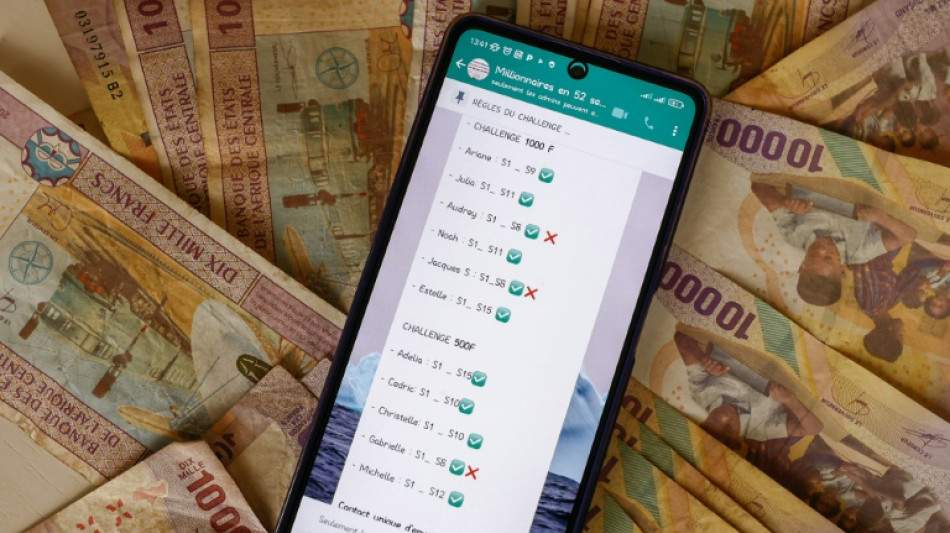
Ancient community banking enters digital age in Cameroon / Photo: © AFP

 New Zealand star Ponga breaks arm in Rugby League World Cup opener

 Indonesian stocks dive 11% as MSCI weighs market reclassification

 Seoul dismisses Pyongyang's scepticism over hypersonic weapon test

 Yamal on song as entertainers Barcelona face Betis challenge

 Wong weighs haze prosecutions as Singapore air quality worsens

 Brush fire prompts an evacuation order along Los Angeles coast

 'Mixed feelings': AI cracks centuries-old ciphers

 Le Pen looms large as Macron enters final months on EU stage

 Three children, one teacher killed in Oregon elementary school shooting

 Man Utd teetering towards crisis as Man City cloud hangs over Premier League

 Trump's new press secretary defends 'lawyer' title

 Wallabies coach has 'faith' as All Blacks juggernaut awaits

 Ailing UK director Mike Leigh wishes he could make '100 more films'

 Pixagram Announces Free Account Creation for 250 New Users Daily Through 2026

 Macron warns urgent to strike EU budget deal before French vote runup

 Zelensky rallies European allies as Trump ties slump

 Guardians edge Rays to seize MLB playoff series lead

 Trump scraps plan to livestream execution after fierce backlash

 Martinez apologises for outburst at Man Utd hierarchy

 Houthis launch deadly attack on presidential palace in Yemen's Aden

 Brazil forward Antony says home burgled during Betis match

 Ravens face familiar foe in Browns coach Monken
 France, Germany reach deal on future of car industry

 Carney campaigns for Canadian unity before Alberta secession vote

 ATP proposes rankings system changes, extra player bonuses

Joseph Ngono's face lights up with a smile as he looks at his smartphone, where a payment worth $830 has just appeared in his digital wallet.
Like many Cameroonians, the computer scientist pays in each week to a shared savings fund known as a "tontine" -- an ancient system that start-ups are now bringing into the digital age.
This week it has paid out 500,000 Central African francs to Ngono, who will use it to cover the final instalment of his children's school fees.
"Without it, they wouldn't go to school," he said.
Shunned by banks, many people in Cameroon turn to their communities for help in the form of tontines, such as the one Ngono uses via the smartphone app Djangui.
In its most common form, members pay money into a common fund and take turns collecting it after an agreed period -- interest free.
Every week Ngono, along with colleagues and strangers whom they sponsor, contributes 10,000 FCFA ($16) each on Djangui.
It gives crucial access to ready cash for Ngono -- he only occasionally receives his monthly salary of 150,000 FCFA ($250) because his employer is "experiencing some cash-flow difficulties."
- Digital savings schemes -
The system of "pooling savings... between people united by connections of family, friendship, profession, clan" existed "long before the introduction of money," said a 2020 report published by the Global Development Research Center.
It lists at least 30 African countries where tontines are used and 14 in Asia.
Launched in 2016 by Guilain Kenfack, Djangui was one of the first tontine apps in the country.
"The idea came to me because I was in a traditional tontine and it was becoming very difficult. We weren't sure if some people had paid or not," he said.
Since its creation, Kenfack said the app has gained 50,000 users.
A number of imitators of Djangui have sprung up and now there are several apps offering tontines online in Cameroon.
- 'Replace the bank' -
As in other countries in Africa, many Cameroonians struggle to get loans from mainstream banks.
The African World Institute wrote in a 2019 report that 85 percent of people on the continent are "excluded from the banking system".
In Cameroon and elsewhere the average interest rate for loans to individuals was 10 percent in 2022, according to the Bank of Central African States (BEAC).
It can exceed 20 percent elsewhere in Africa.
Banks also rarely give credit to those on small and medium sized incomes.
The tontine "replaces the bank" and allows "informal economic players" to make essential expenditures or investments, said Omer Zang, the founder of Social Brokers -- a Cameroonian NGO that supports tontines.
The digitised saving systems have attracted the interest of large banking corporations including Cameroon's Afriland First Bank which offers customers the chance "to tontine."
- Online fraud risk -
However, even online tontines can be risky as people can register under false identities.
"I lost over one million Central African francs ($1,700) that I had saved for a year" in an online tontine, said Paul Kemayou, a 48-year-old civil servant.
"When it came to receiving the money, the administrator was unable to tell me where the money had gone."
This is why some Cameroonians keep to the traditional tontines.
"I prefer the tontines where people meet in person," said Emmanuel Talla, a shopkeeper in Yaounde, who is a member of several tontines in the capital.
"We know each other, the old and the young get together," he said. "The relationships are about more than just money."
F.Pavlenko--BTB