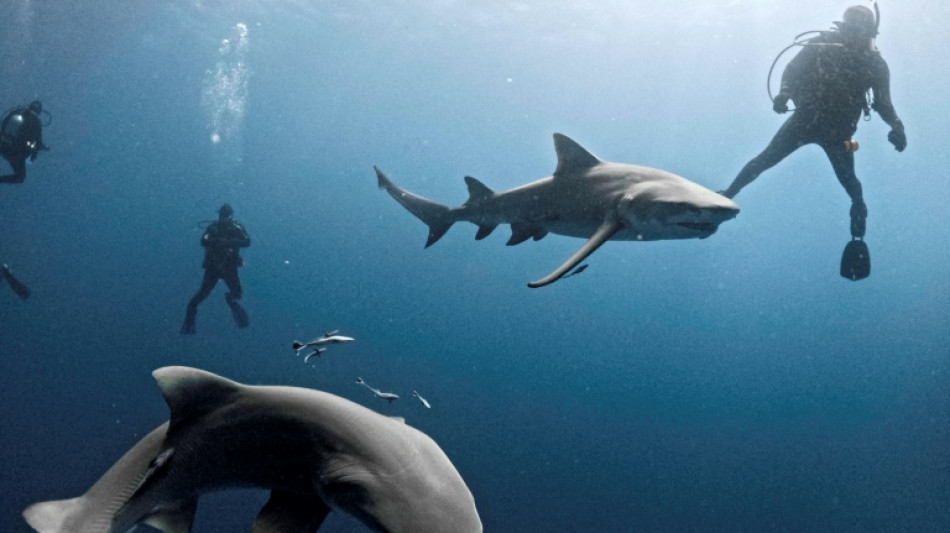
With bites rare, experts want sharks to shed scary reputation / Photo: © AFP

 India closes down New Delhi park ahead of 'cockroach' movement rally

 'Let us build': World Bank chief outlines jobs-led development agenda

 Broncos top Super Bowl champion Seahawks in overtime

 Brilliant Brewers sweep Dodgers to reach World Series

 Brewers complete Dodgers sweep to reach World Series

 High-flying Freiburg try to shut out the noise as fairytale run continues

 Flamengo secure 0-0 draw in La Plata in Copa Libertadores semi

 The final lap? Two days on the campaign trail with Trump

 Asian stocks rise as tech bounces from rout, eyes on Warsh

 Saudi organisers say 2027 Asian Cup 'on schedule' after attacks

 Right-wing Brazil influencers on 'mission' to seal Bolsonaro win

 Using AI to help find Mexico's legions of missing children

 Fiji to deploy solar-powered Australian military drones at sea

 'Multiple victims' in Oregon elementary school shooting, police say

 'Multiple victims' in Oregon elementary school shooting: police

 ChangeNOW Announces NOW AI After Resolving Website Integration Vulnerability

 Argentine demonstration over education cuts ends in clashes

 Argentine protesters, police clash at demo over university funding

 US stocks end higher as AI shares stabilize

 School roof collapse kills 32 children, teacher in Pakistan

 Lyon down Palace in Europa League, Sunderland leave it late

 UniCredit says receives ECB green light for Commerzbank takeover

 New York City pension fund asks Anthropic to delay IPO

 Venezuela's Maduro denies US torture charges as 'false accusations'

 Somalia sets May presidential election despite insecurity

As the northern hemisphere edges toward spring and millions flock to the beach, headlines have dubbed the southeastern US state of Florida the world's most likely place to be bitten by a shark.
They're right, but, at the same time, shark bites are exceedingly rare overall -- a fact scientists wish more people knew, especially amid declining shark populations desperately in need of conservation.
"When the sharks in the water are targeting the fishes that they normally feed on, once in a while, people get in the way and the sharks make a mistake," said Gavin Naylor, coauthor of a recent report tallying last year's shark attacks.
According to data he gathered for the University of Florida's International Shark Attack File, Florida was home to a quarter of last year's shark attacks -- a scary statistic, if taken on its own.
And yet that only amounts to 16 unprovoked attacks, out of 69 total worldwide -- and millions of swimmers flocking to Florida's coast each year.
If sharks wanted to attack us, "people are very easy to target. They are a bit like floating sausages," Naylor told AFP.
"So we know that they must be avoiding them."
- Shark attack 'capital' -
Florida's subtropical latitude means many sharks move through the waters of its continental shelf, which are rich in nutrients and therefore in fish to feed them.
And miles of beaches attract huge numbers of tourists to the Sunshine State -- 135 million last year, according to Florida statistics.
Yet despite the long odds of a shark bite, the predators still carry an outsized reputation -- one probably not helped by their rows of razor sharp teeth, or fictional movies about killer sharks like "Jaws" and the decades-long US cable television phenomenon known as "Shark Week."
New Smyrna Beach, located in Volusia County -- home to half of Florida's shark bites last year -- is inauspiciously known as the "shark bite capital of the world."
Surfers often flock to its coast, where the murky waters reduce sharks' visibility, and increase the chance they will bite a human by mistake.
Bites are like an "airplane crash" -- shocking but rare, said New Smyrna Beach resident Bruce Adams, who remembers close encounters with sharks of his own during his surfing days.
"It's sensational, it sells a lot of T-shirts," he told AFP, lamenting the creatures' bad reputations.
- Swimming with sharks -
In fact, most of us have probably been in the water alongside sharks -- we just didn't know it, said report coauthor Joe Miguez.
"They don't really want anything to do with us," he told AFP.
Some humans meanwhile are seeking out sharks.
In Jupiter, some 90 miles (150 kilometers) north of Miami, Jonathan Campbell has done more than 500 dives with a coterie of enthusiasts, all there to swim with sharks.
"You see sharks in movies and they are scary monsters. But in the water, they are actually shy puppy dogs," he said.
In fact, amid crashing shark populations -- there has been a 70 percent worldwide decline since 1970, according to a recent study -- what the world might need is more sharks.
"We should be more focused on conserving these animals than just going out and saying that they're out to get us," said Miguez.
K.Brown--BTB