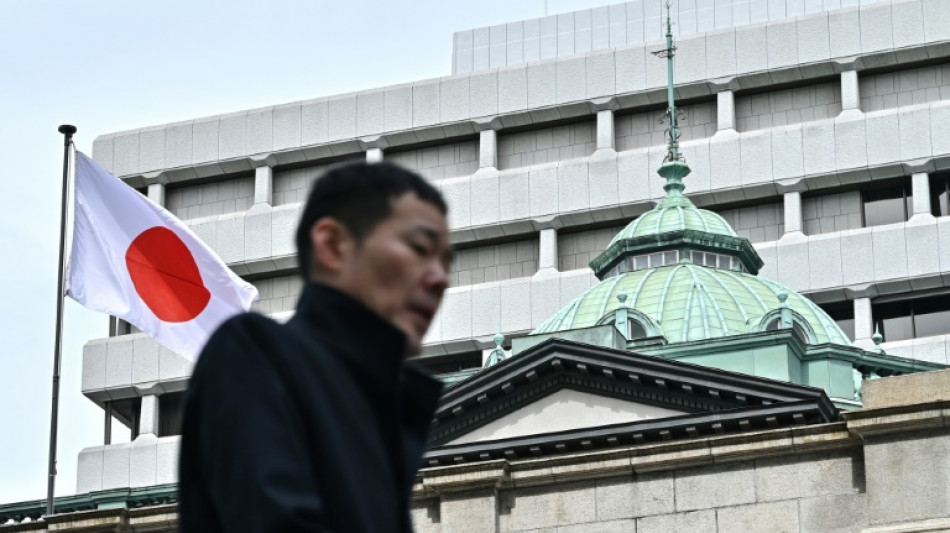
Bank of Japan scraps negative interest rate / Photo: © AFP

 Families of children killed in Pakistan school roof collapse demand justice

 Asian stocks rise as tech bounces from rout, Warsh upbeat on AI

 Trump's new press secretary says China lacked 'proper' toilets

 India closes down New Delhi park ahead of 'cockroach' movement rally
 'Let us build': World Bank chief outlines jobs-led development agenda

 Broncos top Super Bowl champion Seahawks in overtime

 Brilliant Brewers sweep Dodgers to reach World Series

 Brewers complete Dodgers sweep to reach World Series

 High-flying Freiburg try to shut out the noise as fairytale run continues

 Flamengo secure 0-0 draw in La Plata in Copa Libertadores semi

 The final lap? Two days on the campaign trail with Trump

 Asian stocks rise as tech bounces from rout, eyes on Warsh

 Saudi organisers say 2027 Asian Cup 'on schedule' after attacks

 Right-wing Brazil influencers on 'mission' to seal Bolsonaro win

 Using AI to help find Mexico's legions of missing children

 Fiji to deploy solar-powered Australian military drones at sea

 'Multiple victims' in Oregon elementary school shooting, police say

 'Multiple victims' in Oregon elementary school shooting: police

 ChangeNOW Announces NOW AI After Resolving Website Integration Vulnerability

 Argentine demonstration over education cuts ends in clashes

 Argentine protesters, police clash at demo over university funding

 US stocks end higher as AI shares stabilize

 School roof collapse kills 32 children, teacher in Pakistan

 Lyon down Palace in Europa League, Sunderland leave it late

 UniCredit says receives ECB green light for Commerzbank takeover

Japan's central bank on Tuesday on Tuesday its negative interest rate as it finally began unwinding one of the world's most aggressive monetary easing programmes.
After announcing its first increase in 17 years, the Bank of Japan said it was changing its short-term policy rate from -0.1 percent to between zero and 0.1 percent.
Officials "assessed the virtuous cycle between wages and prices, and judged it came in sight that the price stability target of two percent would be achieved in a sustainable and stable manner towards the end of the projection period of the January 2024 Outlook Report", it said.
The bank also said it would call an end to other unorthodox policies including its yield curve control programme on bonds and the purchase of risk assets such as exchange-traded funds (ETFs) and Japan real estate investment trusts.
The Federal Reserve and other central banks yanked up rates to rein in galloping inflation after Russia's 2022 invasion of Ukraine.
But haunted by the country's "lost decades" of stagnation and deflation, the BoJ kept its main rate negative, as it has been since 2016. The last hike was in 2007.
Raising the rate will make loans more expensive for consumers and businesses.
It will also increase Japan's bill for servicing the national debt, which at around 260 percent of national output is one of the world's highest.
Because negative interest rates mean banks lose out by parking capital with the BoJ, the policy was aimed at encouraging them to lend to businesses and thereby jump-start the economy and inflation.
The BoJ has also spent vast amounts buying up bonds and other assets to pump liquidity into the financial system.
The policy has sharply weakened the yen against the dollar, which is good news for exporters but not for consumers as it made imports more expensive.
Inflation has been at or above the BoJ's target of two percent for almost two years.
But despite some tweaks around the edges -- such as more flexibility with regard to its target range for bond yields -- the main interest rate has remained negative.
This is because the BoJ wanted more evidence of a "virtuous cycle" of rising wages and inflation driven by demand and not temporary factors.
The final piece of the jigsaw appears to have come on Friday when Japan's largest trade union secured a wage hike of 5.3 percent from employers, the biggest since 1991.
"Japan's in the ballpark of what's needed to sustain two percent inflation domestically," Stefan Angrick at Moody's Analytics said Monday.
The BoJ was also set to scrap other unorthodox measures including its yield curve control programme on bonds and the purchase of risk assets, the Nikkei reported on Tuesday.
"We trust the BoJ," the paper quoted a source close to Japanese Prime Minister Fumio Kishida as saying. The decision "is in their hands".
But moving too aggressively could also see large volumes of capital attracted to Japanese assets, potentially destabilising financial markets.
N.Fournier--BTB