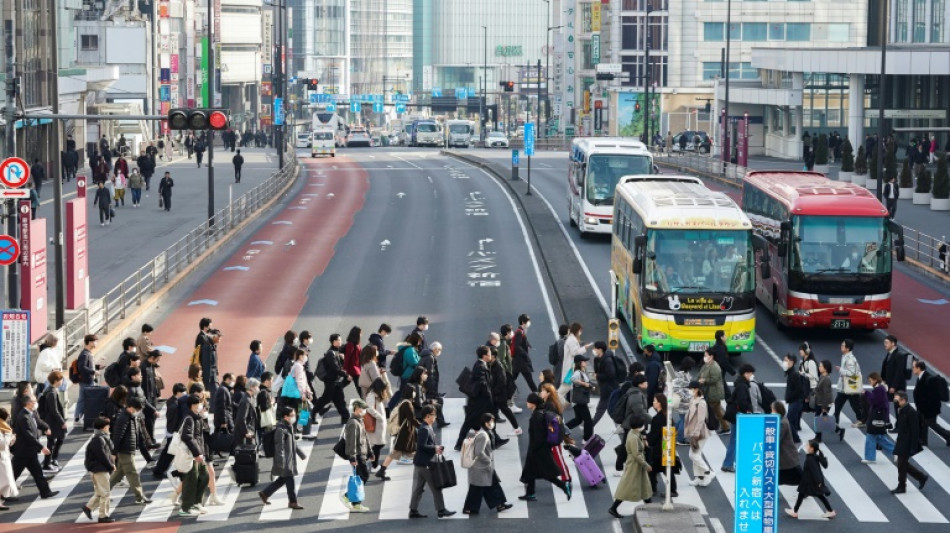
Easy does it: The Bank of Japan's experiment / Photo: © AFP

 Families of children killed in Pakistan school roof collapse demand justice

 Asian stocks rise as tech bounces from rout, Warsh upbeat on AI

 Trump's new press secretary says China lacked 'proper' toilets

 India closes down New Delhi park ahead of 'cockroach' movement rally
 'Let us build': World Bank chief outlines jobs-led development agenda

 Broncos top Super Bowl champion Seahawks in overtime

 Brilliant Brewers sweep Dodgers to reach World Series

 Brewers complete Dodgers sweep to reach World Series

 High-flying Freiburg try to shut out the noise as fairytale run continues

 Flamengo secure 0-0 draw in La Plata in Copa Libertadores semi

 The final lap? Two days on the campaign trail with Trump

 Asian stocks rise as tech bounces from rout, eyes on Warsh

 Saudi organisers say 2027 Asian Cup 'on schedule' after attacks

 Right-wing Brazil influencers on 'mission' to seal Bolsonaro win

 Using AI to help find Mexico's legions of missing children

 Fiji to deploy solar-powered Australian military drones at sea

 'Multiple victims' in Oregon elementary school shooting, police say

 'Multiple victims' in Oregon elementary school shooting: police

 ChangeNOW Announces NOW AI After Resolving Website Integration Vulnerability

 Argentine demonstration over education cuts ends in clashes

 Argentine protesters, police clash at demo over university funding

 US stocks end higher as AI shares stabilize

 School roof collapse kills 32 children, teacher in Pakistan

 Lyon down Palace in Europa League, Sunderland leave it late

 UniCredit says receives ECB green light for Commerzbank takeover

The Bank of Japan on Tuesday announced a seismic change in direction on Tuesday, hiking interest rates for the first time in 17 years.
The move represents an unwinding of an ultra-loose -- and maverick -- policy aimed at putting Japan's "lost decades" of stagnation and deflation behind it.
- 'Ambitious goal' -
The last time the BoJ raised interest rates was in 2007, but its war against deflation began in earnest in 2013 under then-prime minister Shinzo Abe.
"Abenomics" combined generous government spending and central bank monetary easing.
The BoJ spent vast amounts on bonds and other assets to pump liquidity into the system, targeting inflation of two percent that policymakers hoped would fuel growth.
It was "an extremely ambitious goal" and it didn't work right away, said Kazuo Momma, an economist at Mizuho Research and Technologies.
"Having failed to achieve the target within a committed two-year period, the BoJ had no other choice than to pursue further stimulative measures including the negative interest rate," Momma told AFP.
- Spur lending -
The negative interest rate of -0.1 percent -- hiked to between zero and 0.1 percent on Tuesday -- had been in place since 2016, effectively charging banks to keep their money at the Bank of Japan.
The hope was banks would loan out their capital instead, boosting economic activity.
The same year, bank policymakers introduced another measure, which Momma called "even more unconventional": yield curve control.
That consisted of buying as many or as few 10-year government bonds as necessary to keep their yields steady at zero, in order to stimulate lending in the real economy.
On Tuesday, this too was scrapped, along with the purchase of risk assets such as exchange-traded funds (ETFs), with the BoJ saying they had "fulfilled their roles".
- Crisis averted? -
The BoJ's stance has put major pressure on the yen.
But some say it met its aims, helping Japan escape deflation while providing better conditions for the BoJ's hoped-for "virtuous cycle" of higher wages and spending.
Overall, the consensus is that the economy would have fared worse without the measures, said Louis Kuijs, chief economist for Asia Pacific at S&P Global Ratings.
Due to downward pressure on growth and prices, growth "would have been weaker and significant deflation may have occurred if the BoJ had not eased monetary policy," he told AFP.
- 'Zombie' companies -
But Momma said that the policy might also have led to a "lack of fiscal discipline and inefficient allocation of resources through keeping non-viable firms alive".
One research company found that the number of "zombie" companies jumped by around a third in Japan after the Covid pandemic.
Monetary easing can also exacerbate social inequality, and "tends to distort financial markets", Kuijs warned.
Some economists, such as former BoJ board member Sayuri Shirai, still think factors including weak consumption make sustained two-percent inflation a long shot.
"There is no way to justify that two percent is achievable in terms of Japan's inflation environment and wage environment," she said.
- Wasted progress? -
If done too aggressively, the risks of moving away from years of monetary easing are high.
The BoJ "worries that if it tightens monetary policy, economic growth, wage growth and prices will fall again, wasting the recent progress," Kuijs said.
Moving too quickly could also see a flight of capital from elsewhere into Japan by investors seeking higher returns, potentially destabilising financial markets.
"Governor Ueda has stressed that, while there are risks of tightening too late, the risks of tightening too early are larger," Kuijs said.
A.Gasser--BTB